

When it comes to Bong Joon-ho and Park Chan-wook, two of South Korea’s most prominent and exciting directors, I’ve always differentiated the two based on the types of movies they primarily make. The former is known for his dark satires on capitalism and the class system, while the latter crafts sleek, Hitchcockian thrillers with moments of sexual tension. Park’s latest film, No Other Choice, seems to be the director’s attempt at muddying those lines, almost as if he’s making his own version of Parasite. I bring up that film because No Other Choice is not only Park’s funniest movie to date, but it also possesses many characteristics that one would expect from a Bong Joon-ho film, such as distinct tonal sections and a scathing critique of capitalism.
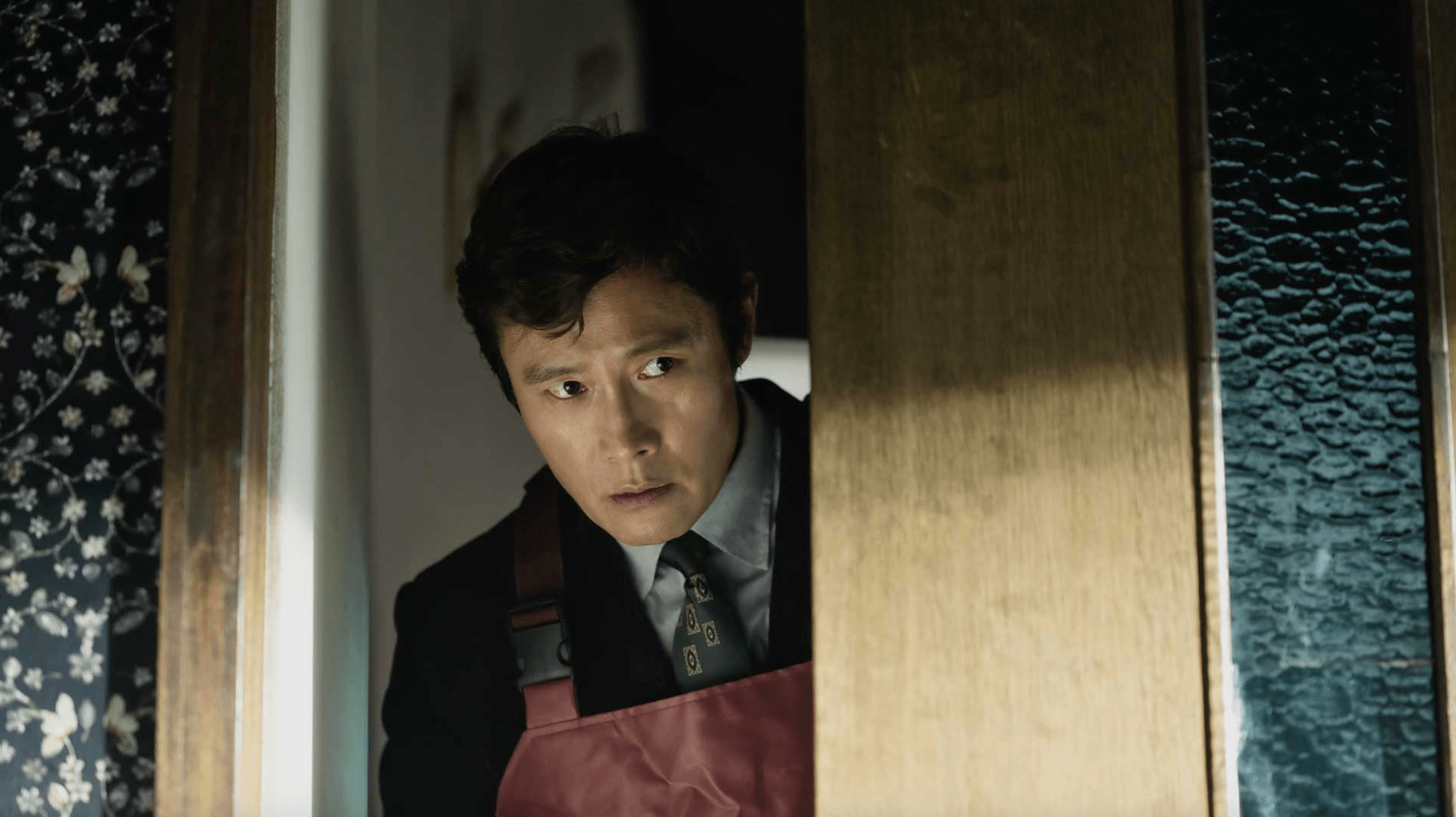
An adaptation of the novel, The Axe, No Other Choice follows a wealthy patriarch named Man-soo (Lee Byung-hun) who, after 25 years of working in a paper factory, is suddenly laid off due to aggressive budget cuts. This completely shatters his and his family’s world, as they lose the extravagant life they once had, become consumed with debt, and have little money to pay for even the bare essentials. After over a year of being laid off and bouncing between job interviews, he comes across a position at another paper company. Determined to secure this position no matter what, he devises a plan to kill off the other applicants until he is the last and only man standing.
At first glance, No Other Choice seems like another classic Park Chan-wook-style thriller. However, what makes this film feel akin to Bong Joon-ho’s work, aside from the anti-capitalist critique, is the tone, which, for at least a good half of the film, is surprisingly goofy. The first half of this film is tonally reminiscent of a Looney Tunes cartoon or the Coen Brothers’ Raising Arizona in that there are a lot of absurd, slapstick moments, like a woman attempting to suck venom out of Man-soo’s leg or characters getting into a screaming match with the music playing so loudly that their dialogue is barely audible. I love this first half because not only are all the gags genuinely funny, but they also work brilliantly within the context of the film.

It makes sense that the first half would be so darkly comedic because the movie is self-aware that Man-soo’s cutthroat and violent scheme to beat out the other applicants for the job is inane. Park always highlights just how pathetic he and his plan are, as the character is consistently shown fumbling around and messing up every opportunity he gets to shoot his first target. Yet I can’t help but initially root for Man-soo as a character because many people, especially myself, have been in his position. There are countless stories of people, especially blue-collar workers, who have dedicated years to their jobs, only to be discarded as if those years meant absolutely nothing to the higher-ups. At the end of the day, people like Man-so are replaced because budget cuts need to be made, and/or they can be replaced by modern technology that doesn’t require a salary or benefits.
Therefore, even if I don’t condone Man-soo’s extreme actions throughout that first half, I can at least agree and even sympathize with his motivations. It also helps that a significant aspect of my sympathy stems from how Lee Byung-hun portrays this character, as he does a phenomenal job of balancing the idiotically inept would-be assassin and the depressed, down-on-his-luck family man who’s desperate to regain a high position in the paper industry. What’s particularly praiseworthy about Lee’s performance is how different this feels compared to his more atypical roles. He is best known for playing tough or hardened badasses in films like I Saw The Devil or A Bittersweet Life, so seeing him effortlessly play a bumbling buffoon goes to show just how much range he has as an actor.
However, while No Other Choice is a funnier film filled with goofier performances than what Park Chan-wook typically makes, it still has the same directorial style and meticulous approach to presentation that is common throughout his filmography. This is a gorgeous-looking movie chock-full of all the signature trademarks synonymous with this director, like dynamic camera movements, intricate set design, and seamless transitions between scenes. What particularly caught my attention is how Park uses lighting and color. The first half of the film primarily utilizes bright lights and expressive colors, while the second half has more darkly lit scenes and a muted color palette. These distinct approaches to lighting and color visually indicate not only Man-soo and his family’s (aside from the daughter’s) fall from grace but also showcase the different tones between the two halves of the movie.

If the first half’s tone is wacky and comedic, then the second half is an entirely different story. After Man-soo kills his first target, the film tonally transitions into the expected tense and sinister thriller that audiences have come to expect from Park Chan-wook’s movies. Yet, like with Parasite, this tonal change makes sense within the context of No Other Choice, as the shift from comedy to thriller coincides with Man-soo’s growth into becoming a more villainous character towards the second half. By his second target, he’s no longer a floundering fool who hesitates at every turn; he’s learned from his mistakes and can kill more efficiently. By his third assassination, he becomes a proficient murder machine who has completely disregarded any shred of morality or humanity he had in the beginning.
It’s kill-or-be-killed in Man-soo’s mind, but in that desperate attempt to become a cog in the capitalist machine again to regain his financial contentment, he loses what made him relatable in the first place. He loses the loving relationship he once had with his wife, Mi-ri (Son Ye-jin), which was presented in the beginning almost like something ripped straight out of a fantasy tale. His kids are arguably worse off, as they’re utterly clueless about the extremities his father takes to return their once lavish lifestyle. It’s a classic Park Chan-wook tragedy that the director has consistently proven throughout his career that he’s a master at telling, and it’s still just as compelling and heartfelt now as it was 25 years ago when he made Joint Security Area.
While No Other Choice isn’t quite as good as Park Chan-wook’s best movies, like Oldboy and The Handmaiden, this is still a flawless movie that progressively got better as it went on. I was not bored for a single second, as I was constantly on the edge of my seat waiting to see what would possibly happen next. By the time it reached its conclusion, I was so satisfied with how everything paid off that I immediately had an urge to see it again. This is easily one of the best films I’ve seen all year, not just at the Toronto International Film Festival (TIFF), and I am confident that this will go down as a modern classic.
Rating: 10/10