

In my TIFF review of Scarlet, I wrote that it was the worst and most disappointing film I saw at the festival, specifically noting its visually unappealing use of 3D CG animation and its incredibly thin, empty story with zero narrative hook as the reasons for my distaste for the movie. What I found most frustrating about that particular film is that it was not destined to fail; had it simply gone about its premise in a different, more nuanced way, it could have been something special. Instead, I got something that irritated and frustrated me to the point that I actively felt like my time was being wasted.
The reason I’m bringing all of this up is that everything I wrote about Scarlet, from the reasons I despised it to the emotions I was experiencing while watching it, is equally applicable to All You Need is Kill. In fact, almost everything I wrote about that movie seamlessly and easily applies to this film so well that you could swap out Scarlet with All You Need is Kill and not much (aside from some nitty-gritty specifics) would need to be altered. It was like I was having déjà vu, and not the fun kind.

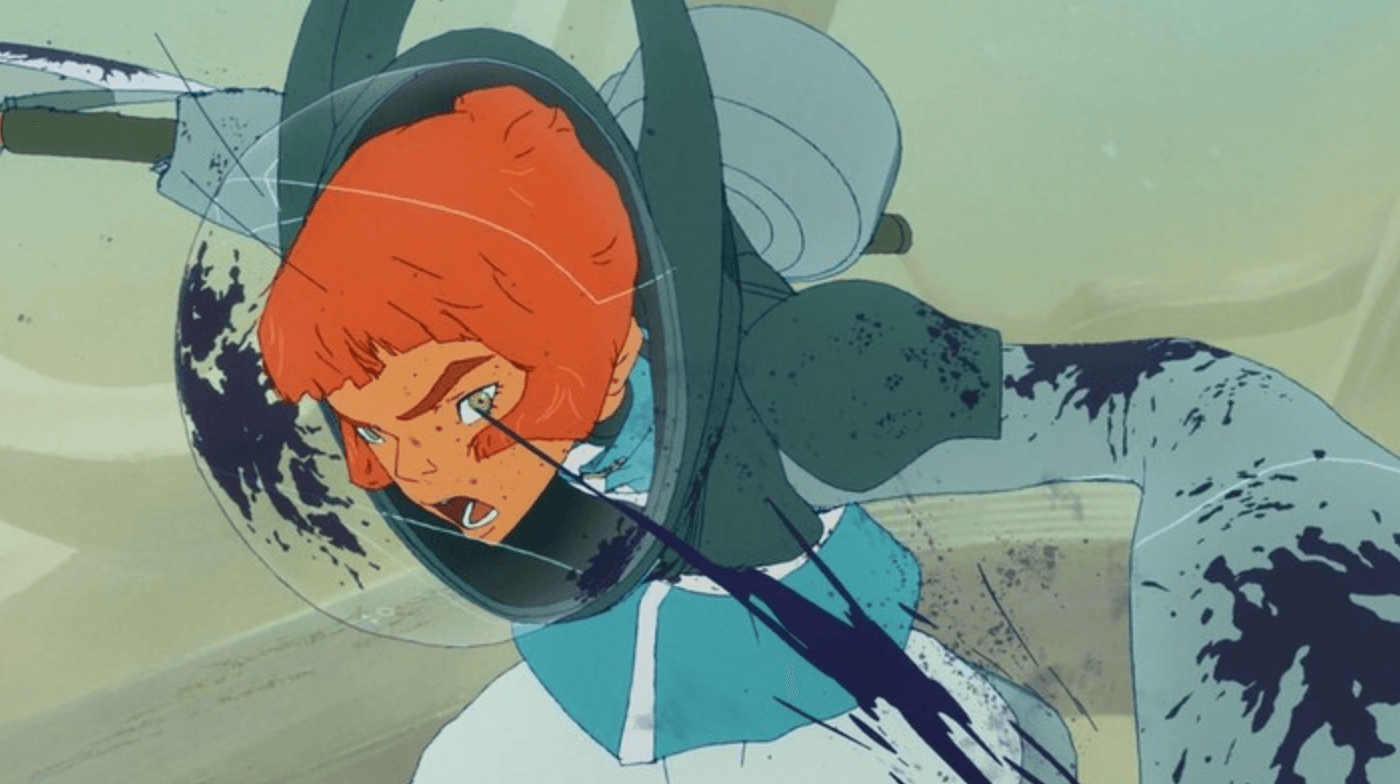
To give it some credit, All You Need is Kill has slightly more going for it visually than Scarlet. For starters, the use of color in this film is captivating, especially in the environment and alien monsters, which are presented in a bright, poppy way that makes them aesthetically pleasing. Additionally, I admire how distinct the character designs are, as the way humans are drawn and presented in this film is so unlike how people normally look in traditional anime. That’s to be expected, of course, as Studio 4°C, the company that developed this movie, has always been known for its very specific presentation style, best exemplified in its greatest works, such as Tekkonkinkreet and Mind Game (one of my favorite movies of all time). If there’s one thing I have to commend Studio 4°C for, it’s that they stuck to their idiosyncratic approach to animation instead of designing something more “normal” or “commercially friendly,” especially since they’re working with a fairly well-known and popular property like the All You Need is Kill light novel series.
This film is at its best when it becomes a barrage of color and visual splendor like Mind Game, and sometimes it feels reminiscent of the movie I adore. However, most of the time, it is a janky, unengaging experience that, once it concludes, leaves me feeling empty. As much as I admired the color and character designs, they are almost always ruined by the film’s creative decision to be mostly animated in 3D CG. As I mentioned in the Scarlet review, I am not fundamentally opposed to 3D CG anime. However, the flaws and baggage that come with that presentation style are strikingly apparent throughout this movie. From the bizarre, unnatural way characters move their heads or even sometimes speak to how blocky people’s hair and other textures look, the animation in almost every frame of this movie had at least one detail that I found incredibly jarring. It’s obvious that All You Need is Kill is trying to be a hyper-stylized action spectacle filled with all the fights, color, and visual expression the human mind can handle in the same vein as Demon Slayer, but it fails to live up to that goal because it’s held back by its insistence on using 3D CG animation.

Part of me doesn’t fully understand what benefit this style offers that traditional hand-drawn 2D animation could achieve much more effectively. A big reason for the success of recent anime films like Chainsaw Man – The Movie: Reze Arc and Look Back is their gorgeous animation, which left a major impression on me. I still fondly think of scenes like Denji and Reze running through a brightly lit festival or Fujino running through the rain because of how beautifully they’re animated and presented. Meanwhile, I was so irritated and displeased with the visual presentation of All You Need is Kill that I’m struggling to remember any memorable moments that left a positive impression. That being said, I could forgive All You Need is Kill for its aesthetic unpleasantness if it at least had an engaging story or memorable characters I could invest in. Unfortunately, just as with Scarlet, this movie doesn’t offer that either, which is frustrating because it has quite an interesting premise.
The concept of Rita (AI Mikami), the lead character of the film, experiencing a Groundhog Day-style time loop in which she repeats the same day over and over again until she successfully defeats the alien invaders, has the potential to go in so many interesting directions. It could create a horrific, existential, and nightmarish experience in which we can see what this phenomenon does to her psychologically. It could emphasize the theme of loneliness, highlighting how alone Rita is throughout much of the film, as she is, aside from Kenji (Natsuki Hanae), the only person to experience this time loop. It could serve as a coming-of-age story in which she uses this phenomenon to grow into a stronger, more confident person. There are so many different possibilities, and granted, All You Need is Kill hints at and plays with all these ideas, but never in a satisfying way beyond a surface-level approach. The only narrative priority this film has is to create as many hype moments and cool action scenes with Rita as possible. While that is not inherently a bad idea, it’s never fully realized because, at the end of the day, Rita is such an underdeveloped and uninteresting protagonist.

Rita has absolutely nothing going for her, as her only character traits are that she’s a physically weak loner and that her abusive mother tried to kill her via drowning, a fact that is cast aside so quickly that I’m wondering why they even brought it up at all. I’m not saying the film should have delved deep into her backstory, as I realize this is an action movie where the spectacle is key. However, if I feel absolutely nothing during the more emotionally heavy scenes, such as Rita breaking down in tears when she meets Kenji and realizes she no longer has to suffer alone, then at the end of the day, the movie failed to give me any reason as to why I should root for her. This did not change when All You Need is Kill introduces Kenji, because not only is he just as underwritten as Rita, but their relationship is so rushed and forced that I felt nothing when the scene where Kenji sacrifices himself for Rita predictably happens near the end of the film.
I am never emotionally invested in any of the character moments, so naturally, I don’t feel any excitement or tension whenever an action sequence breaks out. If anything, the action becomes tedious and monotonous by a certain point. This film is very repetitive, even at 82 minutes. Yet, ironically, it would have been significantly improved if it were much longer, giving the characters more breathing room to grow and develop natural chemistry with each other. After all, that’s what made Edge of Tomorrow, a live-action adaptation of the All You Need is Kill light novel series, a critically acclaimed film, as its longer runtime gave its lead actors, Tom Cruise and Emily Blunt, more to work with and become well-rounded, interesting characters that audiences can connect with in between all the action scenes.
I hate to say it, but this is one of the few rare instances where the live-action adaptation does a better job than the anime, a statement that is particularly heartbreaking for me to say because this film could have been so much more than what it was. This could have been something great, and I could see kernels of that greatness buried underneath. However, as it is now, the best thing I can say about All You Need is Kill is that it is slightly better than Scarlet, though that isn’t exactly a high bar to hit.
Rating: 3/10