

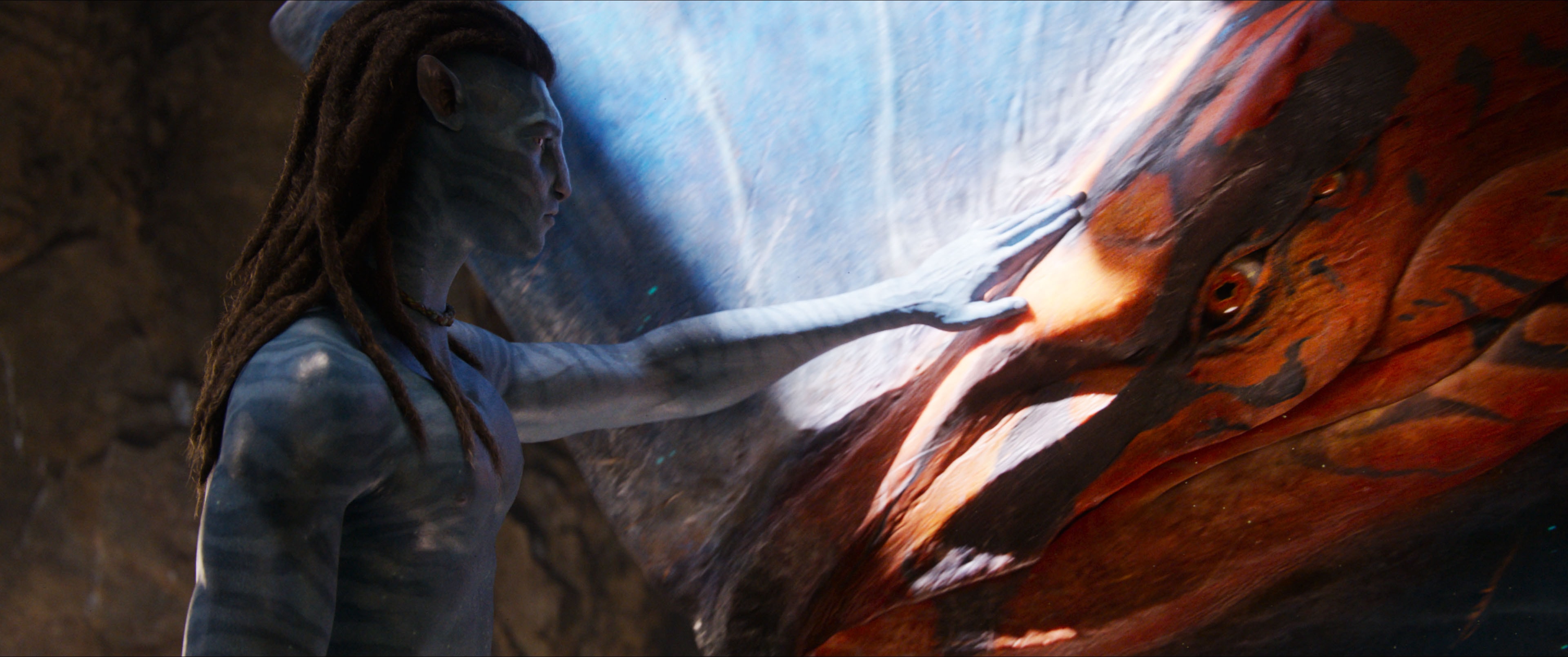
When Avatar first released in 2009, it was an Event movie (with a capital “E”) that demanded to be seen on the biggest screen possible to maximize its groundbreaking special effects and 3D format. I distinctly remember when James Cameron re-released the film with a very awkward sex scene added to make it longer and more awkward (which was then removed for the 2022 re-re-release), and it had such an impact on cinema at the time that those Oscar-winning blue cat aliens were prominently featured on the cover of one of my film class textbooks.
Yet, for all that pomp and circumstance and all the box office milestones that Cameron’s sci-fi franchise has achieved, the Avatar films haven’t had much of a lasting impact on pop culture aside from joking comparisons to the similarly named Avatar: The Last Airbender cartoons, theme parks, and internet memers questioning if anyone actually wants this franchise to continue.
I say this as the release of the third film in the franchise, Avatar: Fire and Ash, is about to hit theatres a full 16 years after the series began and three years since the last installment. Will the performance of Fire and Ash change plans to make the remaining two films? Nope. So is it worth sitting through Cameron’s latest epic? Well, that depends on how big a fan of the series you are.

At a bladder-straining three hours and 17 minutes, it is the longest Avatar film to date, five minutes longer than The Way of Water. (Pro tip: do NOT drink two bottles of water before the movie starts.) At this point, Cameron seems like he’s just playing with the audience, seeing how long he can push people to sit through another one of his ego parades. If every beat is so essential to the plot that it must be over three hours, put an intermission in there.
If you’re like my friend Catie, who went to a screening with me and hasn’t been actively following the Jake Sully (Sam Worthington) saga, then this is not the place to start.
The story picks up almost immediately where The Way of Water ended. Jake’s family is still mourning the death of his son, Netayam (Jamie Flatters), especially his wife, Neytiri (Zoe Saldaña), who becomes increasingly withdrawn and ruled by her anger and grief, questioning whether Jake’s decisions are the right ones. After the family’s adopted human son, Spider (Jack Champion), almost suffocated in his sleep when his respirator’s battery ran out, the Sully clan decides to go on one last family excursion to take him to the human colony for his safety. Meanwhile, Colonel Quaritch (Stephen Lang) is even more consumed by his quest to avenge himself against his former subordinate and tracks the Sullys. Eventually, the two groups collide with yet a third party, the Ash People. This new tribe, led by the vicious Varang (Oona Chaplin), ambushes other tribes and lacks the faith in the goddess Eywa that governs all other Na’vi people. As Quaritch once again fails to apprehend his target, he creates a new alliance with the Ash People to subdue Jake and his allies.

If that already seems like a lot to cram into a movie, that’s only a surface level of what happens in the first half hour. Cameron (who is listed as an editor) is sorely in need of learning how to actually trim and condense a film, because there is no reason for it to be that long. The story meanders and resolves many of its conflicts relatively easily. Many of the scenes intended for emotional complexity were unnecessary and served no purpose beyond padding out the runtime. In particular, I’m referring to a scene involving knives and a walk in the woods. Is there some competition between James Cameron and James Cameron to see who can make the longer film?
Its story and message are also overly simplistic. The native good guys are clearly good, the invading imperial bad guys are clearly bad. The good guys trust their god, are at peace with nature and rely on traditional tools and ways of life. The bad guys are out to exploit the land and its people. Giving guns to the tribes is a bad thing, so of course, the bad guys do it. Jake, the hero, does his best to resolve his conflict with Quaritch, the villain, without violence, and it seems to have an effect that will almost certainly lead to his sudden, but inevitable, redemption. This sudden turn towards mercy is highly out of character for Jake, whose life and family have been repeatedly threatened by Quaritch, a man whom Jake has killed once and almost killed a second time immediately before the start of this film. There is zero nuance or complexity to the plot, conflict, or villains. As much as I approve of this reckoning with the evils of colonialism, a “visionary” like James Cameron should be able to add more layers to a story he’s been working on for almost two decades.
Fire and Ash is, at the same time, the most emotionally complex film in the franchise so far. Neytiri’s grief motivates her to act out and deviate from her previous deference and unity with Jake. She really comes to the forefront as the most interesting and driven character. Kiri (Sigourney Weaver), like all space messiahs, questions why she has been entrusted with this great power. Lo’ak (Britain Dalton) grapples with the guilt he feels for his brother’s death and also with the blame his father places on him.

As basic and cliché as the script is, the cast puts on the best show they can and mostly succeeds in getting us invested in their lives once again. Saldaña really steals the show as she grapples with Neytiri’s journey through the stages of grief, portraying her role with heartbreaking familiarity and relatable rage, yet still with enough of an otherworldly hint to remind us that she is not human. Despite some corny, stilted dialogue from Lo’ak, Dalton plays the role with welcome depth and sincerity. His infrequent narration is very out of place and a confusing element (it made sense in the first film with Jake’s audio diaries, but here it breaks the immersion), and it feels like Cameron is gearing up to make him the focal point of future installments. I’m begging you, James Cameron, please don’t make him say “bro” every five seconds in the following two films.
Despite her best efforts, Sigourney Weaver is unconvincing as a teenager; no amount of audio editing will make her sound like a kid. Champion is likable in Spider’s expanded role, but it’s flat and doesn’t give him much room to play. Both Worthington and Lang portray their roles well, but their characters have developed so little throughout the series that it’s pretty boring to watch them do the same “reluctant leader versus fanatical war dog” thing for yet a third time. Oona Chaplin is this film’s most welcome new addition, as her witchy, wicked character, Varang, is equally imposing and intriguing. I wanted to learn more about her, but Cameron is jealously withholding all details, aside from her mistrust of Eywa.
Beyond that, Fire and Ash doesn’t really justify itself. Cameron may have given the characters more depth and room to explore their personalities, but at the expense of letting the plot stagnate. What made the first two films work so well was that they continued to reveal new aspects of life and culture on Pandora, and while we did get glimpses of two new tribes, that was all we got. Glimpses. We learn so little about the Ash People beyond their distrust of Eywa and their aggression towards other Na’vi tribes. This helps build the mystique and danger around Varang, but it also leaves her underutilized and hurts the plot overall by skimping on one of the few new elements introduced to the Pandora mythos. It’s also disappointing that where Cameron could have introduced the Ash tribes as antagonists with complex motivations, they’re reduced to the “savage native” stereotype.

Instead, we focus so much on the water tribe that it feels more like a wrap-up of the last movie and a tease of the next one than a story in its own right. Fire and Ash and The Way of Water could have been trimmed of much of the fat and combined into a single film. There didn’t seem to be much justification for the movie as a whole, and I left the movie wondering, “What was the point?” (As it turns out, Cameron did break the second film into two parts for “another chance to make two billion dollars.” For once, a little more studio interference might have been a good thing.)
The point could very well be somewhere between “because it looks cool” and Cameron saying “because I can.” And Fire and Ash is an undeniably gorgeous-looking movie. All the Avatar films are. And as technology has improved, I was very excited to dive back into Pandora and explore the strange creatures and exotic environments the planet has to offer.
Overall, Fire and Ash delivers on this front. From lush jungles to barren volcanic wastelands to tranquil mangroves to hologram-filled war rooms, the environments are immersive and beautifully rendered, at once familiar (probably from spending over nine hours watching these things now) and alien. There is a bit of wonkiness at some points where the animation teeters on the edge of realism, but it has just enough CGI plasticity and shininess to tell it’s fake. At these points in the film, I may be watching someone play the Avatarvideo game because the computer-generated elements made it feel like a whole movie of cutscenes. I respect Cameron’s pledge to keep generative AI out of the Avatar films (our screening opened up with a short video of Cameron speaking about the human element of filmmaking). Still, even that couldn’t help those rougher moments from feeling lifeless.

Back in 2009, 3D films were the next big thing, and the first Avatar pushed the boundaries of what we could expect from a 3D movie. Sixteen years later, the 3D craze has calmed down and been relegated to a gimmick used by big tentpole films to squeeze a little more money out of consumers rather than an essential element of the spectacle. Of course, Fire and Ash will be showing in 3D in theaters, and the screening I attended was in 3D. It is pretty cool to see some of the effects, like water splashing at you, and the 3D added an immersive sense of depth to the visuals, especially when a character looks down the scope of a gun, and you can see the heads-up display through their perspective.
But seeing the film in 3D is not worth it. Eventually, the effect fades into the background. For most of the time, I forgot I was watching it in 3D, except when an occasional scene would pop out and remind me, breaking my immersion. Add a long runtime wearing clunky, possibly heavy glasses, depending on your theater and the potential for a headache if you get them during 3D movies, and that will make an already long film an even more unpleasant experience.
All this being said, I still liked Fire and Ash. It is precisely what I expected from an Avatar film: cool visuals, basic story, preachy message, and a long final battle. As long as the film was, it managed to hold my attention the entire time, and not once did I get up to relieve my very full bladder for fear of missing some vital detail or a cool new alien species.

There is still so much of the geography, biology, and culture of Pandora to explore, and I remain genuinely curious to see what Cameron will show us next. I clocked the climactic final battle at about 40 minutes, and it was an exhilarating clash of creatures and machines that is worthy of a big-screen experience, though not the 3D upgrade, except for the most die-hard fans and cinephiles. IMAX at best, if you have the cash to burn. The Avatar formula may be predictable and well-trodden, but it’s a formula that works. Even when Cameron is playing it safe, it’s still pretty good.
In the end, if you like the Avatar films, you’ll like Fire and Ash. If you don’t, you won’t like it. As a casual follower of the series, I found that the movie pushed no boundaries, took no risks, and checked all the expected tropes, but still scratched that itch for a fun time at the movie theater. It’s absurdly long, but it makes up for that with captivatingly rendered imagery. The story is simplistic and didactic, but it’s still a positive and arguably necessary message in today’s society. It’s not a movie that can stand on its own merits, but more of an Avatar 2.5 that wraps up the loose ends of the last installment while priming us for future conflicts on Pandora. Still, I won’t say no to explosions and alien whale friends.
My recommendation: turn off your brain, get to a cinema and enjoy the latest excursion to Pandora. These movies aren’t going away any time soon, so we’ll have fun with them. Earth Kingdom, here we come next. Oops, wrong Avatar.
Rating: 7/10