

Growing up in the Los Angeles-adjacent suburb of Santa Clarita in the late ’90s and 2000s was a bit of an isolating experience. For most of my youth I was one of the few (if not only) Asian kids in my social circle, and though the diversity in Santa Clarita expanded greatly over the years, I never quite shook that sense of otherness. Even among my Asian American peers, I felt a sense of imposter syndrome; like I lacked the necessary knowledge and experience of my own heritage to properly associate with the other Filipino kids who could speak Tagalog or grew up eating balut.
I think I fell into a limbo that many first-generation kids experience: too ethnic to be socially recognized as “American” yet too culturally disconnected from our heritage. It wasn’t until I was an adult that I realized that other people shared this struggle and that there were spaces where we could bond and share our stories.

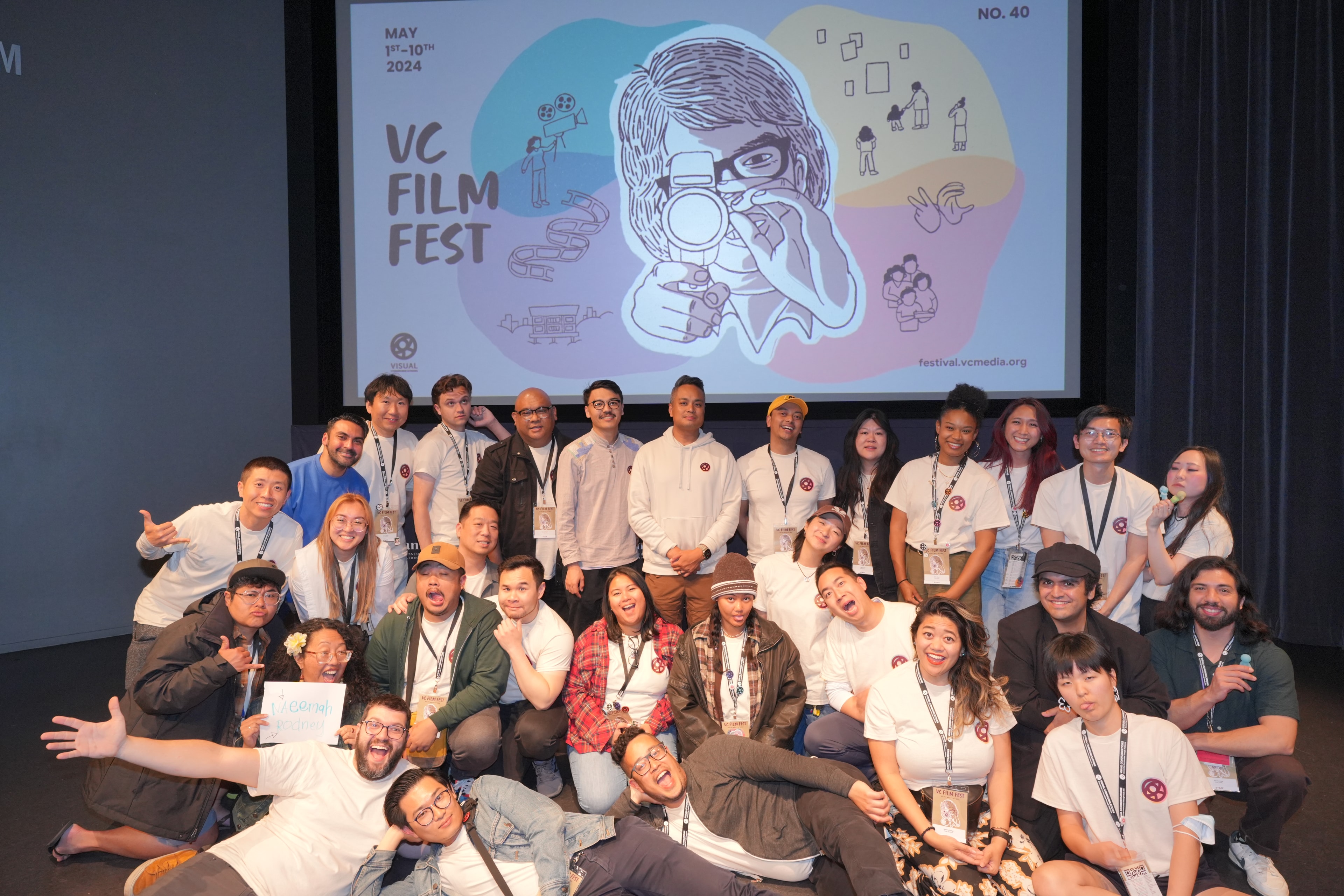
Now in its 40th year, the VC Film Festival is hosted annually by Visual Communications Media, an organization founded in 1970 that, according to executive director Francis Cullado, “connects artists and storytellers to communities.” This year’s festival ran from May 1 through May 10 in Little Tokyo and Long Beach with an online screening component featuring about 160 works including short and feature-length narrative and documentary films, photographic exhibits, video installations and discussion panels.
Full disclosure, from 2018 until 2022 I worked for the festival’s box office and eventually became the head of the department. It was through Visual Communications (colloquially known as VC) that I finally came to terms with my identity and found a community that shared its stories and experiences in a way that I made me feel comfortable being Asian in America.
And it seems I’m not the only one who feels that way. Each year the festival, which is a qualifier for the Academy Awards, hosts budding filmmakers, entertainment industry icons and casual cinephiles alike. Previous attendees have included Dante Basco, Spencer Grammer, Toby Kebbel, Osric Chau and Awkwafina. Basco, best known for his roles as Rufio and Prince Zuko, is a consistent supporter and even premiered his directorial debut, The Fabulous Filipino Brothers, at the festival in 2022.
“This feels like the hometown festival for me and my family. I feel like we always have something in the festival every year,” said Basco, who produced this year’s festival entry VS and whose niece was the production designer for the short film Apartment 605. “It’s great for Asian Americans to be able to showcase their films here in Los Angeles and be supported by our community, our friends and the world. Asians in Hollywood is kind of a buzz right now, but a film festival like this shows that we’ve been here and building for years.”

Eseel Borlasa, Head of Community Engagement for VC and a festival Senior Film Programmer, first volunteered for the festival in 2000. This year, she felt it was important highlight the legacy of the VC Film Fest, which has “presented in spaces that have been celebrated by the industry and the Academy,” for example the Directors Guild of America.
“To be a culturally-centered film festival and to celebrate 40 years in LA, so close to ‘mainstream Hollywood,’ is a huge feat,” she said. “I don’t know of any other continuously operating festival like this at this scale that’s been around for this long.”
While hosting key industry figures and exhibiting studio-backed feature films is exciting and helps to validate the work VC has done, Borlasa said that it is important that the focus of the festival remain on providing opportunities for new filmmakers and giving audience members “emotional souvenirs” that they might normally not experience, like interacting with a director or actor after a premiere.

Filmmaker Erica Tanamachi held the world premiere of her first feature-length film Home Court at this year’s festival. The documentary, which was executive produced by journalist Lisa Ling, chronicles the journey of Cambodian-American basketball player Ashley Chea as she balances her high school athletic career, college recruitment and family life. Tanamachi said that she it was important for the film’s first audience to be filled with people who understood and connected with Chea’s story on a personal level.
“We wanted to premiere Home Court in our home court which was truly the VC Film Festival,” Tanamachi said. “The laughter, the tears – People were seen and they saw themselves reflected. If this was streaming at a Sundance or something and the audience was mostly upper middle class white people, would they have responded the same way? I don’t think so.”

Ling said that she appreciated the opportunity to premiere the film with VC and was impressed by how the scope of the festival has increased and by the “depth and heart” of the selected films.
“It’s important to support the rich stories that come out of the AAPI community and it was really an honor to be part of one that premiered here,” Ling said. “It’s really exciting how the number of films has increased over the years. While this film festival has been around for a long time, I think that people are just starting to catch wind of the breadth of the stories that are available and accessible.”
Audience member Dolly Li said she has known about Visual Communications and been connected with members of the community since she moved to Los Angeles in 2020. She attended the premiere of Home Court and the artist Q&A session after the screening and said that she enjoyed the opportunity to connect with an Asian American story.
“That’s the best part about film festivals. You get to hear a little more about the people who made the film and what’s important to them, the things that were left on the cutting room floor,” Li said. “[Film festivals] are really important for bringing together community, especially in-person. This is a time in which people really want to be able to celebrate each other’s work live, and that’s a part of why films really matter.”
The focus on community is exactly what John Zafra-Haas and Menchie Caliboso value about the VC Film Fest and is one of the reasons why they wanted to premiere of their short documentary Reach Out at the festival. The film, directed by Zafra-Haas and produced and starring Caliboso, explores the collaboration between Caliboso’s band Bootleg Orchestra and Filipino disco singer Roger Rigor to create a song highlighting the need for environmental protections and justice for Filipino migrant workers.

“It was special to premiere our film in Long Beach where I am from,” Caliboso said. “This festival is for the people by the people. The response to our film was really positive and people wanted to work with us. We’re just at the beginning so there are still a lot of opportunities to see the impact of this film.”
“We got a lot of requests for additional screenings…and there is a significant migrant Filipino population in west Long Beach,” added Zafra-Haas, who had also a film in last year’s festival. “Folks want to share our film with more people. To me, having discourse around a film is just as important as the film itself. It’s inspiring to me to be part of a legacy of activists and documentary filmmakers and I hope it inspires others to pick up a camera as well.”
Kady Le is a filmmaker and documentary producer who has attended the festival since 2017 and came this year in support of friends who were showing their works, including Zafra-Haas. Le, who has attended and exhibited her films at other festivals, said that while other festivals, for example the Toronto International Film Festival might be recognized as more prestigious, she found the works at those festivals to be more “pretentious” and less “accessible” than the community-focused films that she finds at the VC Film Festival.
“I love how the festival is held in places in LA county like Little Tokyo that are culturally rich and show the heritage of Asian diaspora in Los Angeles,” Le said. “What keeps me coming back each year is that VC Festival does a good job of creating programs that are relevant. I get to see my own experiences reflected on the screen, and I also get to learn about other people’s experiences.”

Though this year presents a happy milestone and a new launching point for the film festival, other organizations have not been so lucky. For example, the LGBTQ+ arts and media festival Outfest paused its operations and laid off its staff in 2023, though it is exploring plans to return in a smaller form later this year.
In light of this, it becomes apparent how precious yet precarious the more specialized and niche spaces like the VC Film Fest are that give underrepresented and ethnic storytellers a platform and sense of shared experiences and community. However, some in our society still question the need or validity of these spaces. This view often takes the stance of “we don’t see color” and asserts that celebrations like AAPI month only serve to further divide society. This past April, television host Mike Rowe caused controversy when he denigrated Harvard University’s ethnic affinity graduation ceremonies as “segregation.”
“It’s about bringing up equity and access,…we need to not just be color-conscious but culturally conscious,” Cullado said. “It’s not just about telling our histories, but we want to be able to tell our fantasies and nightmares, too. Our founders started because other people weren’t telling their stories, so we had to do it ourselves. And now you’re saying we can’t do it ourselves? That’s sort of hypocritical in the sense freedom of speech and art. You’re not giving us the access to tell our dreams and nightmares, but attacking our right to exist.”
Borlasa, who is Filipino, said that when she initially volunteered for the festival, she only meant for it to be a one-time thing, but the sense of shared identity and understanding of culture kept her coming back. Though VC has always used the festival to advocate for AAPI storytellers, Borlasa believes focus and scope of that advocacy has expanded over the years beyond just providing a space for underrepresented filmmakers to exhibit their work.

“When I came to work with the festival, I didn’t have to explain what kind of Asian I was and I didn’t have a sense of not being ‘Asian enough,’” she said. “It’s not just about seeing our stories on screen making a director famous. The added layer has returned to our origins of making sure the stories on screen empower and unite our community with other communities of color so we can not just exist in a white-dominant space. Let’s change the narrative so we can have equity and leadership in the entertainment industry.”
And it’s not just people of Asian heritage that find value in telling and watching Asian stories. Though Tanamachi’s husband is Japanese American and played in Asian basketball leagues like Ashley Chea did, she is not Asian herself and is of white, Jewish heritage. As such, even though her work focuses on elevating stories from underrepresented communities to inspire social action, she had initial doubts whether she was the right person to tell Chea’s story. Fortunately, she had the blessing of the film’s subjects, who trusted her after seeing her previous work.
“Our crew was all Asian American except for myself…but it was an early conversation of ‘Is it okay that I’m white?’” the filmmaker said. “This is an Asian story and it felt so important for the community to see the film and approve it. Having the protagonists of the film identify, connect and say ‘yes, you are right’ made me feel confident.”
Fostering and recognizing community is really the heart of VC’s operations. In spite of hosting the film festival, Cullado said that entertainment is actually not a major priority of the organization.
“We’re not an entertainment organization even though we’re in Los Angeles and we converge with Hollywood,” Cullado said. “Our affirmation with our filmmakers is not from a studio entertainment perspective, but from having a community that supports them and believes in their storytelling.”

In fact, aside from being an impressive milestone, the 40th festival marks a turning point for the organization, an opportunity to rededicate and renew the purpose and identity of the event. Though it was known as the Los Angeles Asian Pacific Film Festival (LAAPFF) until last year, Cullado wanted to return to the event’s original name “VC Film Festival” while also expanding its scope and impact. Rather than just a rebrand, Cullado feels that the renewal is geared toward updating the values and practices of the festival as a whole.
“It wasn’t just an Asian-Pacific film festival anymore, and we were looking at what that Asian-Pacific experience would be like later on where it would be more multicultural,” Cullado said. “People in the know have always called it the ‘VC Film Fest.’ We’re looking forward to another 40 years of storytelling experiences, and this has been in the works for a long time, so the 40th festival felt like the right time to give the festival the new slate to become whatever it needs to be.”
Additionally, as the festival’s prominence grew under the LAAPFF name, the organization’s other programs got overshadowed and many attendees did not know what VC was. The festival’s renewed identity allows Visual Communications to both raise awareness of its brand and to better integrate some of its other programs like Digital Histories and the Armed with a Camera fellowship into the festival.
Part of this year’s refresh focused on uplifting the communities and artists who have supported Visual Communications over its 50 year history, many of whom are not part of the AAPI community. This year, programs included works by Black and Latin creators. One consequence of the LAAPFF branding was that many people who were not of Asian or Pacific Islander heritage were not sure if they were “allowed” to attend the festival or if the films would be relevant to their lives.
“When I talk to Black or Latinx folks and say they should come to the festival, sometimes they feel like ‘Isn’t that just for Asians?’” Borlasa said. “Sure, the stories are Asian, but the programming is meant to link up the power of Asian, Black, and Latin storytelling to show our lived experiences are similar.”
For Cullado, the next 40 years of the festival are about expanding the audience of the VC Film Festival to attract a wider BIPOC audience.
“What’s the work that needs to be done that will bring other people of color to come watch these films,” he said. “On paper, the festival can speak for itself and I want to celebrate our elders and their work over the last four decades. The last thing I want to happen is for people to think that Asian American films started with Crazy Rich Asians. I think that will change with the new generation of audiences and experiences that are multicultural. Otherwise we’re just preaching to the choir.”