

Growing up in the ’90s and early 2000s, I loved being immersed in the different iterations of Transformers cartoons. My love for the Autobots and Decepticons was so intense that, much to my mother’s face-palm-inducing chagrin, I wished upon a star, out loud, that I would become a transforming robot.
Fast-forward 20-plus years and many games, toys, cartoons, and movies later, and I’m still a fan of the series. Suffice it to say I was very eager to learn that not only were we getting an animated Transformers film, but one set on the storied planet of Cybertron.
While Transformers One may seem like just another summertime action flick on the surface, there’s so much more than meets the eye.

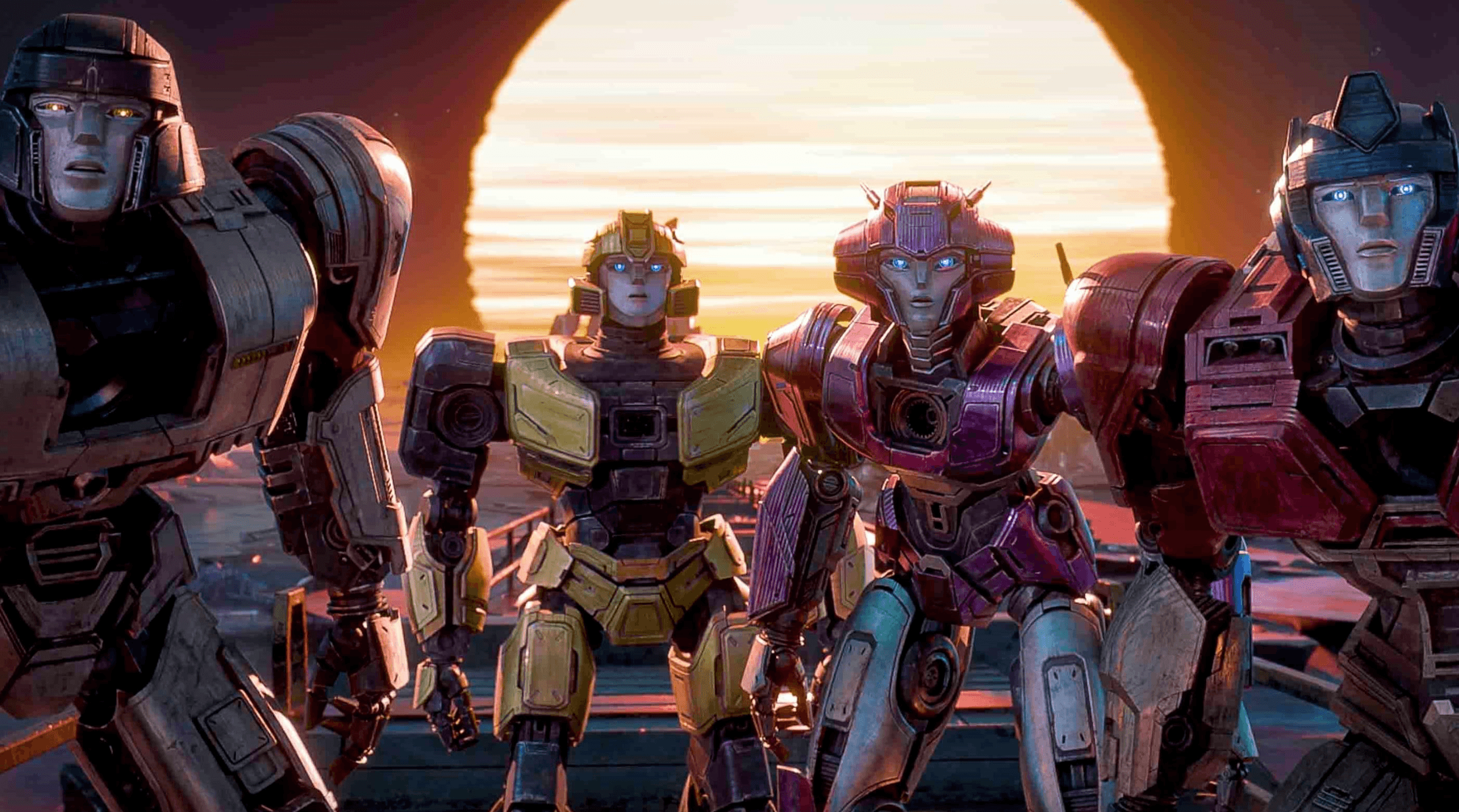
Set before the Autobots and Decepticons clashed or crashed on Earth, the planet Cybertron has been ravaged by war with another race known as the Quintessons, and with the all-powerful Matrix of Leadership missing, its people are facing a shortage of their Energon power source. As the last surviving Prime, Sentinel (Jon Hamm), scours the surface of the world to recover the Matrix, Orion Pax (Chris Hemsworth), a mining bot missing the cog piece that allows him to transform, seeks to find it as well and prove that he’s worth more than his lowly station in life. When Orion Pax discovers the potential coordinates to the Matrix, he drags his best friend D-16 (Brian Tyree Henry) and fellow worker bots Elita-1 (Scarlett Johansson) and B-127 (Keegan-Michael Key) along on a quest to save their people.
It seems standard for an action-adventure movie, right? Sure, it’s well-trodden territory, mainly because most audiences will already be familiar with the conflict destined to befall the people of Cybertron. Transformers One excels, especially in the context of the previous Transformers film canon, in its exploration and definition of its characters, humanizing them and underscoring the tragedy that led former brothers-in-arms to become deadly enemies.
In the era of Michael Bay (who still serves as a producer on this film), the primary concern of the Transformers Cinematic Universe seemed to be cramming as many characters in the runtime as possible with only the vaguest of defining personality traits outside of mainstays like Optimus Prime and Bumblebee. This one is a medic, that one likes guns, this is the cool one, this other one is a samurai for some reason, this guy is a T. Rex, this one is evil, and this one is evil but can fly! Instead, Transformers One wisely limits itself to a handful of core characters and spends time developing their personalities’ nuances and the dynamics between them. There are still many minor side characters and cameos from recognizable bots for longtime fans to enjoy, but these are more like the cherry on top of the cake: a nice touch but not a distraction from the main dish.

The film focuses on the rift between Orion Pax and D-16, eventually leading to their conflict as Optimus Prime and Megatron, leaders of the respective Autobot and Decepticon factions. At the outset, Orion is an optimistic yet reckless bot who is deadset on making a name for himself regardless of the risk. He’s far from the sagacious and battle-hardened leader that audiences know. Throughout the story, Orion discovers the weight of his decisions and the ripple effects of being a leader on his followers. His quest to find the Matrix of Leadership becomes less about his glory and more about the betterment of his people and establishing an equitable and lasting peace. Similar to discovering that your parents were once kids who liked to get in trouble and have fun, it’s intriguing to see the previously unexplored side of Optimus Prime’s story.
D-16 is Orion’s complement and foil all the way through, and this character arc is the most satisfying aspect of Transformers One as we finally see a side of the future Decepticon leader other than the despotic megalomaniac. Where his best friend is a loose cannon who plays by his own rules, D-16 prefers to play by the book, content to work his way up through the system and trust in his heroes. But when that faith is violently shattered, D-16’s rage sets him on a path of righteous vengeance for himself and his people that is both regrettable and relatable. At times, his actions are admirable, heartbreaking, or appalling, but this transformation (pun intended) is made all the more poignant by showing us the hopeful bot he once was.
It’s this contrasting exploration of leadership that, viewing this film as an adult, I can enjoy. One believes in the power of the people, while the other favors definitive shows of strength. Orion learns the value of being level-headed and calm, while D-16 finally allows his emotions to dictate his actions. And while the movie clearly condemns D-16’s violent methodology and “might makes right” philosophy, he remains sympathetic and somewhat relatable.

As good as the nuances and character-building are, the story still stumbles a bit. Again, it is a bit simplistic, and anyone who has ever seen a movie with a twist or has at least a passing knowledge of the characters and previous film adaptations can easily see where the story will eventually lead. I have spent this review up to this point praising the film for taking its time to flesh out the characters and world, but the second act drags. Though a lot of important plot information occurs at this point in the film, and as stunning as the surface of Cybertron looks, I couldn’t help but feel like I wanted to skip past this section as fast as possible, largely due to the plot’s predictability. I would instead have devoted more of this time to the fracturing relationship and climactic conflict between Orion and D-16. When it finally came, it still felt like an abrupt emotional and visual shift even though I’d been anticipating it the entire time as so much time is devoted to building up their friendship, and very little is done to show their esteem for each other actually declining. There is a lot of excellent lore building done in these segments and throughout the plot, like getting a look at the mythic Primes, but often more questions are raised that are still never answered, like why do Cybertronians transform in the first place? How did B-127 get so good at knife-hand combat without any training?
Hemsworth and Henry nail their characters in terms of voice acting, honoring the classic depictions of Optimus and Megatron by Peter Cullen and Frank Welker but also putting their spin on the younger versions of the characters. Orion begins his journey with a reckless, free-spirited energy reflected in Hemsworth’s bright line readings. As the story progresses and Orion becomes more of a leader, he takes on a more somber tone, and there are distinct moments when you can hear hints of Cullen’s rumbling gravitas. Meanwhile, listening to Henry’s D-16 descend from a good-natured and hopeful bot to one filled with spite and fury is utterly captivating and powerful. He spits some of his lines with such bitter and venomous vitriol that it gives me chills just thinking about it.
Along for the ride are Johansson’s Elita-1 and Key’s B-127. Though it feels like Elita was included as the token female bot, Johansson delivers her lines with a toughness and determination that demands respect for the character. Her transition from indifference to resentment to respect and admiration for Orion also helps to underscore his leadership qualities while not sidelining her.

Fan-favorite bot B-127, AKA Bumblebee (AKA Badassatron), is as fun and spunky as ever. Though he has typically been seen having to speak through the radio, he’s voiced with joyful exuberance by Keegan-Michael Key. It’s refreshing to hear B-127 expressing himself clearly and without having to parse through the radio static to understand him, and in light of some of the film’s darker moments and themes, Key’s upbeat moments provide a lot of fun and levity. It’s a 180-degree flip from the primarily silent guardian of the previous films, and it feels like too much of a course correction as B-127’s quips start to overwhelm and monopolize the scenes. Key’s performance is good, but we could have done with a little less.
Rounding out the rest of the main cast are Hamm as Sentinel Prime, Lawrence Fishburne as Alpha Trion and Steve Buscemi as Starscream. All three actors successfully establish their characters and personalities without overshadowing the main cast. Hamm drips charisma as Sentinel. Fishburne’s words echo with wisdom and experience. Buscemi is perfect as Starscream, and his lines carry a sense of snivelling cowardice and smug self-importance.
Beyond its fantastic storytelling, Transformers One is very fun to look at. The underground world of Cybertronian civilization refreshes the retro-futuristic vibe of the original cartoons, while the planet’s surface has a nostalgic synthy vaporwave ‘80s vibe. Like I said earlier, my issue with the surface adventure was never with how good the planet looked. The bot design also has a satisfying variety that will make any fan nostalgic for classic toys. However, there were some scenes where I was disappointed by seeing that undercut by cut-and-pasted minion bots.

Battle scenes shined in Transformers One. Angles and camera movements were crisp and fluid, and the action was easy to follow. Blaster shots are satisfying and explosive, and hits from melee weapons thunder as if they really were swung by massive robots. Many of the injuries sustained by the bots are surprisingly grisly as they lose limbs or are torn in half. Between the nauseating shaky cam, fluctuating aspect ratios and ridiculous amounts of CG/live-action blended visual clutter of the previous Transformers films; I much prefer this new cartoon style.
The actual transformation and watching the bots learn how to do it was fun and visually interesting, but aside from an initial scene, it’s mostly glossed over. As much as the franchise’s title and most of the movie make a big deal about the transforming, I wish we got to see more of it happen and a wider variety of vehicles.
Transformers One is also available to view in 3D; the screening I attended was in 3D. Overall, the experience wasn’t significantly helped or hindered by it. There were moments when the world’s added sense of depth and scope was noticeable and was admittedly pretty cool. However, I only really noticed the effects at the film’s beginning, during close-ups, in one or two landscape shots, and during the credits. If 3D is available and you have the money to spend on the surcharge, why not? If you don’t, you’re not missing much.
Transformers One reinvigorated my interest in the franchise. While most of the films to date (except for the original and the Bumblebee reboot)felt like mind-numbing excuses to sell toys, this new film takes its lore and characters seriously, telling a story that rewards audiences for emotionally investing themselves in the characters. Combined with gorgeously nostalgic designs and fun action sequences, Transformers One serves as an encouraging starting point for a potential trilogy or even larger series. It feels good to be a Transformers fan again.
Rating: 8/10