

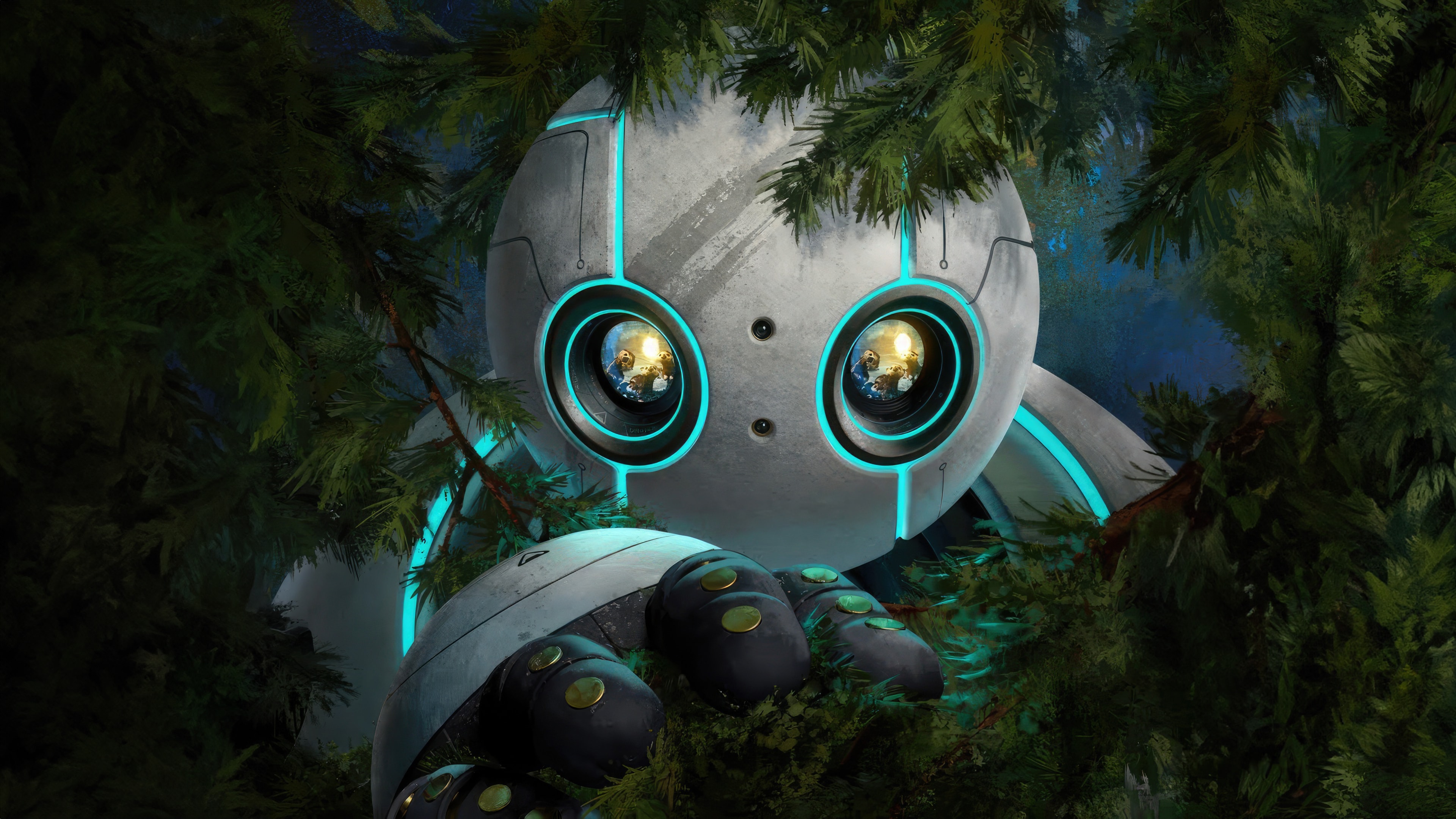
I have noticed a tendency in older generations to assume that animation is supposed to be for kids. For example, Generation X and Baby Boomers I know dislike shows like Family Guy and The Simpsons because the concept of animation for older audiences was foreign to them, and they decided that these shows were using the medium as a way to target unsuspecting youth with their adult themes. However, animation is an art form that can exist without having to be specifically for one age group or another. It can exist just to be enjoyed. The Wild Robot is an excellent example of this.
Based on the book by Peter Brown, The Wild Robot is the story of Roz (Lupita Nyong’o), a domestic service robot who is washed onto an island solely inhabited by wild animals instead of the human colony she was supposed to go to. Lacking an owner, task, or purpose, Roz learns how to understand the language of animals and finds herself raising an orphaned gosling named Brightbill (Kit Connor).

With the help of island residents like the mischievous but tender-hearted fox Fink (Pedro Pascal) and the gruff, irritable beaver Paddler (Matt Berry), Roz must teach the young goose to feed himself, swim and fly before autumn so that he can migrate with the rest of his species or be stuck on the island when winter arrives and perish.
Summarizing the film like that, it feels like any other kids’ flick. A friendly robot living on an island with cute animals seems standard fare for a younger audience. In fact, the screening I attended was full of small children. It’s even reminiscent of a lot of other movies geared to kids. You take a strong base of The Iron Giant, coat generously with some The Wild Thornberrys Movie, garnish with a hint of Wall-E, and you’ve got the general flavor of The Wild Robot.
What I think makes it less of a cartoon for kids and more of a film that just happens to be animated is how it handles its themes. I never felt like I was being talked down to or that darker topics were being dumbed down to be more palatable. Primary themes like motherhood, sacrifice, and found family permeate throughout the film, but not overbearingly. Meanwhile, concepts like death that are usually discussed and portrayed through euphemism for the benefit of younger audiences are discussed with an unflinching matter-of-factness. This is the wilderness, after all. Difficult things are unavoidable.

If the goal of art is to make you think and feel, then The Wild Robot is an exemplary example of animation as art. A word of warning: have a box of tissues ready. I don’t know if it’s just because I’ve gotten soft and sentimental at my ripe old age of 29, but I’ve never cried as much during a movie as I have during The Wild Robot. Aided by some masterful voice work by Nyong’o, Roz’s maternal journey of self-discovery and sacrifice is carefully crafted for maximum emotional impact and total tear duct function. The rousing score and gorgeous animation create moments of exhilarating action or breathtaking spectacle throughout Roz’s story.
It’s not all serious lessons and ponderous topics. The Wild Robot delivers a variety of laugh-out-loud comedic moments, from fart jokes to visual gags to some genuinely unexpected dark humour that made the entire theatre gasp. Some superbly witty writing from veteran director/scribe Chris Sanders, coupled with expert comedic timing, ensure plenty of big smiles and laughs amid the tears.
Good writing can only carry a film so far and Nyong’o’s deeply evocative performance drives home the messages and story beats in The Wild Robot. So much of the journey is reflected in the changes and variations in Roz’s voice. At the film’s outset, Nyong’o gives Roz a bright curiosity with a touch of naïveté, though her voice is still somewhat mechanical and artificial. However, as she gains experience in the world around her, her voice gains depth and nuance. There’s worry and weariness; curiosity is replaced by wisdom. A new depth comes into her voice, making her feel as alive and natural as the world around her, and you can almost forget that she’s an artificial being.

Kit Connor is as delightful as Brightbill and delivers his lines with a believable sense of youthful impetuousness and determination. His robot sounds, and imitation of Roz’s more mechanical speech pattern is particularly endearing, and while it’s not a stand-out performance like Nyong’o’s, he’s good in the role.
The rest of the cast is stacked with a similarly talented crew complimenting Nyong’o’s performance. Pedro Pascal is as perfect as ever as Fink, the Fox. He’s sly and touchy when he needs to be, and charming and warm at other points. Underneath the bravado, you can hear the fear and loneliness driving the character that rounds out the leading trio.
Matt Berry brings his signature biting and sharp delivery to the cranky beaver Paddler. Catherine O’Hara, who is no stranger to playing mothers on screen, adds another to her list as Pinktail, the opossum, who adds a wonderfully macabre sense of humour to the film with her death-obsessed offspring. Mark Hamill growls through the film as Thorn, the bear, and it sounds exactly like you would expect a cranky bear to sound. Ving Rhames speaks with powerful authority, as Thunderbolt, the Falcon, while Bill Nighy’s kindness and gentle wisdom, as Longneck, the goose, is a very comforting presence. Lastly, Stephanie Hsu’s cold and gleeful malice as the robot Vontra provides a stark and scary contrast to Roz.

The Wild Robot is also gorgeous to look at. Creatures like crabs pop with color, while the baby opossums are just plain adorable. The varied landscapes, from dense forests to rocky beaches to a barren snowscape, seem immense and dangerous yet inviting as the trees loom high over Roz’s head. In contrast, the orderly, sanitized world of humans looks so small, bland, and cold in comparison.
What’s most interesting, though, is watching how Roz learns to adapt to and move through her environment. Her programming allows her to instantly learn and copy the movements of those around her, so seeing how she imitates everything from a crab to a skunk to a porcupine is highly entertaining. As she takes damage throughout her time on the island, it’s interesting to note how her appearance changes with each new event, and she is either forced to swap out parts or improvise.
What disappointed me the most was how those details never seem to go anywhere despite all the damage Roz takes and specific mentions or shots showing her deterioration, like leaking fluid or her damaged internal battery. It’s as if an additional storyline was cut for time, and someone also forgot to cut those scenes.

Looking for ways the film could be better just feels like nitpicking. It’s slow to start and find its pacing, but not unnecessarily, as Roz is still learning to navigate her world and understand the animals around her. So much of the story is focused on the relationship between Roz and Brightbill that the action-focused parts of the third act feel like they’re part of a different movie and don’t fit as perfectly as I would have liked. I would have welcomed even more scenes showing Roz trying to fit into nature, copying the behaviors of the animals.
The Wild Robot is a beautiful film with a powerful, moving story and gorgeous animation. Everything from the writing to the voice acting to the character design is top-notch, and given that there are three books in the series, I hope we see more of Roz in the future.
Rating: 9/10