

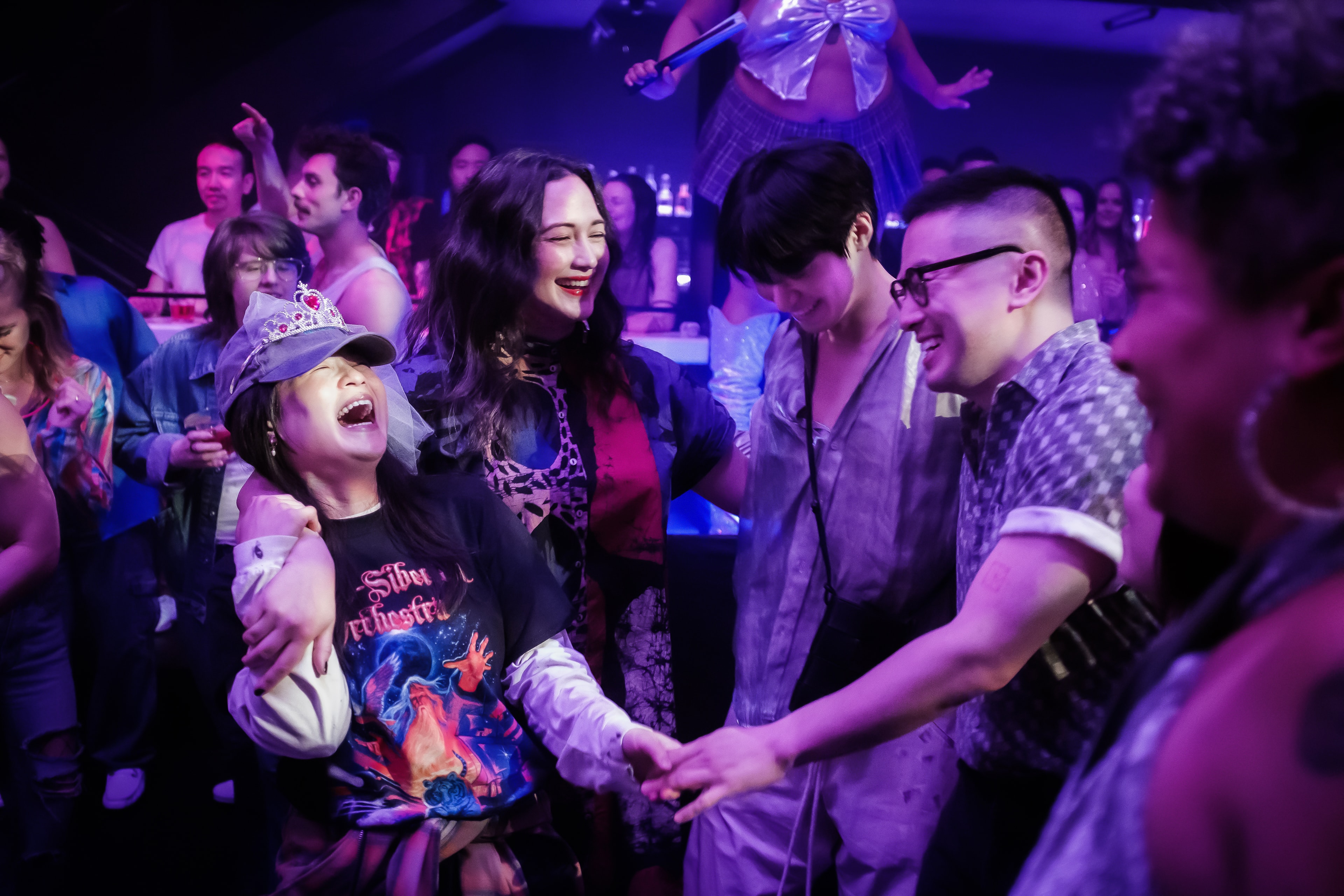
While watching The Wedding Banquet, I couldn’t help but notice that this film had two halves that were constantly at odds with each other. The first half is the standard rom-com movie, in which the film grinds to a screeching halt so that the actors can use the opportunity to riff off each other and exchange jokes or witty banter that belongs more in a stand-up special or sketch than an actual movie.
I was less than pleased with this half of the film’s identity because, personally speaking, I do not enjoy rom-coms, especially ones like this. Whether they’re studio-produced Judd Apatow comedies or low-budget Sundance indie films, they all share this commonality that I personally can’t stand because, on top of being rarely funny, they don’t use the medium of cinema to its fullest extent. Pair that with other cliches of the genre, like the main character(s) getting into a big argument with their significant others only to pull themselves together and win them back, and you have essentially every romantic comedy movie ever.

The second and far more interesting half that made up The Wedding Banquet is the touching yet weighty coming-of-age story that explored themes of self-identity, the Asian American experience, letting go of the past, reconciling the cultural gap between older and younger Asians, and coming to terms with oneself. In case it wasn’t obvious, I connected far more with this part of the film.
When it pushed aside the rom-com vibes and leaned into these more profound moments of drama in which we watch these characters break down their emotional barriers and lovingly embrace one another, I couldn’t help but tear up. The best moments of The Wedding Banquet are when it reminds me of other modern classics that similarly explore the Asian American experience, like Past Lives or Everything Everywhere All At Once. These are films that I love primarily because, as an Asian American, I can see myself in those characters.
This aspect of The Wedding Banquet is so emotionally effective that it unintentionally left me frustrated because, at the end of the day, these powerful and endearing moments of drama are not the core of the film.
This is still a romantic comedy through and through, with all the predictable cliches, tropes, and storylines that one would expect from a movie like this. While they have been updated for a modern audience and presented with more artistic sensibilities, my mind couldn’t help but wonder when the more rom-com-centred scenes played out, leaving me nothing more than mildly entertained.
However, despite my personal disinterest in the rom-com genre, I’m more than capable of looking past my biases if the characters are properly fleshed out and the story is compelling enough to keep me engaged. My favourite “rom-coms,” like Punch-Drunk Love, Her, and Golden Time, are examples that do exactly that, and to some extent, The Wedding Banquet follows a similar path that these stories take.

The best aspect of this film is, without a doubt, the actors, who all give great performances. Kelly Marie Tran does a fantastic job as the lead protagonist as she captures both her character’s dry humour and subdued nature. While Tran consistently proves to be a capable comedic actress, the real highlight of her performance comes when she has to deliver more grounded and dramatic emotions.
One of my favourite scenes in the film is when Marie Tran’s character confronts her mother (Joan Chen) for being a “bad mom” who treated her so terribly after coming out of the closet, only to do a complete 180 years later in such a phony and forced degree. This is an excellently well-acted scene and gives further insight into Marie Tran’s character’s internal struggles with self-worth and her insecurities about whether she’d make a good mother. This is a deeply layered character, and Marie Tran truly owns it.
Lily Gladstone and Han Gi-chan also do a great job playing their characters. Like Marie Tran, they could seamlessly flip back and forth between serious and comedic, depending on the scene. Despite their limited screen time, Youn Yuh-jung and Joan Chen delivered such excellent performances that they managed to be the real standouts of the film.
Bowen Yang did a good job playing a more reserved character than he normally plays in either Saturday Night Live or his other features. While he doesn’t sell his more dramatic moments as convincingly as the rest of the cast, he has great chemistry with his co-stars, making him appropriate for the role.
The characters in The Wedding Banquet feel real and grounded; I couldn’t help but sympathize and resonate with both the internal conflicts and insecurities these people were going through and the raw emotions expressed when forced to address these issues. One moment that stuck with me was the scene where Youn Yuh-jung’s character says to Han Gi-chan’s character, “This is not the future I wanted for you. But I can’t make you the grandson I wanted you to be.” It’s an incredibly poignant line that I immediately latched onto because I could see myself in that same state Han Gi-chan’s character was in when he heard his grandmother say it.

Unfortunately, these emotionally powerful moments are centred around a story that quickly becomes repetitive and cyclical after the first 20 to 30 minutes pass. The Wedding Banquet reels audiences in by unveiling the central conflicts these characters will face fairly quickly. However, rather than letting these conflicts evolve and challenge the characters, the film instead resets them back to square one.
Anytime one of the film’s couples revisits their respective issue, they repeat the same points made numerous times earlier. Very little plot progression is made from these argument scenes, and rarely does the audience learn more about the characters from these repetitive fights that they hadn’t already known before. It’s a cyclical cycle that repeats over and over and over again until the last 30 minutes, when the movie finally starts wrapping up.
Ultimately, The Wedding Banquet is a film that has high highs and low lows. It is not a terrible film, but it isn’t something I’m keen to revisit, as I feel like I got everything out of the film on this first watch. This is a decently directed, decently shot modern romantic comedy that can get very tropey and cliché but boasts excellent performances from its cast of talented actors.
The Wedding Banquet accomplishes what it sets out to achieve, so even if it’s not my cup of tea, it is still a confidently and passionately made picture that will connect with audiences. Certain scenes from this film will stick with me for a while, and that is enough motivation for me to check out Andrew Ahn’s previous features and what he’ll direct next.
Rating: 6/10