

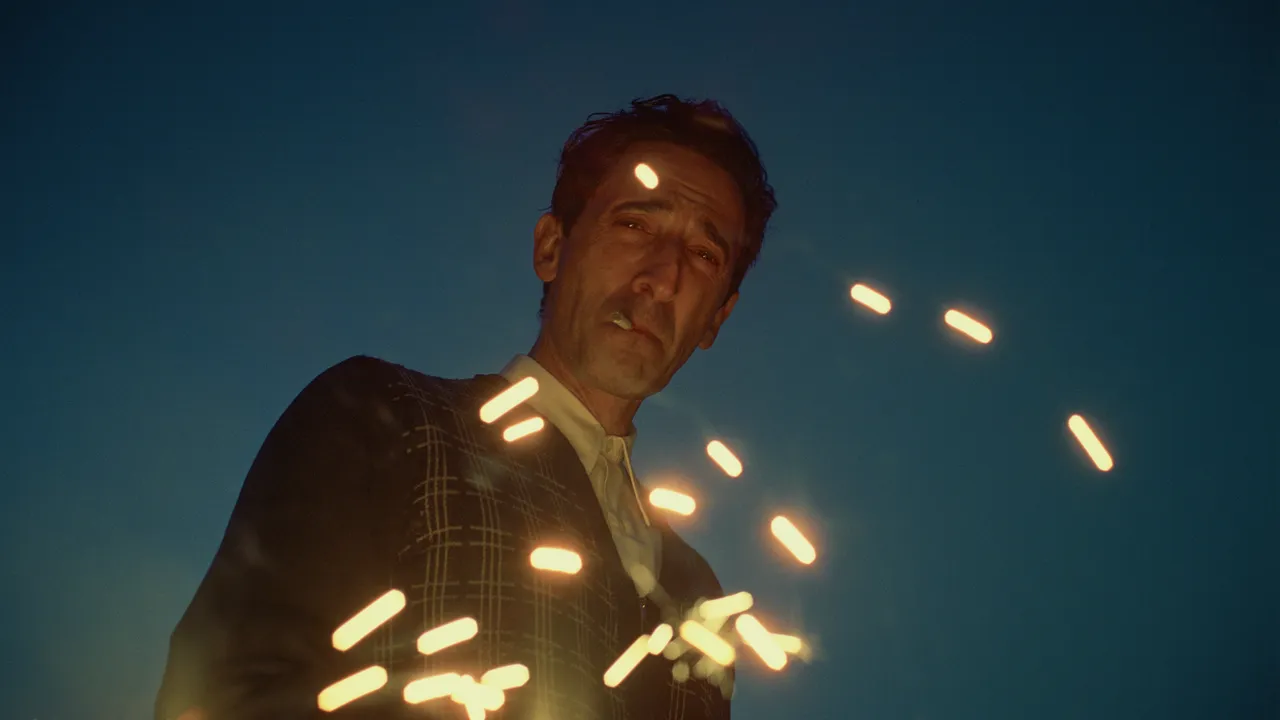
There’s no denying how ambitious and grand Brady Corbet’s The Brutalist is. The fact that this enormous, 3-hour-and-35-minute American historical epic even exist is an accomplishment worth celebrating. There aren’t many movies like The Brutalist, and I don’t mean that in a metaphorical or a cynical sense; I mean, there are very few movies today that look and feel like this one. The Brutalist feels less like a modern movie and more like a 70s picture made and released during the height of New Hollywood cinema alongside classics like The Godfather and The Deer Hunter.
Decisions like choosing to shoot this movie using VistaVision cameras, which use 35mm film, and including a 15-minute intermission between the two halves truly highlight how well The Brutalist accomplishes at being this niche 70s time capsule. In the same way that Planet Terror and Death Proof were made to look and feel like old grindhouse B-movies that could have been made and released in their respective period, The Brutalist provides a similar experience in that if you ignore the fact that it features modern Hollywood actors, it could almost pass as an American New Wave 70s epic.

The Brutalist is a long-time passion project that Corbet has wanted to tell as there is so much love and labor put into the technical craft and filmmaking behind this movie. I mentioned before that this was shot in 35mm (and then “rotated” to a 70mm resolution), but that alone does not accurately describe how gorgeous this movie looks visually.
Whether it’s a tracking shot that follows a bus while the credits roll, a POV shot of a character looking up at an upside-down Statue of Liberty, a medium shot of two characters lovingly hugging each other, or a long take that absorbs every minute aspect of a gigantic building, every single frame of The Brutalist is just extraordinary to look at.
Corbet and cinematographer Lol Crawley clearly master the camera as this film is nothing less than a visual feast for the eyes to absorb and consume every second of. While Corbert’s previous films, The Childhood of a Leader and Vox Lux, were visually impressive, The Brutalist is a massive improvement.
The score is another notable technical aspect of the film worth praising. At one point, the music would sound sweet and whimsical, reminiscent of the score from Pablo Larrain’s English biopics like Jackie and Spencer. Other times, the music would have this loud and bombastic tone, implying a sense of wonder and triumph. The music can even be sinister at points, like listening to the score of a horror movie. The score swings for the fences as it jumps back and forth between these different tones, and for the most part, the film effectively uses these different tones in the music at appropriate moments

Additionally, all the performances in the film were, for the most part, great, with Guy Pearce as the standout actor. While Adrien Brody and Felicity Jones were good for what they were given, Guy Pearce truly transformed into his role as Harrison Lee Van Buren, a character who was capable of being kind and compassionate at one moment and scummy and vile at another.
Unfortunately, while The Brutalist is a technical marvel with lots of great filmmaking worth praising, it completely fumbles the ball when telling a satisfying narrative worthy of this massive 3-hour-and-35-minute runtime. My enjoyment of the film can be evenly divided between its two halves broken apart by the 15-minute intermission.
The first half was nothing less than exceptional. Much of the imagery was not only incredibly striking, but it also expressed so much detail that moved the narrative. László Tóth’s journey of coming to the United States to search for his American Dream was incredibly compelling. Adrien Brody does a great job selling the emotional and physical turmoil László undergoes as he tries to start a new life in America.

The movie hurls a lot of dialogue and plot points in the first half, and while it may be a bit overwhelming for some, I couldn’t help but eat up every minute of it. Not only was what I was watching interesting enough to hold my attention, but a lot of what was being presented had enough ambiguity to it that I could come to my interpretation of what I was watching. Throughout the first half, the film doesn’t talk down to its audience or hold their hand.
They simply present things as they are and allow the audience to come to their conclusions about the type of person László is, how his passion and craft for architecture consume him, and his relationships with others. The film’s first half was so narratively rich and wonderfully written that had it continued this momentum in the 2nd half (after the intermission), this could easily be a great American classic that will be remembered for decades.
Unfortunately, the 2nd half of this film does not keep up that momentum in the slightest. It does the opposite of everything great in the first half, as I couldn’t help but feel underwhelmed and betrayed by what Corbet attempted to do in the second half of The Brutalist. Admittedly, the first hour in which László reunites and reconnects with his wife Erzsébet (Felicity Jones) was interesting to watch, especially considering how much she was shrouded in mystery as all we knew about her at that point was information László gave while attending Harrison’s dinner party.
However, towards the last hour of the 2nd half, the narrative goes completely off the rails as what was being presented became both unnecessarily blatant and aggravating and, at times, unintentionally goofy and over-the-top.

The moment everything starts going downhill is a scene where László and Harrison travel to Italy to find a special marble found in a cave. Harrison commits an incredibly atrocious act against an inebriated László without going into spoilers. On top of it being tasteless and emotionally manipulative, the message this moment is trying to communicate is so obvious and forced down the audience’s throat that it’s almost impossible not to understand this scene’s greater metaphorical purpose.
Similarly, there’s another scene near the end of the film that is as equally blatant, in which Erzsébet is dragged out of her wheelchair and across the floor by Harrison’s son after she accuses him of committing the terrible act. She yells and screams as she’s dragged, and this moment plays out not only egregiously melodramatic and Hollywood-y but also so unintentionally hilarious that I struggled to contain my laughter.
However, the absolute worst of this downward spiral came from the film’s atrocious ending, which goes forward 20-30 years into the future in which László is an old man living in Israel. While it was nice that the film attempted to be as authentic to the time period as possible by shooting on what appeared to be an old 80s/90s video camera, the actual substance within that ending is nothing less than insulting and unbearable.

For whatever reason, Corbet decides to use this ending to just flat out explain all the themes and ideas that were explored throughout the film by having a woman speak in excruciating exposition about how much of a great man László is, how beautiful the buildings he designed were, and ultimately how he managed to overcome his struggles against anti-Semitism and xenophobia as a Jewish immigrant.
For a film that started as this epic narrative that didn’t talk down to its audience and left its story and characters open to interpretation, The Brutalist ends in such a pedantic and overbearing way was such a massive betrayal. It was incredibly disappointing to see a movie with so much love and care put into the technical aspects and so much ambition put into telling this grand immigrant American Dream story crash and burn before it crossed the finish line. I wanted to love this film so badly, and while there are a lot of elements to admire and respect, overall, this film falls short of the 70s New Hollywood epics it was trying to imitate.
Rating: /10