

By Timothy Lee
When The Boy and The Heron (the original Japanese title being How Do You Live?) was in development, it was originally thought to be the final film by legendary anime director Hayao Miyazaki. This has now proven false as both Ghibli Vice President Junichi Nishioka and the film’s producer Toshio Suzuki have publicly stated that Miyazaki is already planning to work on a new film. However, as exciting as this news may be, had Miyazaki committed to his promise of retiring from feature filmmaking once and for all, then this latest animated film would have been an astounding and masterful way to finish his career.

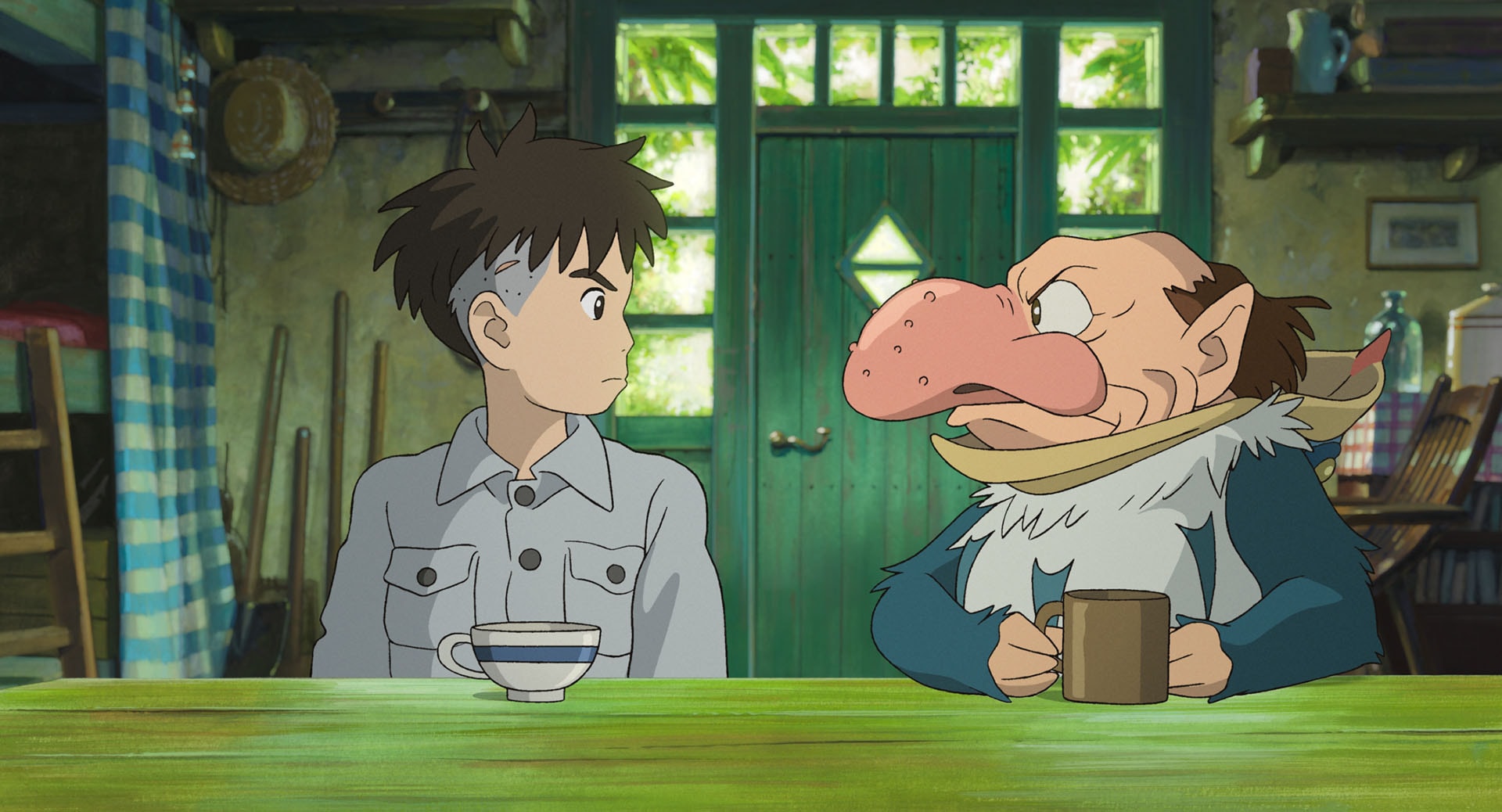
Loosely based on the 1937 novel How Do You Live? by Genzaburo Yoshino, The Boy and the Heron takes place during World War II and follows a young boy named Mahito Maki (Soma Santoki/Luca Padovan) whose mother perishes from a hospital fire. Years after her death, Shoichi (Takuya Kimura/Christian Bale), Mahito’s father, remarries his late wife’s sister, Natsuko (Yoshino Kimura/Gemma Chan), which forces Mahito to move into Natsuko’s massive house in the Japanese countryside. One day, a pregnant Natsuko suddenly disappears and is last seen by Mahito walking towards a mysterious tower that his great-granduncle built long ago before disappearing himself. Determined to find his stepmother, Mahito travels to the tower. However, he is quickly transported to a fantastical world that could only have been conceived from the mind of Hayao Miyazaki as it features elements like man-eating parakeets, a young lady who can light her entire body on fire, and an old wizard struggling to keep this mystical realm together.
To state that The Boy and the Heron is a gorgeously animated film would be a colossal understatement. From the very first minute, Miyazaki immediately flexes the film’s beautiful animation, showcasing that the audience is in for a visual treat. The movie begins with the deafening noise of a siren alarm, followed by the bright yet dangerous glow of the fire burning the hospital where Mahito’s mother works. Realizing that his mother is in danger, he rushes out in a desperate attempt to save her, resulting in one of the most haunting and surreal moments in the film. As Mahito rushes out to save his mother, he is forced to run past these abstract figures of people, all while embers of the fire brush past his teary-eyed face. This sequence feels less like a traditional Ghibli scene and more like something ripped straight out of “The Scream” painting. All of this happens within the first five minutes of the film. Within the first five minutes, Miyazaki has already grabbed the audience’s attention, and at no point does he ever let go throughout the entire 2hr4m runtime.

Several moments throughout the film, like those first 5 minutes, are both visually beautiful yet hauntingly surreal, reinforcing why Miyazaki has earned his status as a master of animation. From the frogs that cover up Mahito’s body when the mysterious Grey Heron confronts him to blood that spills from his head after Mahito strikes himself with a stone to the strips of paper that latch onto the young boy’s face when he finally discovers Natsuko, there are a handful of sequences in which the animation is so striking that they will forever be etched into the audience’s memory. Miyazaki has truly outdone himself with The Boy and the Heron, as it is easily one of the best-looking movies that Ghibli has produced. In an age in which animated films are made using computers and CG, Miyazaki is still committed to using traditional, hand-drawn animation, and the result is a movie that proves that the old-school ways can still compete with the latest technical innovations like Across the Spider-Verse and Teenage Mutant Ninja Turtles.
However, while the animation makes The Boy and the Heron worth seeing, the story is arguably the best aspect of Miyazaki’s latest film. Like any of his other movies, the narrative of The Boy and the Heron is incredibly deep and richly complex. At first glance, the film appears to be a simple Alice in Wonderland-type story in which Mahito is transported to a mystical world where he goes on an adventure to rescue a loved one. This is not exactly new territory for Miyazaki since he has tread similar grounds before, most notably in Spirited Away, where the main character, Chihiro, has a journey similar to Mahito’s. However, while The Boy and the Heron can be enjoyed as a straightforward fantasy adventure with lots of dark and mature elements, at its core, though, this is a story about a young boy attempting to grow up and move on from a traumatic event that occurred in his life.

The significance of the opening 5 minutes isn’t just to show off the cool animation. It’s to establish the central theme of the film, which is how grief and trauma can psychologically scar a young child. Not only did Mahito lose his mother, whom he loved dearly, but she’s now being replaced with another woman who looks exactly like her, something that the film mentions a couple of times. This is a lot to take for a boy, and the film excellently showcases how these traumatic moments affect his well-being. He has nightmares of his mother burning alive while she begs him to save her. He harms himself with a stone that leaves a nasty scar on the right side of his head. He is cold and emotionally distant from the people in his life, including his stepmother, Natsuko, who only wants what’s best for him. Despite putting up a brave face and pretending to be okay, Mahito is just a kid overwhelmed with grief and trauma.
Because of Mahito’s internal struggles, his adventure in the spiritual realm is much more satisfying. He goes on this fantasy quest not just to rescue Natsuko from captivity. He doesn’t go on this journey because he believes in the Grey Heron, who claims his mother is still alive. Mahito knows it’s a trap and that the creature has ill intentions. Mahito takes on this task because he doesn’t want to repeat what happened at the film’s beginning. He doesn’t want to lose another mother. Mahito is frustrated that he couldn’t save his mother from the hospital fire and doesn’t want the same thing to happen to Natsuko. Although he was emotionally distant from his stepmother, she is still an important motherly figure in his life whom his father clearly cares for. Mahito wants what’s best for everyone, so if he can’t save his mother, he can at least try to save his stepmother.

This motivation not only elevates this Alice in Wonderland-type adventure but also makes the ending of The Boy and the Heron even more satisfying. Towards the film’s conclusion, Mahito meets a powerful wizard (Shōhei Hino/Mark Hamill) who is revealed to be both his great-granduncle and the ruler/protector of this fantasy realm. His great-granduncle asks Mahito to become his successor and continue his work of maintaining this spiritual utopia. Mahito refuses, though, preferring to return to the human world. The wizard is perplexed by this choice, asking why the boy would prefer returning to a world ridden with war, disease, famine, and, most importantly, loss and pain. Not only would Mahito be able to continue his great granduncle’s work, but also be with his mother, Lady Himi (Aimyon/Karen Fukuhara), forever.
As tempting as this choice is, though, Mahito still says no. He not only has important people in his life that he needs to be with, like his father and Natsuko, but he also has finally come to terms with the loss of his mother. As fun as it was to cherish one last adventure with his mother/Lady Hina, at the end of the day, he recognizes that he can’t change the past or bring his mother back. The best thing he can do is take one step at a time and move forward with his life, knowing that his mother will always be with him, watching from the heavens. This is an incredibly mature conclusion for Mahito to come to, but it’s a conclusion that is completely justified.

The Boy and the Heron has been described as “partly autobiographical” in that many of the characters are based on both Miyazaki himself (Mahito is partly based on the director) and the important people in his life. Knowing just how personal this film is to Miyazaki it makes Mahito’s journey and character arc that much more emotionally powerful because it’s not just the character coming to terms with his past and legacy, but it’s Miyazaki himself coming to terms with these facets as well. There are a lot more things that can be said about The Boy and the Heron that haven’t been said yet in this review, like how Joe Hisashi’s score is excellent and enhances the film or how amazing the vocal performances are. However, many of these elements feel minor compared to the core aspect of the movie that is truly worth praising and studying.
At the end of the day, the movie isn’t just another kid’s adventure filled with wonder and excitement. It’s a personal memoir from Hayao Miyazaki himself, coming to terms with his past and legacy as both an artist and human being but exploring these bits of himself in the only way he knows how: a fantasy adventure featuring a brave young boy and a mischievous talking gray heron. The Boy and The Heron isn’t just a modern masterpiece. It is the ultimate culmination of everything that Miyazaki has worked on and achieved.
Rating: 10/10