

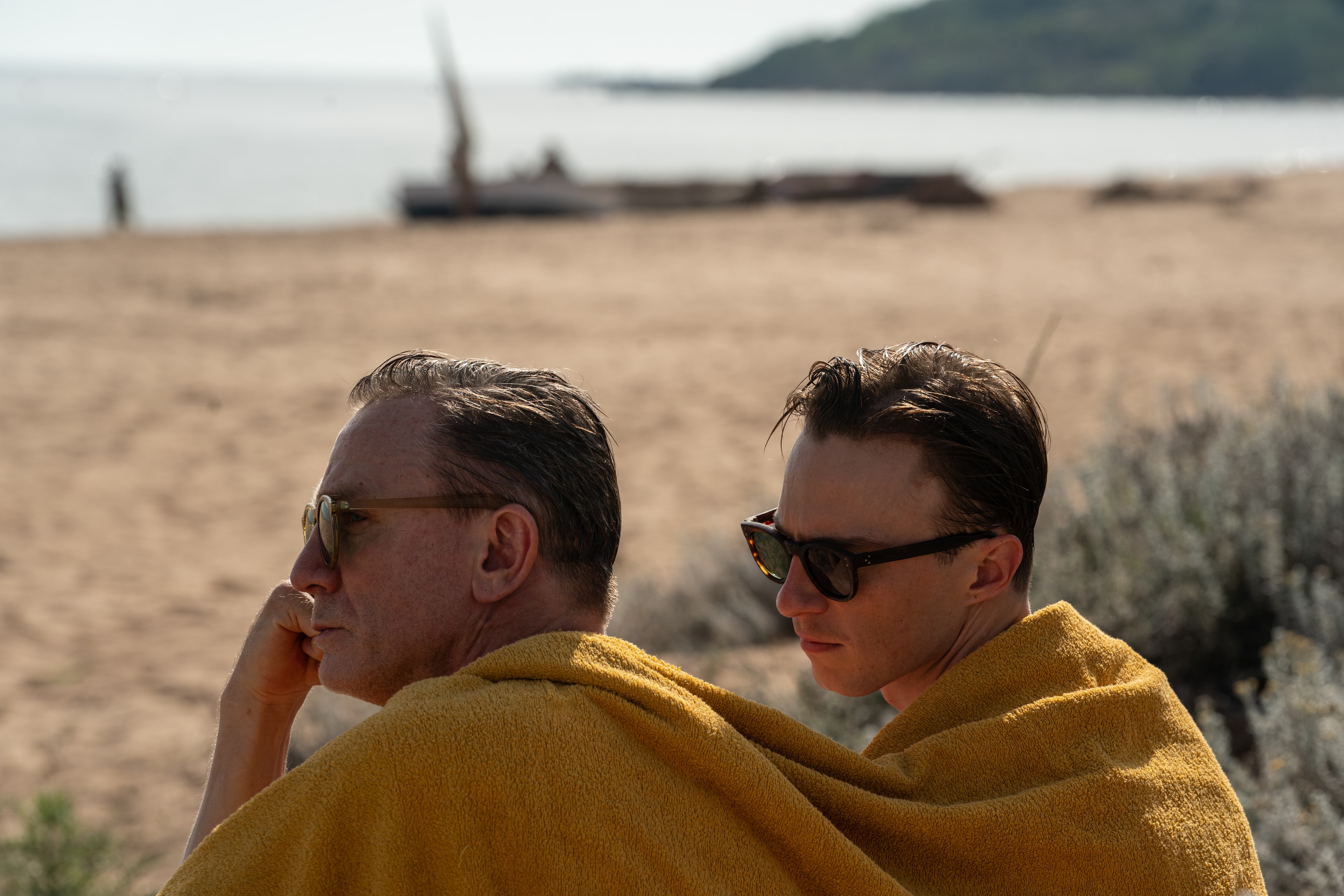
It’s has been no secret that Queer was a longtime passion project for Luca Guadagnino. The Challengers and Call Me By Your Name director has stated that he has wanted to make a film adaptation of William S. Burrough’s 1985 novella of the same name ever since he read it when he was 17. Many decades later, Guadagnino has carved a space in cinema for himself, so it is exciting to see a film like this come from a genuine place of passion and artistic expression.
I was vaguely familiar with Burrough’s work to know that I shouldn’t expect another Challengers, but not enough to understand what movie I’d be experiencing. Guadagnino has always been a hit-or-miss director for me in terms of my enjoyment of his films, as they range from decent movies I don’t connect with, like I Am Love and Bones and All, to unforgettable experiences like Challengers. Thankfully, after the credits rolled and I sat quietly to absorb everything I watched, I quickly realized that Queer not only belongs in the amazing experiences category, but it’s also easily one of the best films Guadagnino has ever made.

To state that Queer is an emotional rollercoaster of a movie would be an understatement because I pretty much experienced every emotion that you could imagine when watching a film like this. When we are first introduced to the character of William Lee (Daniel Craig), we see him at a particular moment in life where he spends his days in Mexico City hopping between bars and hooking up with younger men.
Despite all the color and flashiness that exudes from these provocative moments, it’s clear that this lifestyle isn’t fulfilling for William. Booze and sex aren’t enough to fill the huge, gaping hole in his heart. He desperately seeks a personal, human connection with someone, and while he finds comfort in his friends like Joe Guidry (Jason Schwartzman), it’s simply not enough.
However, everything changes for William when he glimpses a young, handsome American GI-turned-expatriate named Eugene Allerton. It’s love at first sight for William. Despite not exchanging a single word that night, William feels a spark when he lays his eyes on Eugene, which takes his breath away. Eventually, after drinking a bit of liquid courage, William takes a leap of faith and hits on the cool and suave Eugene, who reciprocates his attraction. However, despite spending nights together and forming a relationship, Eugene is cold and distant towards William.
It’s clear from various surreal moments in which William fantasizes about caressing his cheek and stroking his hair that he’s smitten with Eugene and sees a real connection with the man he wants to pursue. However, Eugene indicates early on that he might not be as invested in this relationship. There’s even a dinner scene in which Eugene admits that he isn’t queer in the same way as William is.

Desperate to forge a deeper connection with the young man, William invites Eugene to take a trip to South America in search of yagé, a plant that supposedly gives people telepathic powers if consumed. Eugene initially hesitates but eventually agrees when William asks him again. Together, they travel across the continent before making their way into a jungle in Ecuador, where they find Dr. Cotter (Lesley Manville), a researcher who brews a yagé for them to drink. At this point in the story, I was still on the fence.
The first two acts were reminiscent of Luca Guadagnino’s previous forays into the romance genre. Namely, I Am Love, Call Me By Your Name, and Bones and All, in which we watch a beautiful yet uneasy romance blossom between two flawed characters. This type of story is one I have seen far too many times, and while Queer gives Guadagnino the ability to flex his mastery over this genre, it was one I was overly familiar with. It didn’t feel like I was experiencing anything new.
However, right before I was about to write off the movie as “decent, but didn’t connect with it,” the third act reared its head and kicked things into overdrive. The third act took the story in an interesting and compelling direction. What was being presented slowly helped me realize what this entire film meant and what Guadagnino was trying to say. After William and Eugene drink the Yagé brew, they undergo a series of hallucinations. They vomit out their hearts, their bodies meld into one, and they can read each other’s thoughts.

What starts as frightening surrealism slowly morphs into a beautiful and awe-inspiring form of the abstract that better expresses how perfect Wiliam and Eugene are together than all the worlds in the world. This moment reinforces what William, and by extension the audience, already, but tragically, knew from the start. There is this beautiful spark between the two men that could be something amazing if both parties fully commit, but Eugene is so disconnected from his sexuality that he can’t give William the love he desires. It’s why it’s heartbreaking when Eugene telepathically says to William, “I’m not queer… I’m disembodied.” William knows this is the case, but it doesn’t change how hard it hurts him.
However, as amazing as this moment was, this was not the moment that made me truly fall in love with and fully understand Queer.
That honor goes to the film’s ending, in which William starts having these surrealist dreams about himself and his unrequited love for Eugene. After a few minutes of back-to-back surrealism involving William shooting Eugene in the head and cradling his body for a moment before it disappears, William then finds himself as an old man in a hotel room.

Evoking the same imagery and emotions as the ending of 2001: A Space Odyssey, the final shot ends with an old William lying on the bed with Eugene, who cradles him as he dies in his sleep. This final moment of Queer was the last nail to this coffin called my heart because very rarely do I get emotional when watching films, but Guadagnino managed to do it.
Ultimately, if you remove the abstract surrealism and intense love scenes, Queer is a movie about finding that perfect someone who could fill that hole in your heart, only to realize that your perfect someone may not reciprocate those feelings. There may be a mutual attraction that leads to brief periods of excitement and passion, but if there is no genuine love to keep things going, all those moments will eventually become nothing more than distant memories. Everyone wants to be found. Everyone wants to love and be loved. Everyone wants to be cradled by their one soulmate who will love them unconditionally, flaws and all.
William desperately wanted that from Eugene, but Eugene wouldn’t give that to him. In William’s eyes, that rejection leaves him nothing but an empty old husk of a man who dies alone in some random hotel with only a sensationalized memory and a what-if scenario to keep him company. Queer is a movie that beautifully and masterfully explores these ideas and emotions, and my only regret is not realizing that until the very end. At the very least, now I have a reason to rush back and see it again.
Rating: 9/10