

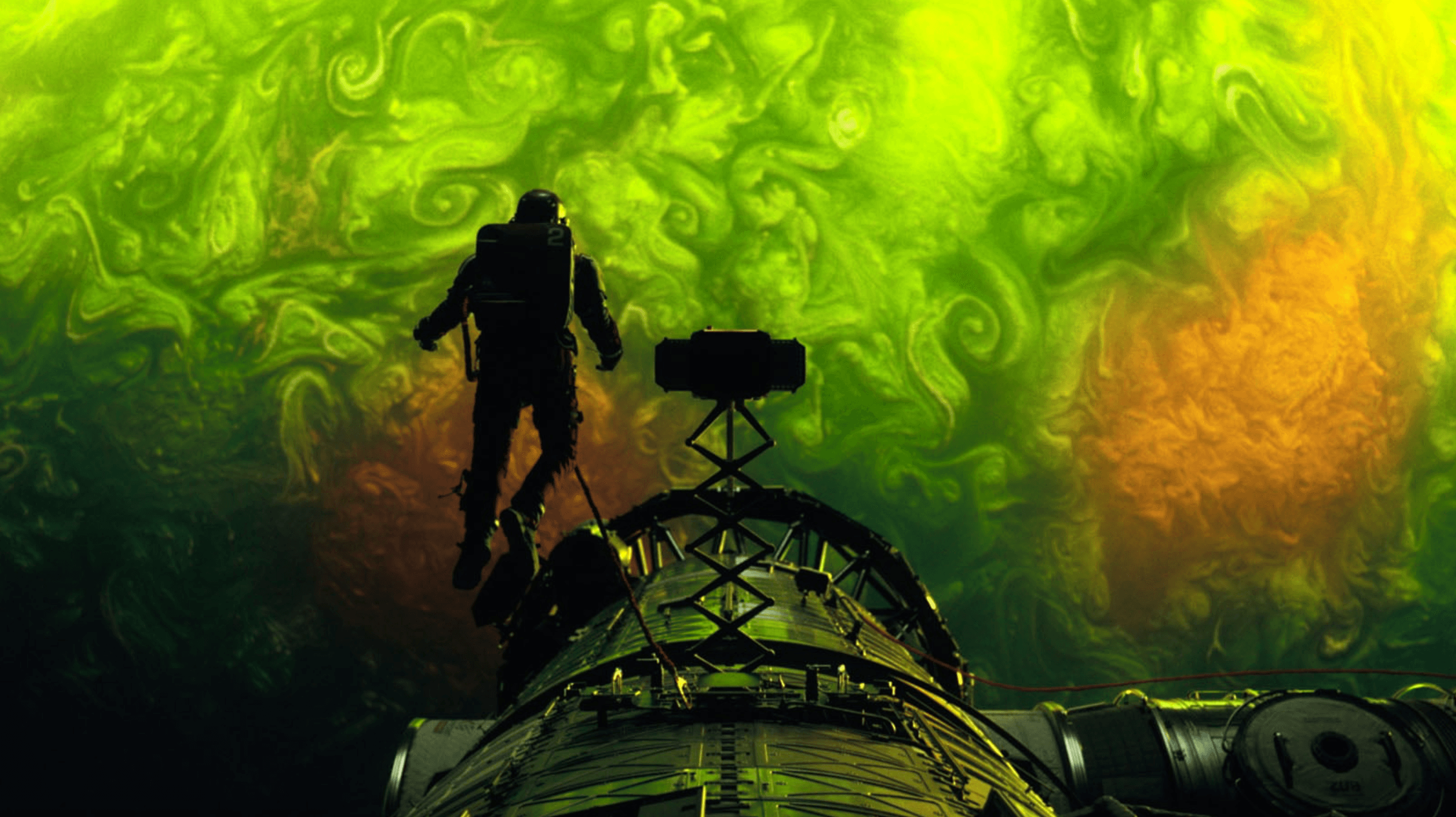
The hyperbolic praise surrounding Project Hail Mary has multiplied almost as rapidly as the astrophage threatening the sun in the film itself. In many cases, this level of hype can feel overblown. But after seeing the film, it becomes clear that the enthusiasm is justified: Project Hail Mary is that rare blockbuster that blends spectacle, heart, and big ideas into something genuinely special.
The adaptation of Andy Weir‘s (The Martian) novel of the same name explores so many different themes: humanity, hope, loneliness, friendship, and sacrifice. The moral and philosophical questions it raises feel like a grand-scale version of Philippa Foot’s The Trolley Problem, exploring utilitarianism while also delving into the deep friendship between its protagonists. Translating these concepts to the big screen in an entertaining and visually impressive way would be a massive challenge for any filmmaker. Thankfully, however, Project Hail Mary finds itself in the fortunate position of being the product of two massively talented storytellers in directors Phil Lord and Chris Miller (the masterminds behind the Spider-Verse franchise, among many other fantastic films).

On the surface, the duo, once removed from Solo: A Star Wars Story, may seem like unconventional choices. However, given their ability to successfully blend comedy, visual style, and raw human emotion with a terrific story in Weir’s source material, we immediately understand why they were the perfect choice. The results clearly speak for themselves, because Lord and Miller crushed it.
The story follows junior high science teacher Ryland Grace (Ryan Gosling), recruited by Eva Stratt (Sandra Hüller), the head of the initiative “Project Hail Mary,” to help solve a catastrophic phenomenon that is dimming Earth’s sun. As Grace journeys farther into space than any human before him in an attempt to save the planet, he forms an unexpected friendship with an extraterrestrial named Rocky — a bond that ultimately inspires the courage and hope he needs to survive and fight for life back home.
The heart and soul of the film lies in the friendship between Grace and Rocky, which is an incredibly difficult feat to accomplish. Lord and Miller have the unenviable task of portraying Rocky as a sympathetic character without a visibly obvious face. However, through sound design, puppetry, terrific vocal work from puppeteer James Ortiz, and a ridiculously stellar performance from Gosling, the ingredients add up to one of the most tangibly emotional friendships we’ve seen in science fiction since E.T. and Elliot. Lord and Miller approach this friendship with wonder and comedy, allowing for both Ortiz’s puppetry and Gosling’s full emotional commitment to sell the relationship to us as audience members. Moments ranging from their initial meet-cute to quiet conversations about their respective home worlds allow us to invest in the depth that develops between them, which inevitably raises the film’s emotional stakes when danger befalls them.

As alluded to above, not enough can be stated about how good Gosling is in this film. For example, when we are first introduced to Grace, it’s through a scene of disorienting physical comedy that allows the actor to play the clown with his manic “Ken-ergy”, then match the film’s tonal shift at a moment’s notice when we begin to understand the tragedy and risks involved in the what and why of how he got to his current state. This transition never feels jarring, partly because Lord and Miller handle the tone beautifully when introducing the stakes, but also because Gosling plays their notes so well with his physical and emotional sincerity.
For long stretches of the film, we find Grace alone, so Gosling has to keep us completely engaged and connected to him – a challenge given the character is a bit of a socially awkward, fairly lonely individual who feels out of place within humanity. And yet, thanks to Gosling’s overall likability and earnest underdog nature, it becomes completely plausible to buy Grace as the hero he eventually becomes, whether due to the tenderness Gosling displays in scenes with Rocky, the wonder he expresses when making his monumental discoveries, or the quiet sense of existential dread plaguing him, knowing what might potentially become his fate. Gosling imbues Grace with a sense of humanity we can connect to from the first frame to the final.
From a thematic standpoint, the way Lord and Miller, alongside screenwriter Drew Goddard, approach the heavy themes of Weir’s book is subtle and proficiently executed. As filmmakers, they absolutely specialize in showing over telling, which is all the more important in a film driven by its characters. Take the way they approach Stratt’s character and how it contrasts with that of Rocky’s.

While Stratt’s character may easily be written off as cold or overly utilitarian, Lord and Miller still manage to find ways to showcase an inner softness and sympathy within her by inserting simple scenes of Hüller belting out Harry Styles’ “Sign of the Times” at a karaoke night, or exchanging the slightest tone of regret in the actress’s delivery of “You are my solution” to Grace. It’s choices like these that allow us to identify with the overall challenge a character like this faces, as well as the confidence in the calls she has to make. It allows Stratt to serve as a foil to Grace and even to Rocky, showing that she’s where Grace eventually needs to be as his journey progresses.
This weaves perfectly into the themes of sacrifice for the greater good and the value of human life at the individual level. Having her point of view conflict with Rocky’s, a character determined to save his friend by any means, allows Lord and Miller to explore both sides of their proverbial Trolley Problem in character-focused ways. Neither Rocky’s nor Stratt’s viewpoints are wrong. And the choice comes down to Grace to decide where he needs to inevitably steer himself. Ultimately, it’s these character-driven choices and the execution of them that allow the movie to beautifully convey the themes of Weir’s novel on such a poetic and emotional level.
On a technical level, the film is an absolute marvel. The cinematography from Greig Fraser (Dune, The Batman) is not only stunning but also awe-inspiring and simply jaw-dropping. The use of colors and the way he frames shots to depict Tau Ceti and the astrophage are absolutely gorgeous, with the specific “fishing” scene in the movie being one of the most visually incredible moments I’ve ever seen on the big screen. Which leads me to an important recommendation: Project Hail Mary should absolutely be seen on IMAX. The visuals pop and sparkle so much better on the screen. However, the IMAX ratio also provides narrative support. Lord, Miller, and Fraser have chosen to film scenes on Earth (which represent past events in the narrative) in 35mm and scenes depicting space (representing present events in the narrative) in 70mm. With the movie being non-linear, as we see glimpses of the past while Grace tries to uncover lost memories, the switching of aspect ratios helps clarify what moments you’re seeing on screen and where. Besides that, it’s beautiful and immersive, truly making you feel like you’re part of the journey.

The score from Spider-Verse composer Daniel Pemberton is both modern and memorable. It lends the film a rousing, dramatic weight and a sense of emotional wonder as Grace and Rocky’s friendship begins to develop. His use of synthesizers gives the movie its distinct sci-fi sound, which also feels modern, channelling similar works from contemporaries like Hans Zimmer and Ludwig Göransson.
If I have one complaint about the movie, it would be that, at 156 minutes, it definitely feels long. It’s intended to be an epic, of course, and it certainly comes across that way. However, the pacing feels a bit slower at times than perhaps it needs to be. You’re absolutely engaged the entire time, but there might be a tighter film somewhere within by about 15 minutes. The only conundrum is that I have no idea what they could possibly cut since all scenes do feel necessary for the characters and the narrative.
That being said, on almost every level – visual, technical, thematic, performance, and narrative – Project Hail Mary is a triumph! Lord and Miller continuously push the boundaries of cinema and themselves as filmmakers with every project they are given, and this film just might be their greatest masterpiece yet. It is an absolutely genre-defining, jaw-dropping spectacle packed with heart and humor. Anchored by an astonishing performance from Gosling and a heartwarming friendship between his character, Grace, and Rocky, I simply cannot think of a sci-fi journey from the past six years I’ve enjoyed taking as much as the adventure I took with Project Hail Mary.
Rating: 9.5/10