

Animation doesn’t get the credit it deserves from critics and guilds. When it comes to cinema, you’re likely to see a live-action film about marital and familial problems sweep Oscar nominations. In contrast, an animated movie that tackles the same issues is overlooked.
However, Netflix Animation’s In Your Dreams proves, once more, that the same mature themes and levels of sophistication can transpire through any medium, especially animation, when the right artists and storytellers are involved.

Netflix has been on a roll with animated storytelling. From Klaus to Guillermo Del Toro’s Pinocchio to this year’s Sony Pictures Animation-produced phenomenon, KPop Demon Hunters, the company has proven that it believes in the medium far more than most other studios do. Now, with their latest release, In Your Dreams, Netflix is giving its partner, Kuku Studios, founded by Pixar alumni Alex Woo, Stanley Moore, and Tim Hahn, a chance to shine with a mature, surreal adventure through the world of dreams.
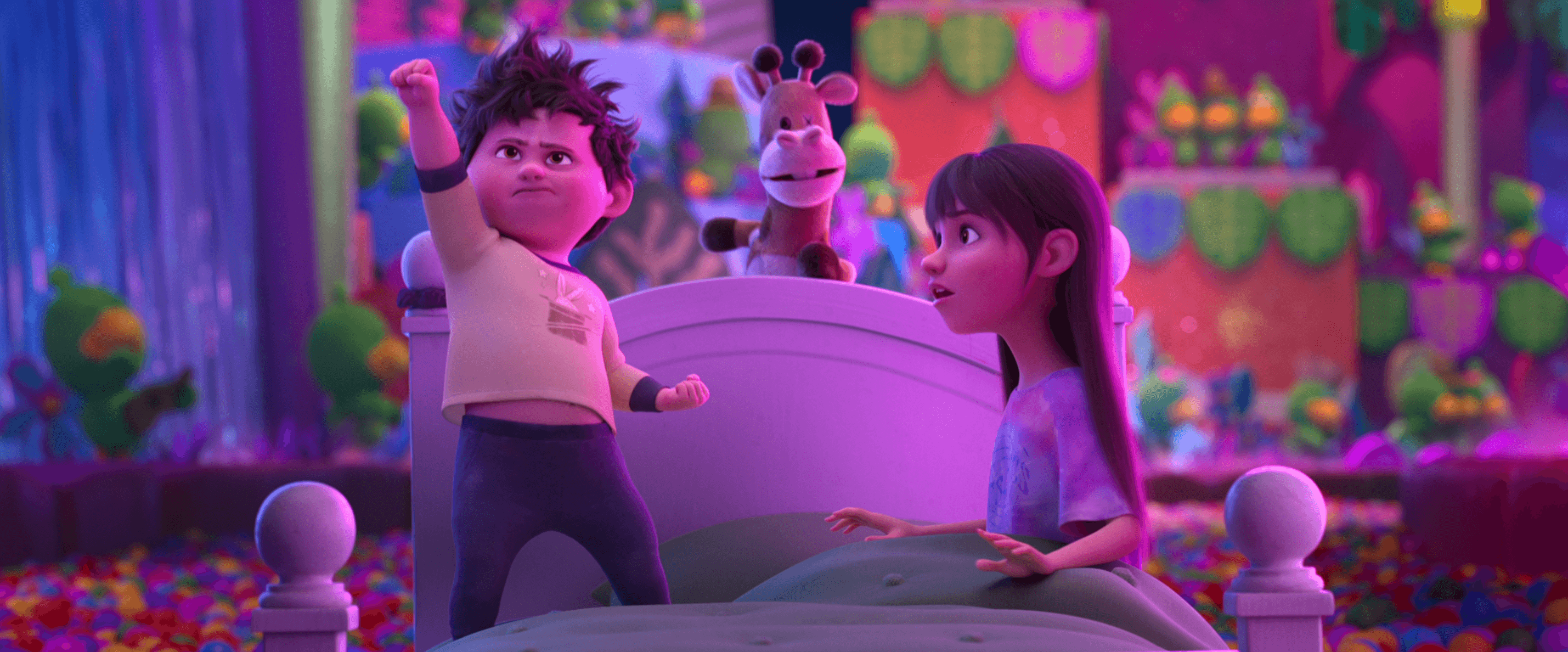
In Your Dreams tells the story of a mixed-Asian family from the perspective of two siblings: tween perfectionist Stevie (Jolie Hoang-Rappaport) and her younger, mischievously sloppy brother, Elliot (Elias Janssen). As Stevie watches an emotional rift growing between her once-harmonious parents (Simu Liu and Cristin Milioti), she begins to fear the worst, believing it’s her job to fix their marriage and keep their family together. In her most desperate moment, she and Elliot stumble across the mysterious book of The Sandman (Omid Djalili), and read about a way for him to grant wishes through their dreams. So they embark on a surreal journey through their dreams to find The Sandman so he can keep everyone together.
Right off the bat, you can tell that Woo, Moore, and co-writer Erik Benson wanted to touch on several very real familial themes that aren’t typically explored in animated storytelling. Furthermore, they wanted to make sure this was a movie that didn’t pull its punches. More often than not, animated films talk down to children, insisting that a catchy song and dance number can fix all life’s problems. However, the team at Kuku understands life is much more complicated than that. This is the exact reason why In Your Dreams succeeds where recent fare from Disney Animation or even Pixar has fallen short.

It approaches its themes with a moderate sophistication and understanding that life is messy, knowing answers and solutions to our problems aren’t resolved with magic or a wish. It’s a hard lesson to ask of its characters, much less an audience of children, but one that is necessary and honest. It’s the type of brutal honesty and allegory that Pixar made their name on, but has strayed slightly from post-Toy Story 3. There was a moment in the movie when a character was asked to choose between having everything they could ever want and facing the bitter sting of reality. This is an incredibly challenging thing to ask of any child protagonist, and you have to admire the bravery of In Your Dreams for doing this.
More than that, depicting something as fundamental as characters maturing from childhood to adolescence by having to understand and accept the truths of human nature – namely, understanding marital problems aren’t their fault, and accepting it’s not their job to fix everything – is a heavy but necessary subject to explore. And to do so through a well-meaning character like Stevie makes the film feel incredibly personal and honest, along with making her feel far more human than she has any right to be.
The characters are well fleshed out, as the film not only explores the relationship between Stevie and Elliot’s parents through their eyes but also their own fractured relationship. Stevie’s desperation to resolve their familial crisis leads her to find a scapegoat in her younger brother, associating the start of her parents’ marital troubles with his birth. It’s logic that feels so real when approached by a character who embodies the mental and emotional maturity of a tween. Having Elliot’s carefree, messy personality act as a foil to this perfectionism is crucial to both of their development, allowing him to retain a sense of childlike wonder and heart that Stevie’s growing maturity is starting to outgrow. Furthermore, having us see and understand their parents’ relationship and why the issues arise from their parents’ own conflicting dreams – both the real ones and the broken ones – provides a sense of honest relatability and complexity for both parents, despite their limited screen time.

Accompanying the heavier themes are the fun, surrealist imagery of Kuku’s colorful, creative animation style. You see flourishes of inspiration from Pixar and Studio Ghibli across multiple frames (the sand helpers being an absolute nod to Miyazaki’s iconic susuwatari). The character work, especially on The Sandman and Nightmara, is stunning, as are visually splendid detours into a land made of food, and the land of sand.
A lot of the surrealism feels like what Pixar explored in Inside Out, so in some ways, it feels derivative. Ideas like “the teeth falling out” dream or the “naked” dream were already viewed in that film. For a movie about dreaming and imagination, you’d expect more creativity than that. We do get fun nightmares here and there, which are still a blast to look at. Admittedly, and thankfully, the film doesn’t make the dream sequences the focus of the story.
If there’s an area that falls a bit flat throughout the film, it’s unfortunately the humor. For a movie that intelligently explores its themes and characters well, you might expect the comedy to be a bit more witty. While I’m not opposed to the typical fart and butt jokes that come from animated films aimed at younger audiences, there’s a bit of a sharp juxtaposition between trying to tell a story that’s thematically as complex and interesting as this one, and the juvenile attempts at humor that fall flat. Yes, I’m sure kids will appreciate that Baloney Tony farts fireballs, and Elliot’s butt crack shows when he’s trying to do a magic trick. However, it does seem a bit lazy for a movie that is actually a lot smarter than that.

I’ll also say that, for as much of the marketing campaign is centred on Baloney Tony, he doesn’t have much of a role in the movie. It’s definitely an unnecessary character, transparently shoehorned in for the novelty of tossing in a cute character for comic relief. Craig Robinson, a funny actor, does an excellent job voicing the little plush toy, but the character feels superfluous, not really contributing to the growth of Stevie or Elliot. I expected much more from it narratively, given how heavy the marketing campaign leaned on this character.
That being said, comedy is hard, and none of this negates the rest of the movie’s positive aspects. I’d rather have a film that has something to say than a movie that’s a series of incoherently linked slapstick skits (see Minions). I wish the comedy hit the clever heights of animated films with equally mature weight, such as Up, Finding Nemo, Inside Out or ParaNorman.
Overall, however, In Your Dreams may fall short on some superficial things, but it’s still so much more profound and emotional than most animated products being churned out by rival studios. In its own right, having the courage to explore human themes like embracing the imperfections of reality, understanding and accepting difficult emotional choices is not an easy topic to broach. Yet, the film does so spectacularly through a family and characters that are both complex and real. I’m as impressed by its maturity as I am dazzled by its whimsy. And as such, this is one terrific animated film audiences shouldn’t sleep on!
Rating: 8/10