

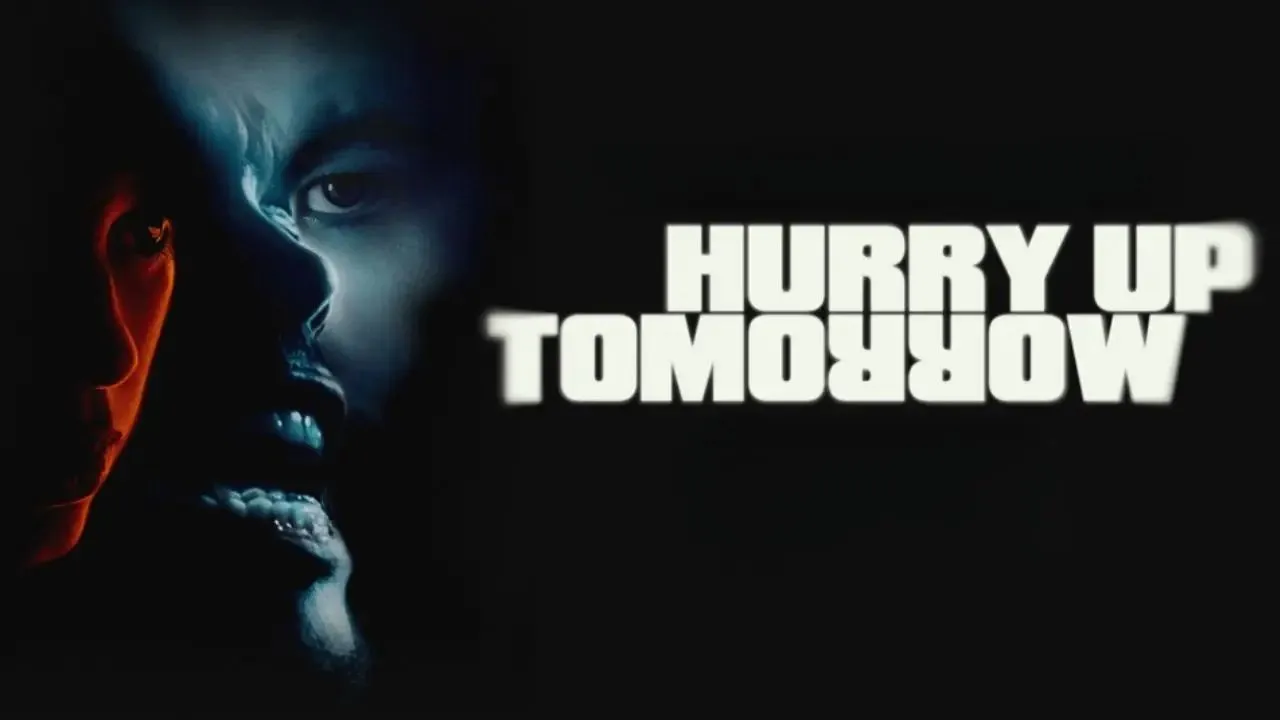
The Weeknd’s long-awaited feature debut, Hurry Up Tomorrow is here…and the response is strong.
Many musicians and singers have dipped their toes into filmmaking, with only a handful having the talent and creativity to break into the industry as successfully as they have the music business. For example, David Bowie (TheLast Temptation of Christ, The Prestige), Whitney Houston (The Bodyguard), Lady Gaga (A Star is Born), and Björk (Dancer in the Dark) have all proven to be capable actors. Other musicians like David Byrne (True Stories) and Rob Zombie (House of 1000 Corpses, The Devil’s Rejects) have shown their talents behind the camera as successful writers and directors.
While these examples are more the exception than the norm, they nonetheless prove that a musician can transition to the screen as an actor, writer, or director if they have the talent, but The Weeknd (Abel Tesfaye) is not as his film, Hurry Up Tomorrow, is nothing less than a disastrous ego-trip.

The movie is listed as a “psychological thriller,” but to call it such is an insult to actual psychological thrillers with genuine, competent filmmaking and real thematic ideas and stories to express. At best, this film seems to be more of a Freddy Got Fingered-style parody of modern arthouse films than an actual cinematic experience, and it often feels like such anyway, considering how obnoxiously shot, edited, and written it is.
Do you like long takes? You better, because this film is overloaded with so many random oners that serve no purpose other than a desperate attempt to make the film look visually sleek. You also better like fast-cut editing and strobing bright lights because these elements are present in almost every other scene. How about random moments of surrealism in which The Weeknd is transported into nightmarish scenarios that supposedly capture his mental state and psychological breakdowns? There are a handful of them in Hurry Up Tomorrow because it’s an arthouse psychological thriller; we have to include them because otherwise this wouldn’t be a “real film.”

The film desperately wants to have a personality and be compared to the directors it’s imitating, like David Lynch and Terrence Malick, but it instead just comes across as an embarrassingly try-hard attempt to appear deeper and more substantive than it is.
However, as much of a filmmaking disaster as Hurry Up Tomorrow is, I do not entirely blame Trey Edward Shults. His previous work, like It Comes at Night and Waves, shows that he has some actual talent. Instead, the brunt of the blame should be placed on the film’s lead star, co-producer, co-writer, and co-composer, The Weeknd. Admittedly, I have not seen The Idol, the HBO series The Weeknd co-created, produced, and wrote with Euphoria director Sam Levinson, and starred in with Lily-Rose Depp. However, I was familiar with its incredibly negative reception, with much of it placed on The Weeknd since the show was his passion project.
Much of what I heard about The Idol helped me go into Hurry Up Tomorrow with low expectations but with the hope that either The Weeknd learned his lesson or that Shults is a strong enough director to steer his ideas into something coherent. Neither scenario ended up happening, though.

Hurry Up Tomorrow is, at its core, a vanity project that is essentially a feature-length music video that is so unbearably pretentious and vapidly shallow that I struggled to understand what I was supposed to take away or connect with other than ironic enjoyment. This is a film that seems to exist for the sole purpose of propping up The Weeknd’s potential second career as an actor and writer, and if that’s the case, then it failed at accomplishing its goal.
Watching Hurry Up Tomorrow from this cynical perspective is more entertaining anyway because there are so many scenes that appear to be The Weeknd’s attempt to be deep, provocative, or emotional but just come across as hilarious or outlandish more than anything.
The best example of this is a scene when Anima (Jenna Ortega) ties up The Weeknd to a bed, plays one of his songs, dances along to them, and then explains the meaning of these songs to The Weeknd. In retrospect, this seems to be The Weeknd and Schults’ attempt to invoke a similar tone as the scene from American Psycho in which Patrick Bateman robotically explains Hip to Be Square to Paul Allen.

However, as bizarre as Jenna Ortega’s performance was in this film, it’s nothing compared to The Weeknd who, to put it bluntly, cannot act to save his life. The end result is a performance that is so laughably awful that it’s incredibly difficult to take him seriously. One of the best examples of this is a scene in which The Weeknd leaves an angry message for his ex-girlfriend (Riley Keough), ranting about how he loved her but that she broke his heart and she didn’t win.
It’s supposed to be a heartfelt and devastating moment, but it just comes across as cringey and unintentionally amusing because of how The Weeknd delivers each line. This is especially the case whenever he swears, as it comes across so juvenile that it feels more like it’s being said by a middle schooler who’s just learning how to swear than a fully grown adult.

Ultimately, as much as I ironically enjoyed Hurry Up Tomorrow, I’m still frustrated that all this money, talent, and star power was wasted on one person’s vanity project that didn’t even succeed at what it set out to accomplish. This is barely a film, and it’s so desperate to be seen as some sort of invigorating arthouse experience that it ends up coming across as pathetically try-hard, pretentious, and devoid of any substance.
Plenty of other films like I’m Not There, Purple Rain, and Better Man have tackled the similar concepts and stories as Hurry Up Tomorrow but with authenticity. I can only recommend Hurry Up Tomorrow for the same reason I’d recommend a Neil Breen or Tommy Wiseau movie, but if you’re looking for anything else, you’re better off with the other movies I mentioned.
Rating: 1/10