

Capturing timelessness is as difficult as achieving it in the first place. Just ask Disney. To this day, the House of Mouse has seen a plethora of live-action remakes come and go to varying degrees of success. However, more often than not, whether slavishly faithful (The Lion King) or maddeningly radical (Snow White), the reception for these sorts of films has understandably soured over the years, with a mixed reception often being the best case scenario. It’s truly ironic that perhaps the best live-action translation of any timeless animated classic would come from the Mouse House’s one-time rival, Dreamworks.
Indeed, it is with relief and joy that I submit to you that Dean DeBlois’s How to Train Your Dragon is, without a doubt, the quintessential example of how to adapt an animated classic for live-action properly. This is a sweeping, meticulously crafted, gloriously gorgeous adaptation that fully understands what made the 2010 animated classic and its sequels masterpieces. Adeptly learning from the mistakes of past examples, DeBlois’ translation sacrifices comedy for drama, presenting us with a timeless story, characters, and themes that could not be more relevant today than ever before, but with a visual flair that is unparalleled, and character shifts in tone and performances that recontextualize a classic screenplay.

If you’re not familiar with the story (though I’m not sure who isn’t at this point) How To Train Your Dragon follows Hiccup Horrendous Haddock III, an adolescent Viking from the Isle of Berk; a Viking colony that has been at war with dragons for centuries. Admittedly seen as a complete misfit to everyone in Berk, including his very own father, Stoick the Vast (the chief of Berk), Hiccup sets out to prove himself as one of the community by taking down a Night Fury; a legendary dragon few have seen. However, in doing so, unable to slay the beast, Hiccup realizes that everything Berk knows about dragons is wrong. It begins a lifelong friendship with the Night Fury, whom he affectionately names Toothless, which ultimately changes everything and everyone in Berk forever.
It was no surprise that DeBlois is and has always been a gifted filmmaker. From his early work partnering with The Wild Robot director Chris Sanders on classics like the original Lilo and Stitch, to crafting all three installments in the original How to Train Your Dragon trilogy, DeBlois has consistently proven himself to be a powerful storyteller, understanding what to do with character and theme, often handling them in incredibly mature ways, especially within animation. The test here, however, was seeing whether he would be able to translate the same sort of magic into the live-action medium, especially in adapting a film many (including myself) consider to be near perfect.
The answer is a resounding “yes,” with the director making his live-action debut by bringing his Dragon films to life in a stunning manner. How to Train Your Dragon, much like Jon Favreau’s The Lion King, may seem like a beat-for-beat translation, and situationally speaking and dialogue-wise, it almost certainly is. However, DeBlois has the good foresight to make subtle adjustments in his actors’ performances and execution that significantly shift the tone and emotion, skewing towards a more dramatic and richly somber take on the source material, despite an almost one-to-one screenplay. This results in a movie that never sacrifices what made the original a classic, but also never feels soulless, unlike other remakes before it (again, like Favreau’s The Lion King).

To make a quick analogy, whenever anyone goes to see a stage adaptation of a Shakespeare play on Broadway or film, the text remains unchanged. However, every other element does: the production design, the performances, the direction, the director’s intent, etc. How to Train Your Dragon feels a lot like that. It’s the same classic story and text, but with stellar execution, emphasizing emotion, particularly between Hiccup and the key relationships in his life, such as Stoick and Astrid.
DeBlois chooses to tone down the humor and the sarcastic tone of Jay Baruchel’s classic interpretation of the character to bring out something more emotionally realistic in star Mason Thames’ performance. And the effect is more mature as such, with Thames showcasing a version of this character somewhat traumatized from the neglect of his father, the loss of his mother, and the consistent bullying from his peers. Don’t get me wrong, Thames is still able to bring out the comedy in a charming way, but his true strength lies in his emotional performance. He also brings out a significant sense of believability when approaching Hiccup’s relationship with Toothless. Like the animated film, the bond between the pair feels genuine, with Thames infusing an authentic sense of heart into his portrayal of the character. He’s able to beautifully bring out the winning underdog persona of the character, without sacrificing his compassion or wit, and his charisma sells every moment of this movie.

DeBlois and Gerard Butler, reprising his role as Stoick, also do some incredible work together, recontextualizing aspects of Stoick that would be harder to translate in animation than live-action. Case in point, pauses and looks of regret highlight that underneath the stern and disappointed demeanor in which the character approaches his son, there’s a subtle softness, vulnerability, and love that exists beneath the surface. This always existed in the animated film, of course, but through Butler’s eyes, it feels a lot stronger, yet just as subtle. This might even be the actor’s best performance in any film, as he chooses to hit notes that differ from his vocal range in the previous animated movies, but never strays from the core aspects of the character. His inflections, deliveries, and mannerisms, along with his facial expressions, make Stoick a lot richer and more profound than he’s ever been in animation. And it’s the most complex Butler’s ever been in a motion picture. Truly excellent work.
Nico Parker also deserves immense praise for her depiction of Astrid. She has a lot to do, as the film introduces an understandably complex character, in some ways looking down on Hiccup as a nepo baby. The character challenges his skin-deep entitlement and utilizes this assumption to motivate herself to rise above his status, fueling her every desire to become the best and eventually the chief. And Parker is excellent at capturing these aspects of the character, staying true to who the character is, while making her more intense in the way she portrays these ambitions. Then, when the character realizes who Hiccup is at his core, Parker adeptly switches to a compassionate, tender, and sympathetic tone. Her chemistry with Thames is also incredibly sweet. In short, in the face of unjust online toxicity, she has proven all naysayers wrong, playing the character perfectly!
The rest of the ensemble is also quite spectacular, with Nick Frost giving a gentle and hilarious performance as Gobber, and actors Bronwyn James, Harry Trevaldwyn, Gabriel Howell, and Julian Dennison filling out the rest of the Dragon Riders of Berk. They all provide terrific comedic relief, hitting almost the same notes their A-list counterparts did in the original movies. However, like the other characters, there’s a touch more to their characters here than we get in the original film. Roughnut and Toughnut are older remedial students. Snotlout is trying to earn his father’s respect, and Fishlegs is a lot closer to Hiccup as a friend and confidante than we saw in the original movie—wise choices, despite their overall limited screen time.

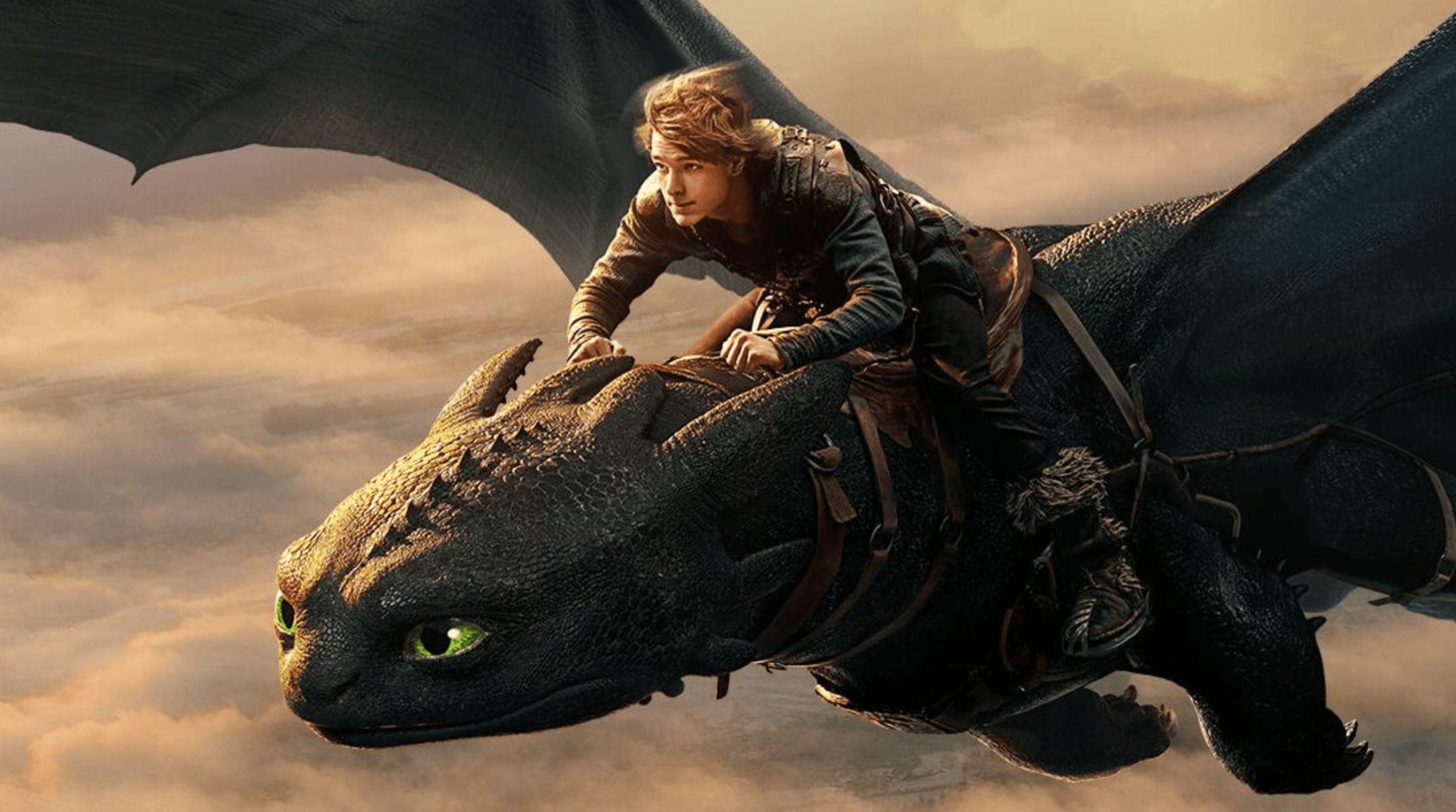
In addition to the performances and the subtle changes in the characters, what truly makes the film a triumph are the technical aspects, starting with the VFX of the photorealistic dragons. What they can accomplish in bringing every dragon species to life realistically is on par with the work and effects of bringing the dinosaurs to life in any Jurassic Park film. It’s genuinely astonishing work getting to see these animal-inspired versions of The Monstrous Nightmare, The Terrible Terrors, The Deadly Nadder, Gronckles, and The Hideous Zippleback. Perhaps the most impressive are the Red Death and, of course, Toothless. Unlike the expressionless, photo-real work in The Lion King, DeBlois brings photorealistic verisimilitude to his creatures, while also using their eyes as a means to convey genuine emotion. We know in the film when a dragon is happy, scared, angry, or upset, because of the way they’re able to emote. In other words, DeBlois smartly combines photorealistic aspects with exaggerated animated elements to ensure that we never sacrifice character for visual effects.
Without this, the movie wouldn’t work because Toothless would be ineffective. Thankfully, every moment with the wonderfully animated version of the character feels as heartfelt as it did in the original movie. The way they get you to fall in love with Toothless again is astonishing, and particularly impressive given how much I felt, even after viewing the original dozens of times in my life. This all stems from the smart decision to prioritize the expressive look in his eyes and on his face when bringing him to life. As such, Toothless looks great, is incredibly well animated, and comes to life seamlessly once more.

Of course, when speaking of the beauty of this movie, the VFX are only one aspect. I predict that there will be no way this film won’t receive an Oscar nomination for the incredible production design we’re seeing here. Every aspect of Berk is brought to life with vivid colors, that truly feel authentic to both the movie and to its Viking-era roots. The wooden and stone halls, the decor adorning every wall, the shields and their colorful designs, as well as the helmets and weaponry —all of it feels transportive and immersive, giving the film a grander and more epic feel than most younger-skewing fantasy titles.
The cinematography, courtesy of Matrix veteran Bill Pope, is also astonishing. Pope successfully conveys the sweeping sensation of gliding through the skies and shores around Berk, capturing the beauty of its lush mountains and the Northern Lights that surround it. Every flight scene, from the test drive sequence to the romantic flight scene, feels gloriously fun, truly making you feel like you’re atop a giant dragon, exploring the beauty of Berk below you. John Powell’s powerful score further enhances the experience. While most of it is adapted from the original films, Powell is still able to add more power to highlight the classic themes of the original, but make it feel more epic.
I would say the only real downside to recreating a classic animated movie in live-action is that it’s a recreation. While How to Train Your Dragon does this so brilliantly, it also strengthens the story and character emotions as a terrific rendition of a classic. However, those looking for something completely different won’t find it here. Many skeptics, as well as those of live-action remakes, may still take a look at this one and may ask what the point is. The cynical may still think “money” is the only reason, and to a degree, they would be right. They don’t do anything too new with the story, which may disappoint some.

That being said, though, sometimes taking a classic film and trying to tweak it for modern-day sensibilities when it doesn’t need tweaking could backfire. Take a look at a pleasant enough movie like Lilo & Stitch. Although well received, you can’t deny the backlash that occurred when both Jumba’s character and the original film’s ending were changed, which wasn’t warranted. How to Train Your Dragon successfully avoids all of this by retaining what made the classic so great, even though there was little to improve upon, while reinforcing emotion, relationships, and character.
Overall, that makes How to Train Your Dragon the blueprint for how to do a live-action adaptation. It meticulously translates the original film, presenting it more dramatically and emotionally without sacrificing any of the charm or heart of the original. It strengthens the timelessness of the original story. Like an excellent production of a classic play, the performances from the incredible actors and the execution of the material feel fresh, without compromising the original emotional impact of the script. With breathtaking visuals, production design, cinematography, and music, How to Train Your Dragon treats us to an astonishing, heartfelt, and epic cinematic experience that will keep hardcore fans and new fans alike incredibly excited for their next visit to Berk!
Rating: 9/10