

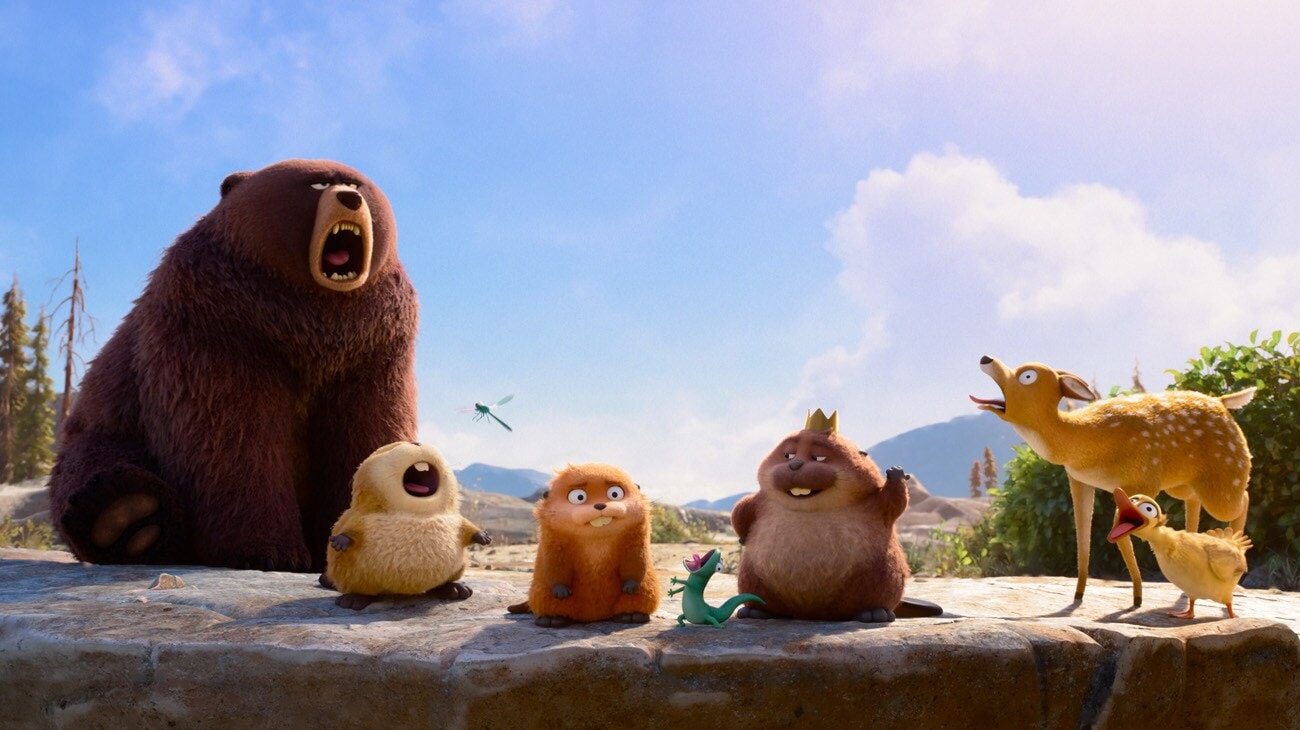
One simply cannot talk about the history of film without citing Pixar Animation Studios’ contributions to cinema. While many might dismiss that statement, Toy Story changed filmmaking forever, and brilliant, sophisticated films like Wall-E, Ratatouille, and Up proved that animated films could carry as much weight as live-action ones. In light of announcements for sequels to Coco, Toy Story, and The Incredibles, one may think the days of original Pixar masterpieces may be behind the company. However, once audiences see Hoppers, they’ll realize the studio has never been fresher and more relevant than ever.
While the word “masterpiece” has a tendency to be thrown around often as over-complimentary hyperbole, in the case of Hoppers, it is actually quite apt. Just as audiences were beginning to get a bit tired of the “buddy road-trip” template many Pixar films tend to take, director Daniel Chong (We Bare Bears) has granted us an unapologetically weird and unique Pixar feature that feels more mature, more kinetic, and more hilarious than the studio has been in years. It’s exactly what we need during an era defined by franchise filmmaking; a true original in every sense of the word!

From its very first scene, Hoppers establishes an incredibly different and flawed protagonist in Mabel Tanaka (Piper Curda). She’s angry, passionate, frustrated, and from those first moments, already incredibly relatable. Having grown up close to her grandmother and wanting to protect the glade that still connects them, Mabel battles the town’s mayor, Jerry, who plans to destroy the glade to build a freeway. Unable to beat Jerry as a human, she finds a way to infiltrate a program called “Hoppers” to “hop into” the body of a robot beaver, so she can convince the town’s keystone species to relocate back to the glade to stop construction.
I don’t believe any summary can adequately capture how insanely original and hilarious the premise for Hoppers is, and more than that, how very special and hopeful. At its core, this is a film that highlights themes of conservation and community, as well as empathy and the ability to look beyond humanity’s negative aspects to see the inherent good. Mabel’s anger and frustration throughout most of the film, whether from her failing to collect signatures for a petition or automatically writing off her mayor as a horrible person incapable of change, is so refreshingly relevant and relatable during the times we’re living in. In one scene, she shouts in exhaustion and futility how powerless and alone she feels, and we can’t help but feel that way too. One minute in a social media comments section is enough for us to get there.
Mabel, overall, is proof that Pixar still has what it takes to create characters that feel truly human, and here it’s incredibly genuine rather than forced. Every line Mabel delivers and every reaction she has, impulsive or otherwise, feels like something any audience member would do, or at least, understand the motivations and feelings behind it. And that, in many ways, separates her character and the film’s writing from more recent efforts like Elio or Elemental. For instance, one needs only look at the relationship between Ember and Wade in Elemental to see a more strained approach to character development and comedy. However, how the film progresses with her arc and character feels truly organic.

Which is another thing that elevates Hoppers; its biting sense of humor. The film is hysterical, with an almost Gary Larson-absurdist approach to its comedy and takes on the animal world. From little jabs and snippy responses to silly questions (“It’s an arrow, Ted”), to over-the-top sight gags, to morbid and almost pitch-black humour (both present in one shocking scene that had my audience literally gasping in astonishment, and another involving a nightmarish robot character), the humor feels a lot more mature and offbeat. It’s very likely due to the film’s skilled story artists and writers who benefited from an almost-improv approach to the comedy with various gag sessions held at the studio (something we got to witness firsthand). The result feels acerbic, natural, and adult, without ever going overboard or overpowering the story’s heart.
As with all Pixar productions, the voice performances by the cast are terrific. However, one has to single out three MVPs: Piper Curda, who plays Mabel; Bobby Moynihan, who plays King George; and Dave Franco, who gives an incredibly demented performance as Titus, the film’s villain. Curda infuses Mabel with pitch-perfect spunk and energy. She’s vulnerable when she needs to be, rages when it’s perfect, and injects so much enthusiasm into the role to make her incredibly lovable and sympathetic.

However, the most charming character in the film is Moynihan’s George. The character is the literal voice of reason: laid back, optimistic, and kind. Scenes between him and Mabel are always touching, with the character’s almost zen-like approach to community and life serving as the perfect foil for Mabel’s sympathetic anger. Moynihan’s boyish charm is what generates this wonderful optimism, and by the end of the film, you simply want to hug the cutie!
The animation and production design are vintage Pixar. Water effects in the glade and the super dam are gorgeous and authentic (huge credit to the influence from beaver expert Dr. Emily Fairfax, who consulted on the film). Effects such as flames and environments in the animal world are spectacularly detailed and realistic. However, Hoppers does something that mixes up the character design of typical Pixar protagonists with a look that is authentically Chong’s.
Influences from his character designs in We Bare Bears made it to the screen, particularly when the animal characters are being viewed by humans. It gives the movie a much more unique flair that separates the look from previous Pixar movies, which feels like a bold assurance that they’re looking to mix things up a bit more. The idea that these animals would look different depending on the points of view the audience sees the story from (the human POV vs the animal POV) was a sharp one, and the filmmakers even use it for both comedic and narrative purposes.

The biggest criticism I can give the movie is that some may find the film’s dynamic, chaotic energy a bit overbearing. I personally thought that the chaos never diminished the structure or tone of the film, which progresses logically, regardless of how outlandish many occurrences may seem. However, I can see those who are critical of Tex Avery-inspired energy finding themselves turned off from the film’s frenetic pacing. This is really due to the quick cuts and fast-paced editing, which enhance the comedy but channel the feel of a Dreamworks Animation film in some ways than what we’re traditionally used to from Pixar.
That said, for me, that’s a great thing! It’s the exact reason Hoppers feels like a fresh and unique entry to Pixar’s 30-year legacy. Because of this, it’s my pleasure to say Hoppers is an absolute hoot! A hysterical and incredibly clever charmer that feels fresh, original, and completely relevant right now! It’s pure Pixar punk rock, and the best original Pixar film since Soul! Make sure you hop over to theaters as soon as you can to see this absolute winner!
Rating: 9/10