

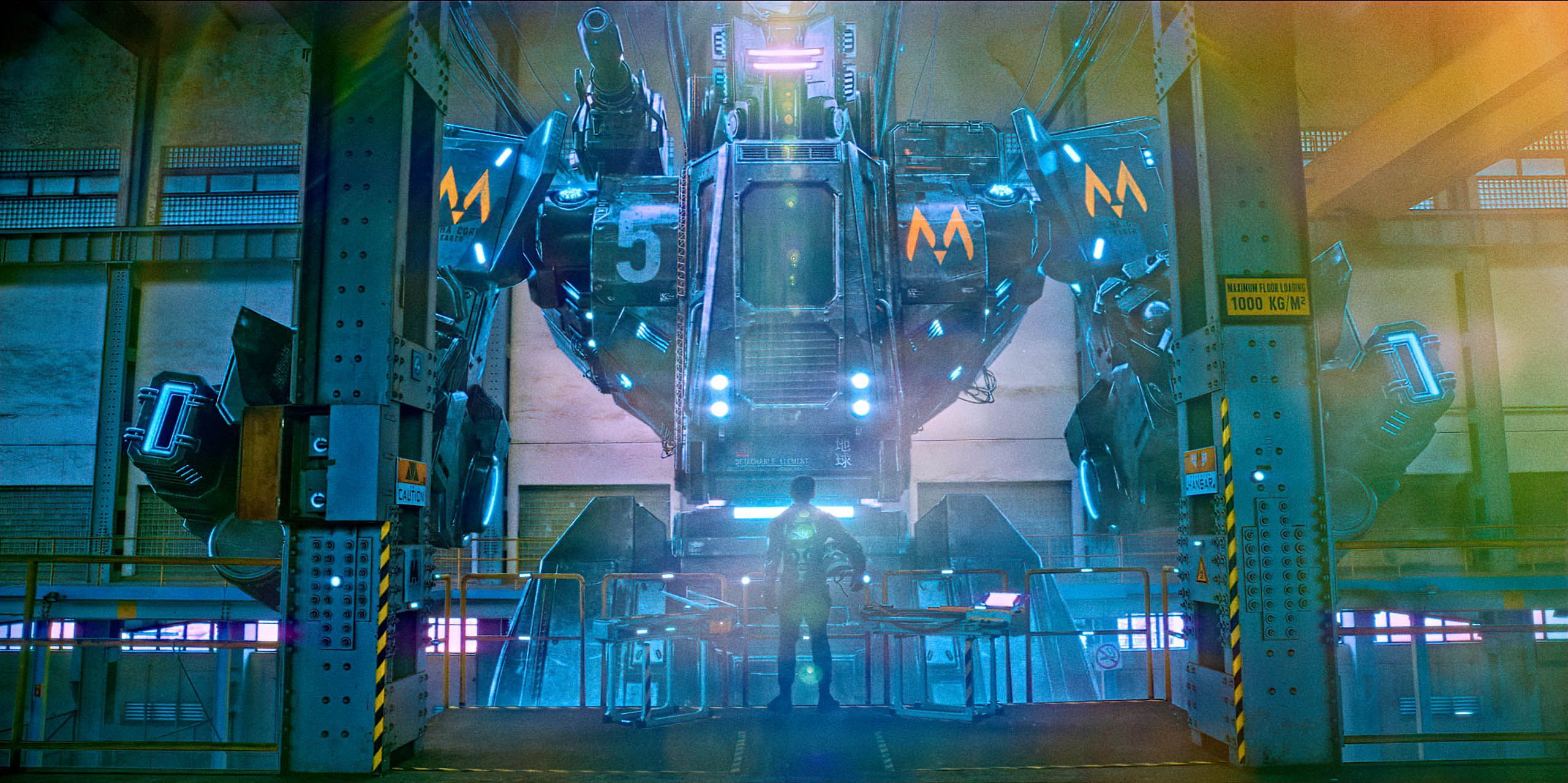
As a thought experiment, picture your favorite piece of art/entertainment within the mecha genre (Mobile Suit Gundam, Pacific Rim, Titanfall, etc.). Then imagine someone took your favorite mecha narrative, shorted its natural length to a 95-minute runtime, gutted all the characters to the point they become embarrassing caricatures instead of fleshed-out people, shoved in awkward humor that incredibly unfunny, and injected a slew of special effects and CG that are marginally better than ones featured in The Asylum’s Atlantic Rim. That’s the best, most detailed way I can describe Heavens: The Boy and His Robot.
Despite how I described this film, its opening scene was somewhat entertaining. Granted, the giant robots and spaceships that clashed against each other were indeed not great to look at, and the scene itself was filled to the brim with mecha anime cliches that fans of the genre are all too familiar with. However, looking past all these red flags, there’s something in my ancient reptilian brain that enjoys seeing giant sci-fi robots fight against giant spaceships or other giant robots. The first 5-10 minutes is essentially the cinematic equivalent of a child banging their action figures against each other, and the film maintains this tone and atmosphere. I would have been more willing to overlook many of Heaven’s glaring technical issues.
Unfortunately, once that opening sequence concludes and we’re stuck with the film’s irritating protagonist, Kai (Jonathan See), the rest of the movie becomes an incredibly dull, uninteresting, and repetitive experience that is neither fun to sit through nor bad enough to get anything out of it ironically. It’s incredibly obvious that director Rich Ho took inspiration from Shinji Ikari from Evangelion when modeling his protagonist, Kai. They’re both physically weak, mentally scarred protagonists whose parents abandoned them; they desperately yearn for some semblance of belonging and love from their leaders and fellow soldiers and have an unexplained psychic connection with their giant robots.

However, unlike Shinji, an incredibly well-written and human character with an entire anime series to flesh out his personality and motivation, Kai has much less time to grow as a character and is much more poorly written. His character is just, “I’m sad because my family left me to fight in the war, and I’m too scrawny and weak to become a competent soldier.” This is his only personality trait; he has no other interesting or unique aspects about himself. This is all he has to offer, and because of that, a lot of the dialogue stems from how weak/pathetic he is or how much he misses his mom/dad. Even his robot is uninteresting because the film clarifies that it is an extension of Kai’s personality, so several characters constantly question how it’s “the weakest robot they’ve ever seen.” Kai is not a character: he is a walking, talking caricature of an anime mecha protagonist.
Thankfully, Kai manages to break away from this “character development” plateau when he is predicted and inevitably thrust into the epic final action set piece. He also proves he is a strong and capable mecha soldier. However, by that point, I was so checked out that I was physically incapable of even remotely investing in the characters or the story. While the dumb, banging-action-figures-together action with the giant robots and spaceships was still somewhat entertaining to watch because I had zero emotional attachment to the film, my mind started wandering elsewhere at a certain point.
Ultimately, I couldn’t help but wonder why the director didn’t just make this an animated series in the first place for a movie that’s so obviously influenced by mecha anime. Not only would animation allow the big battle and special effects to be more palatable to the eyes, but an extended runtime would also help flesh out the characters (including the main character) and give them more room to breathe and naturally develop. An animated version of this same story would have done wonders, but as it is right now, it is nothing but a disappointment.
Rating: 2/10