

It’s hard to believe it’s been nine years since Mad Max: Fury Road was released. The film introduced a new generation to writer/director George Miller’s dusty, violent, vehicle-obsessed vision of post-apocalyptic Australia.
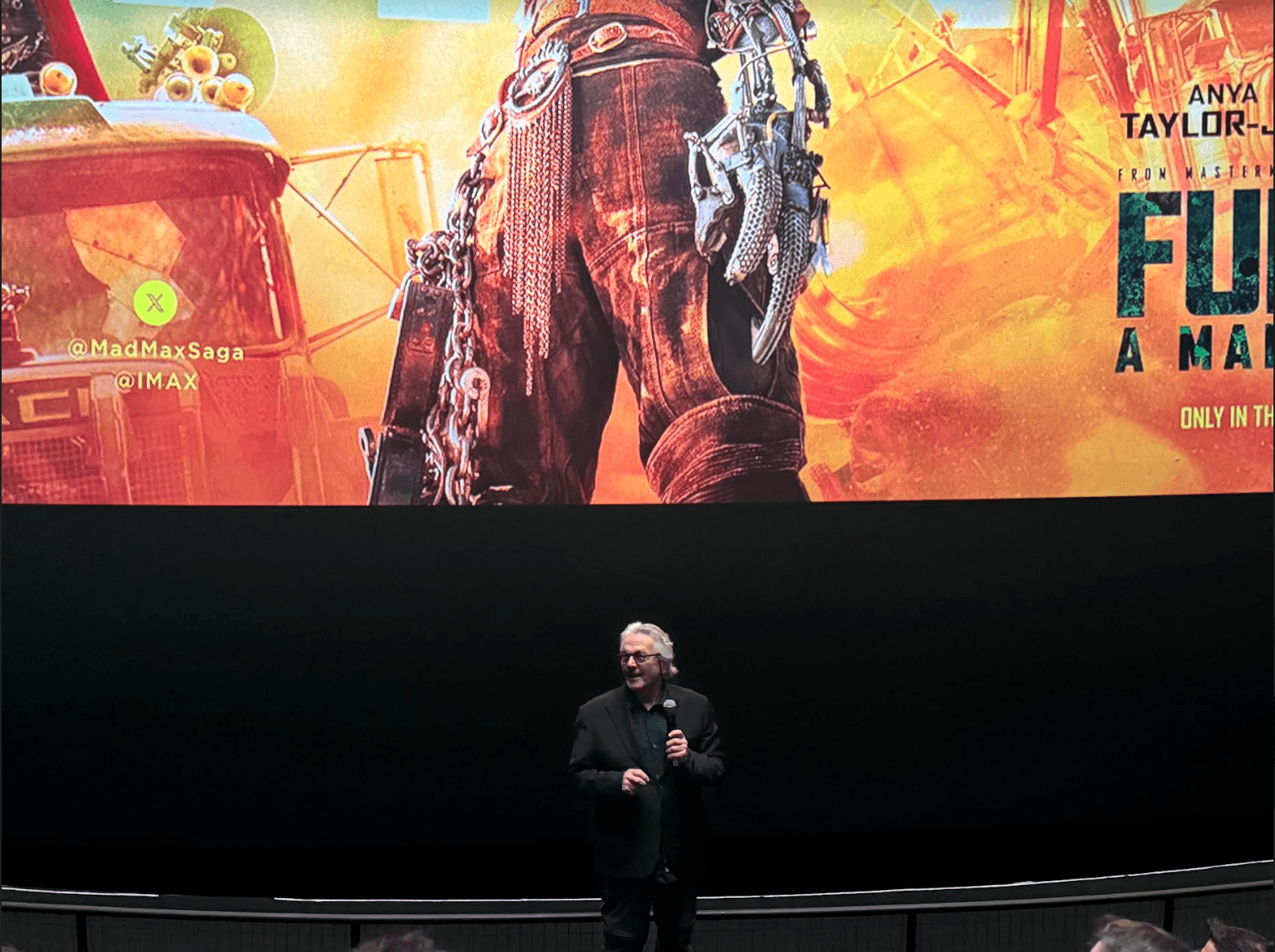
On Monday, I attended an advanced Furiosa: A Mad Max Saga screening at IMAX Headquarters in Los Angeles. Miller was in attendance and spoke to journalists. In a statement before the screening, the director shared that the film had only been completed two weeks prior and had yet to see the final cut.

The film is a prequel to Fury Road and explores the titular Furiosa’s journey from kidnapped girl to war-rig-driving Imperator. Miller wrote the Furiosa script before Fury Road even started filming to flesh out the world further and add cohesion to the filmmaking process.
“We wrote the screenplay for Fury Road, and realizing that’s a story that basically happens over three days and two nights…and all the exposition has to be done on the run, we wrote the story on Furiosa,” Miller said. “The actors, the designers and all the crew got the screenplay for (Furiosa) before we shot it. It’s the only way we could have done Fury Road; otherwise, it wouldn’t have been cohesive.”
Miller also said that in addition to helping expand the world’s lore and its characters’ backstories, making Furiosa allowed him to approach filmmaking with a different intent.

“That’s the (story) I most wanted to tell because it was different. The fact that (Furiosa) is a saga is a big contrast to something told in real-time sequences like the two big sequences in Fury Road are almost real-time,” Miller said. “So that’s a completely different filmmaking exercise, something told over 18 years.”
In fact, speaking of different filmmaking, Furiosa was initially planned to be an anime.
“We were thinking of making it as an anime, and that’s why it was fully developed, partly, but then Fury Road was once again delayed, and there was no point in making an anime,” Miller revealed. “We were going to do it with Mahiro Maeda. He started this illustration and he put a teddy bear, and that became part of the story. That was way back before Fury Road.”
Charlize Theron originally played Furiosa, though the mantle passed to Anya Taylor-Joy for the younger version of the character. When she initially read the Furiosa script, Theron was excited for another chance to play the role and even wanted to film Furiosa before Fury Road. Unfortunately, according to Miller, the changing ownership and multiple “regimes” of Warner Bros. stymied his attempts to make the film for about a decade.

“I thought we could still do it with Charlize, and then I saw these other movies like The Irishman where they made people look younger, and particularly I saw GeminiMan,” Miller said. “All I was looking at was the technology; I wasn’t looking at the performance. I thought, ‘We can’t do it.'”
While the current de-aging technology might be up to Miller’s standards, he is impressed by how far other production tools like cameras have improved in the decade since he made the last Mad Max film. In particular, he mentioned how using an Unreal Engine-based previsualization software called Proxi made planning and storyboarding his action sequences much more manageable.
“It really is a much faster and accurate way to previs than all the traditional treatments. We were able to map out every camera, every camera move,” Miller said. “There’s a lot of space to use; it’s just not linear. You could do that with storyboards, but it’s very hard to figure out how each shot flows into the mix. So that was a perfect tool to do it. Previs can be very painstaking; it’s a little like animation. And now the tools are getting way faster.”

Miller shared that when working on Fury Road, he and his team had a table with models and choreographed the action scenes by “literally playing like kids.”
“We had this massive table out in the middle of the desert with a big tent, and every single stuntman, every single camera, every War Boy, had a little model,” Miller said. “They’d say, ‘Okay, you move that way, and I moved this way, and the camera does this, and I get killed and fall off here.’ All of that had to be worked out shot for shot; every shot was rehearsed on a toy box. Now we’re able to do that digitally.”
While Fury Road was met with plenty of audience and critical acclaim, including six Oscar wins and nominations for Best Director and Best Picture, Miller said that success only impacted how he approached Furiosa other than allowing the film to get made in the first place.
“What drives how you make a film is always the story, and you’ve got to use the right tools to tell the story,” Miller said. “That’s the only catch.”

Prequels often have difficulty establishing stakes or giving audiences a reason to invest in their stories since, by their nature, we already know the fates of the characters. For Miller, telling the story of Furiosa’s early life is less about where she ends up than exploring a story of resilience and survival. He added that it’s the kind of story that’s “not uncommon” and one he can relate to, having parents who fled Europe for Australia to escape the horrors of World War I.
“You’ve got someone who’s taken as a child, who can no longer depend on others,” the director said. “She has to unevolve unpracticed inner resources to survive, and then go through all that hardship and trauma and so on, and still endure the Wasteland. We all have those in our histories, or we know people like that. It’s not about where they end up; it’s what happens and how that person is forged in those worlds.
“We’re interested in those sorts of stories. But that’s one of the functions of stories: to help us process the world and make meaning of the world around us. That’s why, regardless of what happens in Furiosa, for me it’s part of that process. I think that applies to all stories.”
As for what’s next for the world of Mad Max, Miller said that he has a script focused on Max’s travels a year before Fury Road takes place. Will that story see the light of day?
“If this does well,” Miller said with a laugh.