

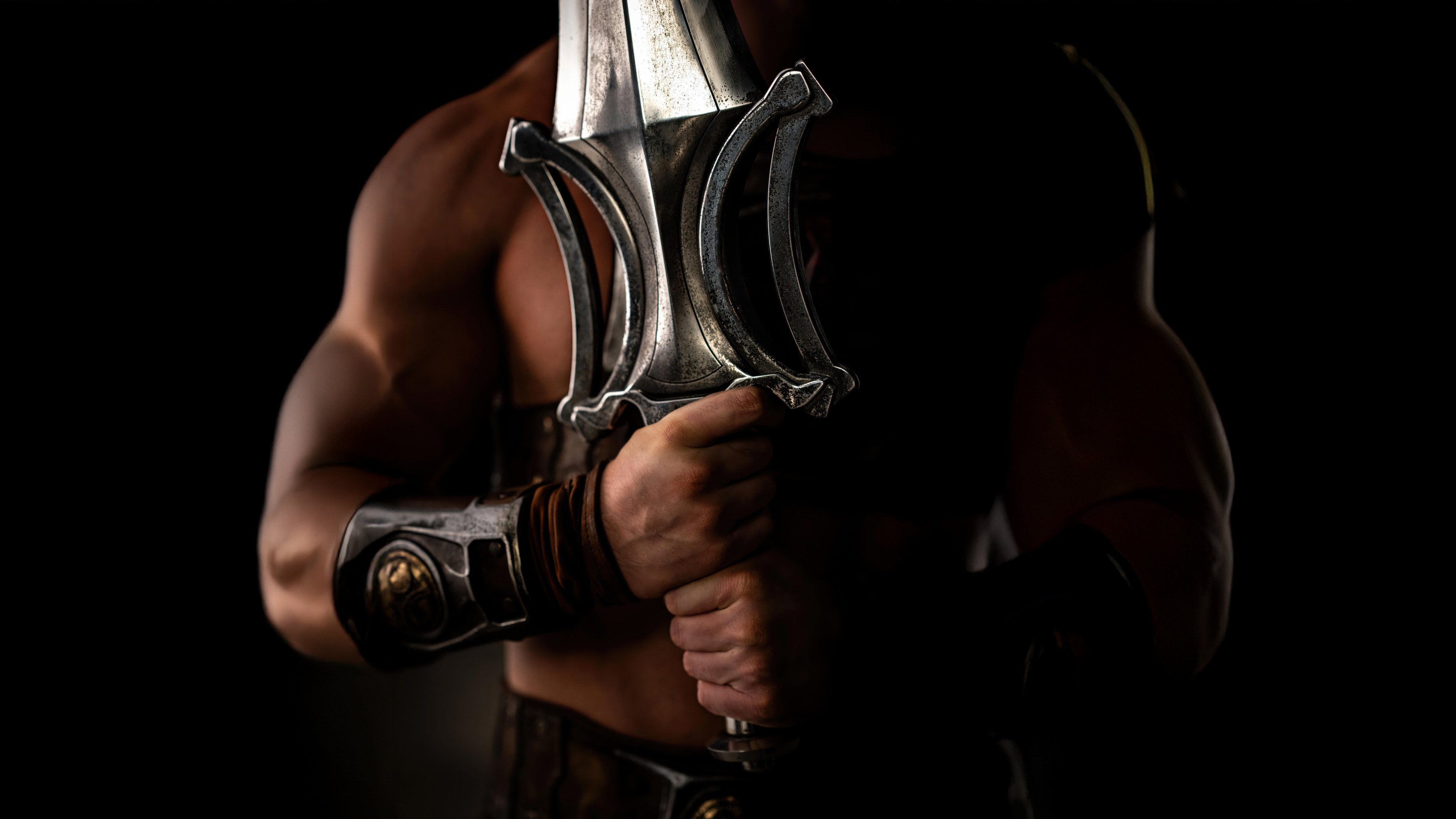
Geeks of Color attended the Amazon MGM Studios early press experience for Masters of the Universe in Las Vegas on April 15, 2026.
The Travis Knight Masters of the Universe roundtable lasted twenty minutes. He spent half of it telling me what he thinks it means to be a man.
I sat across from him in a Las Vegas hotel suite on April 15, in a small press roundtable hosted by Amazon MGM Studios for the early press experience of Masters of the Universe. Five other journalists in the room with Travis Knight: Mike Manalo from Nerds of Color, BJ Colangelo from Slashfilm, Alberto from Best Movie Italy, the press from Singapore and Brazil, and me. No notes from publicists about what to avoid. Just the director who is about to drop the most expensive love letter to the He-Man toy line ever filmed.
The room covered Knight’s parallel year (Wildwood drops this fall), the ’80s versus modern empathy frame underneath Adam’s arc, the math behind casting Nicholas Galitzine and Camila Mendes, what this story means to the kid who built it, why the 1987 film was never his He-Man, the Trapjaw transformation built off his Bumblebee approach, and how much of the movie actually takes place on Earth. No spoilers. No film verdict. Just Travis Knight on Masters of the Universe, in his own words, on what the movie is trying to do.
What stuck with me was not the action talk. It was Knight talking about the through-line between Adam and Duncan. Two men, two eras, two ideas of strength. I had already been on the set in London a year earlier and watched them film a scene that pushes that conversation into the light. So when I got the room, I asked him about that scene.
Check out the full Q&A below!

Travis Knight Discusses what Masters of the Universe means to him
What does Masters of the Universe mean to you?
Travis Knight: It’s a huge part of my childhood. I distinctly remember when I was first exposed to it, and it was so different than anything I’d ever seen before. Every right-thinking person was a Star Wars fan at that time, so that was my big introduction to sci-fi, blending sci-fi and fantasy. Masters of the Universe was that, but it was kind of weird, psychedelic, strange, and playful. It just felt like it shouldn’t exist. It felt like someone took a bunch of ideas, threw them in a blender, and spewed it out. I was delighted by all of it. I had the toys. I read the little mini-comics when the cartoon came out the next year. I loved the cartoon. I remember rushing home after school and watching the He-Man/She-Ra Power Hour. The greatest kid Christmas gift I ever received was the Castle Grayskull play set. That was my Red Ryder BB gun. I’ve been in a steady administrative decline since. That was the peak.
It’s a funny thing about toys, a child’s plaything. People mock that stuff. It’s just a little plastic. And it is, of course. But you see with my own kids, and I certainly experienced it as a kid, that toys are essentially vessels for our ideas, our imagination. We pour a lot of ourselves into them. They become extensions of us. Anything that’s deeply loved becomes a part of us. That’s how I felt about Transformers when I was a kid, and that’s how I felt about Masters of the Universe. I’ve been trying to carry that with me my whole life.
Geeks of Color:How does it feel now that you’ve made this movie to know that there’s going to be a kid whose best present is going to be the version of this Castle Grayskull?
Travis Knight: Oh, don’t put that in my head. I haven’t really thought about that, but I’d be honored if that’s the case for anybody. Ultimately, that’s why we do what we do. We do these things for connection. I remember when I was a kid, the movie that meant most to me was E.T., and I saw it with my mom in a cinema. I was about eight years old, and it was the first movie that moved me to tears. It felt like somebody had ripped out my insides and put it on screen. Like somebody knew exactly how I felt. Steven Spielberg was nothing like me. We were thirty years apart. But he understood an aspect, and he dived deep and pulled things out. It was essentially a portrait of childhood loneliness, and it deeply connected with me. I was moved by it, and I carried that with me.
When we tell stories, that’s ultimately what I’m trying to do. I’m trying to forge an emotional connection with the audience. There is a kind of sacred contract between the director and the audience. The idea is that if you give me your time, if you give me your attention, I will give you something. The main things I want to evoke in everything I do are wonder, laughter, and tears. I want people to have incredible spectacle. I want people to have a good time, and then I want it to mean something. I want them to be moved by it. The notion that maybe this movie could be that for some kid somewhere, that would be extraordinary for me.

The Masters of the Universe director on ’80s masculinity and Adam vs. Duncan
Press:You are a master storyteller, one of the most understated and underrated working today. We’re fortunate enough this year to have not one but two Travis Knight movies coming out. How do you approach two incredibly different movies and put your whole heart into both of them at the same time?
Travis Knight: It’s tricky. It’s not something I recommend. Each one of these is a full-time job, and they require every ounce of your attention. I’ve been working on this movie for about two and a half years, and it’s been an absolute joy. I’ve been working on Wildwood for sixteen years. Stop motion is its own kind of glacial torture, and it requires extraordinary discipline. Over that period of time, things can shift dramatically. You have to know at the core what the emotional epicenter of the story is and hold on to that, because it’s very easy for these things to drift over time.
With Wildwood, I read that book seventeen years ago, when it wasn’t finished being written yet. I adored it. I knew at the time, we could not do the book justice. So over time, we just built up the creative tools and the technology to do justice to that story. We’re going to finally see if we did it when it comes out this fall. With Masters, I don’t have that kind of history with the actual production, but it has been a part of my life for most of my life. These are two things I care very deeply about. They’re very different from one another, but if you squint, you can see they share the same DNA.
Press: I loved what you were saying about the landscape of masculinity in the ’80s. Unfortunately, I think we’re at a crux moment right now, where we’re starting to see that cycle repeat in a new, insidious way through mass-fear grifters. What sort of messaging are you hoping contemporary audiences who may not have grown up with He-Man in the ’80s will take away from your Masters of the Universe?
Travis Knight: It felt like an opportunity to have a conversation about a topic, not in a way that felt like preaching to people, but in a way that was thoughtful and sensitive and empathetic. To talk about a subject we don’t talk about a lot in movies, which is masculinity. There are great aspects of that, and there are terrible aspects. Growing up in a very different era, I saw a lot of the latter. I was very different than a lot of my peers. I was an odd kid. I was a sensitive kid. I was an artistic kid. The normal recessions that boys my age had, I just didn’t share. The things I valued were not valued by my peers, or my gym teacher, or anybody else for that matter. But you still soak in all of this stuff.
Things are very different now. Although you’re right, there are dark storm clouds that threaten taking us into a place I don’t think is particularly healthy. But at the very least, to be able to have that conversation, to say, what does it mean to be a man? What are the good aspects? What are the aspects we wish we could improve? That’s really Adam’s story. Eternia for me essentially represents ’80s masculinity. This high-bound culture where power and strength and emotional discipline rule that society, and he doesn’t quite fit in that world. He grows up in modern America, which has a very different form of masculine. More about empathy and understanding and communication. How do those things smash into each other, and what happens when they do? You see that in his relationship with his father. You see that in his relationship with Duncan, who is a well-meaning man but a man from the earlier era, and he has very strong opinions about what that means. I love seeing these two guys fight that out. I try to approach each one of those perspectives with empathy. See this guy’s got a point, but also he doesn’t have a point. See how they play when they get together.
Geeks of Color: I was on set, and you actually textually get into that. There was a scene with Duncan and Adam together having that conversation. Could you talk about why it was so important to really hammer that home with their relationship?
Travis Knight: I didn’t want to paint either side of that discussion with a broad brush. I wanted to make sure we approach each, say, okay, why do you think this? Why do you feel this? And then what could you learn? It’s only through those guys who have very different points of view on how men should behave that we see they teach each other something. They learn from each other, and they both are better because of it.
I don’t want to be so boxy, but I do wish that as a culture we could do more of that, where we can engage with people in a thoughtful and sensitive and empathetic way, try to see where they’re coming from, try to find common ground. We don’t really live in a time where that’s happening to my satisfaction. The hope is that through telling stories like this, maybe people could think about it in a way that helps them.

Casting Galitzine, Mendes, and building the Masters of the Universe cast like a band
Press: How did you go through the process for Camila, and how did you pick Nick? Did you see them in a movie?
Travis Knight: Casting is probably the most critical decision you’re going to make, because these are the people who have to embody these characters and grow this story you’re trying to tell. With this movie, it was going to be challenging because I’m asking a lot of my actors. For both Nick and Cami, they need to be action heroes. They need to be able to be funny. And they need to have a tapped-in resource of emotion, because to me, the story doesn’t work if it doesn’t have a heart. Both of them could do all three of those things. Nick was the first person I hired, and he was the most critical person to get right. From the moment I met him, I thought, this is the most charming guy I’ve ever met.
The obvious thing is, oh, you’re a movie about He-Man, you’ve got to find some guy who’s jacked. Rippling pectorals and six-pack abs and giant cannon arms. To me, that wasn’t really the point of any of it. I needed to find a body. I needed to find a soul. I needed to find someone who could take the spirit of who this character was and bring it to life in a believable way on screen. With Nick, when I worked with him, we did some scene work together, and I saw he can do absolutely anything. When people see this movie, whether they know him or whether they’re being introduced to him for the first time, they’ll be astonished at the range of things that he can do. It’s really exceptional.
But he did not look like He-Man. So we had to ask, okay, could you possibly be someone who’s the most powerful man on Earth? To his great credit, he did it the hard way. He didn’t go on gear. He didn’t go on steroids like some of these cats do. Mum’s the word. He did the hard work of actually transforming his body over that period of time. I saw him on set one day. He was training on set, and I hadn’t seen him for months. When I saw him, he was like, guy. He looked like a different person. It was astonishing how seriously he took it.
With Cami, it was the same thing. Just finding someone who could embody the character in the right way, who could possibly be an action hero, which is something she’d never done. She embraced it wholeheartedly. She did all the training, the choreography, the wire work. She also transformed her body. She got jacked for this film. And yet they have such incredible chemistry. She’s so charming. She’s so funny. And she’s got a really tender heart underneath it all, which to me was the most important thing to get right in those two. They’re both people who don’t really fit in for a variety of reasons. For Teela, it’s because she’s a woman in a man’s world. For Adam, he’s a sensitive kid who doesn’t share the same values with the world he grows up in. They both have a deep empathy underneath. That ultimately is their superpower. They can find ways to connect with people who are different than they are.
Once I found them, I could build the rest of the cast around them. It’s a little bit like building a band or an orchestra. Each one of these instruments has to sing in a different key. You need your bass player. You need your lead guitarist. You need your rhythm guitarist. You need your frontman. You need to find all these different flavors that commingle in a harmonious way. Ultimately, I think we got there, and I could not be more proud of this cast.
Press: For a while, Noah Centineo was cast to play He-Man. When you arrived on the project, was there nobody involved? Was it a fresh start for you?
Travis Knight: Yeah. People have been trying to make the Masters of the Universe movie for eighteen years, I think. This movie is old enough to vote. It’s had a long gestation period. When I came aboard, there was nobody attached to it. They’d had so many people attached to it over those years. Screenwriters and directors and various actors. When I came, there was a script that existed written by Aaron and Adam Nee and David Callaham. It was really fun, and we held on to a bunch of that stuff that I felt was consistent with the story we wanted to tell. But ultimately, I needed to be able to shape the movie in a way that was consistent with the emotional story I wanted to tell. That’s when I brought on my creative partner, Chris Butler, who I worked with at LAIKA.
As a kid, what disappointed me about that [1987] movie was that it was not my He-Man. That was not the thing I loved. It’s an incredibly entertaining film, and I have a lot of affection for it. But there was not a blueprint to adopt or avoid for me as far as that was concerned. I always go back to the source. For me, it was the toys, the comics, the cartoon. That was where I fell in love with it. I wanted to honor what was unique and distinctive about it, and also dig into that stuff and find what could naturally be drawn out of it. An emotional story we could tell, a thematic story that had resonance in our modern world. I think we’ve done that.

Travis Knight on Trapjaw, the Masters of the Universe villains, and Eternia vs. Earth
Geeks of Color: You mentioned earlier where we find Adam in America. Can you just talk about the balance, how much time is spent on Earth versus Eternia and the other places we go in this world?
Travis Knight: Very, very little time is actually spent on Earth. It’s an important grounding for us, and there’s a reason why we did it, but you’ll see when you watch the movie. There’s a lot of virtue that comes out of him being a part-Earthling, because that is part of his ancestry. His mother is from Earth. It allowed us to do certain things that pay off down the road. In terms of percentages, I don’t know. 15% of the movie takes place on Earth. Really. Well, 17 and a half.
Press: Finding the tone for your villains. The villains in this world have been portrayed in various ways. Watching this, it really felt like, “Oh yeah, you nailed that.” Just enough sinister and just enough silliness. Could you talk me through that?
Travis Knight: Yeah, it all goes down to tone. It comes down to the critical story you’re trying to tell and then how you tell it. It’s a balance of those things. It’s cheekiness. It’s reverence. It’s fun. It’s playful. That to me is part of the DNA of Masters of the Universe. It was always that. It was never super serious. And yet we take it very seriously. We do love these characters. We believe in the world. We want to have fun with it, but we are telling an emotional story that does have stakes. It’s trying to find a way to balance those things.
These characters are very over-the-top. They do ridiculous things. They have ridiculous names. So a lot of it was trying to find reasons for those things, which you’ll see when you watch the movie. But it was also just trying to honor those characters in a way that felt like the Masters of the Universe we loved as kids, but that also makes sense in this world. We make adjustments along the way. But Triclops feels like Triclops. Trapjaw feels like Trapjaw. Skeletor feels like Skeletor. It’s our own version within this modernized cinematic take on the material. At its core, we always go back to the source material to find out what made it special to begin with.
Geeks of Color: Bumblebee is still my favorite Transformers movie. When I was looking at Trapjaw, just the fluidity of how he switched from his weapon, did you take any info from your work on Bumblebee?
Travis Knight: I’m not gonna lie. When I had conversations with my designers about the transformation of Trapjaw’s arm, the Swiss army thing, there was a way to do it that felt like nanotech. There was no f—ing way I was going to do nanotech. It was going to be a physical thing that actually transforms like they do in the Transformers movies. I definitely pointed to how these things need to go tactical and practical, just like the approach I took on the Transformers film. We got to a place where I’m really happy. It feels like it’s made out of oil and grease, it moves in a funky way, and it’s nasty. You do not want to get cut with that thing. In the Venn diagram, there’s an overlap.
Masters of the Universe release date: where and when to watch
Masters of the Universe hits theaters on June 5, 2026, from Amazon MGM Studios.
Nicholas Galitzine stars as Prince Adam / He-Man, with Camila Mendes as Teela, Idris Elba as Duncan / Man-at-Arms, Jared Leto as Skeletor, Morena Baccarin as the Sorceress, Alison Brie, James Purefoy, Jóhannes Haukur Jóhannesson as Fisto, Jon Xue Zhang as Ram-Man, James Wilkinson as Mekanek, Charlotte Riley, and Kristen Wiig as the voice of Roboto. Travis Knight directs from a screenplay by Chris Butler, Aaron Nee, Adam Nee, and Dave Callaham, based on the Mattel property.
GoC’s Masters of the Universe coverage continues with our set visit to Elstree Studios.
Masters of the Universe is in theaters on June 5, 2026.