

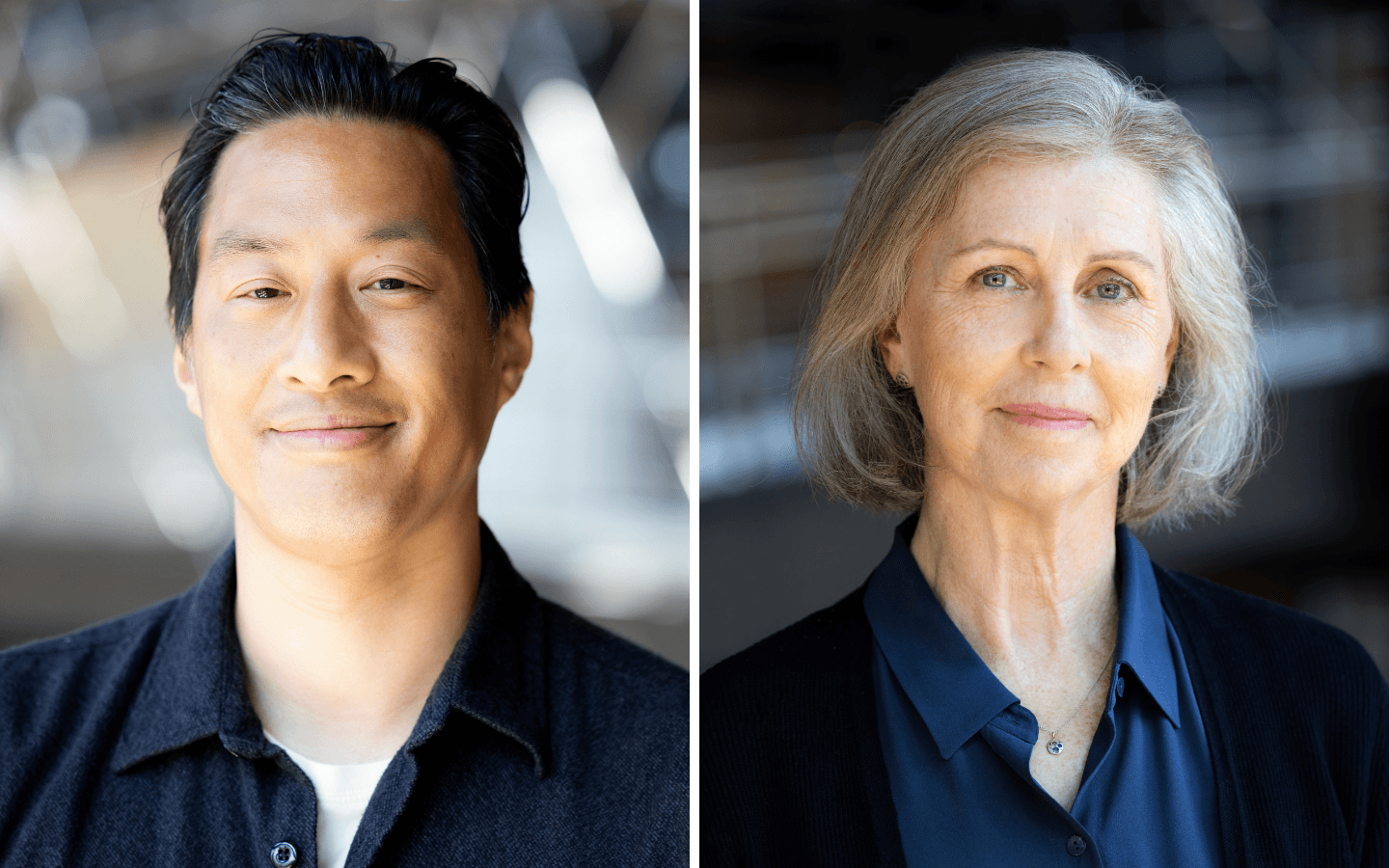
Yesterday, we took you into our press day coverage for Pixar’s Hoppers. As we spent the day at Pixar Animation Studios, meeting the crew behind their newest classic, members of the press were also able to spend some time chatting with director Daniel Chong and producer Nicole Grindle to ask questions about their new film, and the process of bringing it to life.
We were lucky to attend the conference, so let’s dive in to see what they had to say about the new movie, hitting theaters on March 6!

Chong spent the early days of his career at Disney Animation, before moving on to Pixar, then leaving to create his hit Cartoon Network series, We Bare Bears. As a former Pixar alum, he was invited back by Pete Docter to create his own film for the studio. Six years after that return, we are now seeing Chong and his team’s amazing work finally hitting the screen.
In contrast, Grindle has spent the past two decades at Pixar cultivating and helping to craft some of the most legendary films of all time, from A Bug’s Life and Monsters Inc., to Ratatouille and the Incredibles series. Together, she and Chong formed a dream team of epic proportions, crafting together a film with Hoppers that truly feels ridiculously different from anything the Emeryville-based studio has ever completed. As such, members of the press, who were lucky enough to see the film in its entirety, were eager to dive into the origins of the story, and the process of bringing it to life at last.
For Daniel, you alluded that your initial pitch was penguins. And I’m curious how different is the story that you told in Hoppers from what you had originally conceived involving penguins?
Chong: Yeah. It’s a great question. And yeah, it’s a very involved story, but it was very, very different. I mean, the whole idea there was that penguins were disappearing. And they went to the Arctic to find out what was going on. And so, they hopped into penguin bodies to infiltrate penguin society. Part of the joke to me was the joke of there’s so many penguins and you’re looking for, like, suspects and clues, so there was a bit of a mystery element to it. And then you found out that the penguins had some secret plan, you know, to get revenge because humans were destroying their habitats…So yeah. But it was dead not because of that. It was dead because too many penguin movies. So yeah. I don’t know.
Grindle: Also, it was international. At some point we’re like, “Okay. We got to bring this in a little bit.”
Chong: Yeah. Actually, the interesting story about that was, we originally had it as a globetrotting movie. Because, you know, we looked at, like, Mission: Impossible and spy thrillers like that. And I remember we were very lucky during the pandemic, we got to work with Damon Lindelof from Lost. And he did a session with me just hanging out, and I pitched him the movie. And that was the one thing that he was very adamant about. It’s like, “The movie’s too big. Just make it a local area that, you know?” He was right because it really simplified [things], and made the movie more manageable to write. So yeah.
Grindle: And I think more interesting and impactful, honestly. It got more specific. You were able to do more deep dives into the characters.

If you could hop into any animal, what would you want to be?
Grindle: I’d want to hop into my dog…or into a dog, so I could talk to my dog.
Chong: Yeah. That’s great. During the production of the movie, we had two cats that live with us indoors, but a mom cat dropped off three kittens at our front door and they just never left, and we started feeding them. So I guess they kinda belong to us now. But, I don’t know, they disappear, though, into the neighborhood. And then they come back for meals. And I always wonder, like, what are you guys doing? Where are you going? Some of the neighbors say, like, “Oh, yeah, I saw the gray one. It was over there.” But yeah, I’d be interested to hop into a cat and find out, what’s up with those guys? Where are they going? What are they doing? What are they up to?
Grindle: I don’t think I’d want to hop into a predator, though. That’s the thing I’m realizing. I was just reflecting here, you know? I don’t think I want to know about that. That’s why the beavers are so appealing, right? They’re just nice, sweet, peaceful vegetarians.
Was this the last film that actor Isiah Whitlock Jr. worked on? And can you just speak to what it was like working with him on this film?
Grindle: Sure. I mean, it was great. He worked with Pixar a couple times before, so people here knew him. I remember, like, saying something about, like, “Yeah, we’ll come back to you. You’ve done such a great job. Obviously we want you in another film.” We worked with him in person the first time, and then we did pickups via Zoom the second time. So, you know, it’s a relatively small role. He knocked it out of the park, basically, the first time we recorded with him. And I think it was the, “flap around and find out” line.
Chong: He loved that line.
Grindle: But that’s the one we went to pick up. Because I think it was something later that we figured out to do. And yes, he loved it. It was fun. So it was wonderful working with him, and we were definitely really brokenhearted. I was shocked, actually, to hear that he had passed.
Chong: Very lowkey guy. I remember he came in with a little cap on. And just very quiet. But once he got behind the mic, and there’s a lot of actors like this…he came in and he came to life once he was on the microphone. Or once he was acting. And yeah, he was just a really lovely guy. So yeah, we’re really happy that he’s in the movie. I don’t know if we’re the last role. I mean, I think it’s been reported that this is his last movie, at least. So it’s an honor for sure.
Grindle: Definitely.
In one of the other sessions, it was mentioned that the Oakland Zoo was one of the field trips. What role did that play and what you guys were researching while you were there?
Grindle: Well, they have bears. That was a great trip. They have three bears that were, I think, abandoned when they were cubs. And so they were adopted into the zoo when they were cubs. These three siblings. And they’ve grown up there. So they’re now enormous. But they’re really habituated to being there and around humans. And I don’t know. They just are super comfortable. The way the enclosures work there, they’re these big glass windows so you can see them really close. So on our visit, they cleared them out, and they let us go in and put in food and other kinds of [things].

Chong: It’s like a game.
Grindle: Like little puzzles.
Chong: They had these pipes, but the bears would have to twist it. It’s like a Bop-It. They had to, twist it and turn it so that food would come out. Because they’re teaching them how to scavenge.
Grindle: And I think it’s stimulating…Right? It’s something that is fun for them. So we went in and we put all those things in, and then you know, we got out and they let them in, and we got to watch them finding them. And it was so great. And people were doing all kinds of sketching. And, you know, it makes you want to make another film that centers on Ellen. Right? Because they’re just so charming. ‘Cause they’re so big, and yet they felt like little cubs. They were so playful with one another. So that was a big thing about the Oakland Zoo.
Chong: I don’t think I should do another project with a bear in it.
Grindle: No? Fair. Fair. I understand why you chose bears, though.
How did you guys strike the tone of what was comedy-appropriate for a movie like this that also had the jokes per minute like nothing that Pixar has seen before?
Chong: Oh, thank you. That’s very nice of you. I mean, the reality of that is that we’re really in the room. Like you, guys were at the gag session. I mean, we’re laughing at our own jokes, you know? And we’re just trying to make each other laugh. And that really is the only thing we’re striving for when we start. We’re not thinking of, like, “oh, will a kid understand this? Is this funny to an adult?” We’re just expressing our sense of humor and our sensibilities and putting it on the screen. Surely when we do audience previews, you start to gauge, “is there enough here for a child to connect with? Is there enough here for an adult to connect with?” And I think that will help modulate, “Do we need more? Do we need less? Or do we need to tweak?”
But I would say, and very much like my TV show, we’re just chasing, like, our own sense of humor, and, you know, what will be fun for us. I will say that the kind of comedy in this movie, I mean, I can’t step outside of myself and go like, you know, I could’ve done it any other way. It’s my sense of humor. But it definitely did strike a lot of early audiences when we screened it. They were like, “is that a Pixar movie? Is that, you know, something that feels like it fits in the Pixar canon? Or does it feel like something that they would expect from Pixar?
And I think some people were a little taken aback by the movie. Like, that was so different. But I think, like, over time, I think as we finessed it, and as the characters got stronger and better, I think people just started to embrace it, the difference, and that it could be something that can exist in this movie. And I will say the biggest buyoff we got was that people like Pete Docter, Lee Unkrich, Andrew Stanton, the first time they saw the movie, they immediately loved it. They knew it felt like a movie that would exist here. And they are the people who built the foundation of the tone here. So I would say as long as they felt like it fits here, I think that that’s probably it. You know, we’re probably okay. And so I think that’s how we navigated that.
So, a recurring question that I see pop up in comment sections for the trailer of this film is, “Isn’t this Avatar?” So in the film, I cracked up when you actually made a reference to some similarities between the initial concept and Avatar. At what point during production did that line enter the film, and do you plan on sharing any piece of that in the marketing before the film release?
Chong: I mean, I think in a funny way, when I pitched the
movie, I would say, like, “Oh, Mabel Avatars into the
beaver.” So we would use it almost like a verb, you know,
just as a shorthand. But I think it wasn’t till our second screening
when we just started thinking, like, “oh, maybe we should
just embrace it. Embrace the reference.” Because I think in
some ways, I mean, for some people, it might rub them the wrong
way and it, you know, it becomes a little too meta. But for me, it creates a nice baseline for people that they can, like, kinda go, “Oh, okay, I know what that is.” Because, like how the joke continues, “This is nothing like Avatar.”
That also, to me, is part of the equation. Because I think when people, and I hope you guys agree when you watch the movie, it also isn’t like Avatar at all. You know, it’s a jumping-off point. It always got a laugh, you know, when we did screenings, so I think essentially we’re like, okay, I think it’s working fine. And so I think when we started to embrace it. It started to become a nice in for people on how they could understand what this concept was. Because, you know, especially right now where it’s so hard to cut through an original movie, it’s nice to have these shorthands,to be able to help people understand what you’re going for. And then obviously find ways to subvert it and do something very different.
Grindle: Yeah. And I would say right out of the gate, we knew we wanted to use it in marketing. You know, exactly to combat what you’re saying. You know, people’s perception that it was a rip-off. And in fact, I don’t know if anyone listens to The Town? Matt Belloni, he was interviewing James Cameron and he said, “Well, you know, Pixar ripped off Avatar.” It made me so mad listening to it. Like, “We did not.” And we owned that it nothing like Avatar. Please, Matt Belloni!
Chong: It’s funny that we thought that we would get ahead of it because it’s in the movie. But people are still like in the comments going like, “It’s like Avatar.” I know. It’s like, “I know. We said it.” Okay. We shouldn’t read comments.
Grindle: No, we shouldn’t. But the best thing about that is that everybody’s talking about it. And I mean, that’s what we’re trying to do. We’re trying to punch through so people recognize that this movie exists. So as it turns out, this has been a great conversation point. So it’s kinda worked out.
We noticed in one of the slides that “the Avatar” line had
to be redone, like, 80 plus times. Just wondering, curious, as to why, so many times and variations?

Chong: I think it’s not a commentary, or it’s not a criticism of Piper at all. She is amazing, and to me she did 84 very different kinds of reads. To me it speaks to how anal I am about comedy. And how a little inch of a shift can make something, like, 10 percent funnier. And that’s how I think protective and specific I am when it comes to the comedy. And it means a lot to me, and I think timing every frame, every, like, read, inflection, matters. And there are so many ways you can say, “This is like Avatar.” But what is the most unexpected way to say that line? I think really, one of the ways that we would always chase those, it’s got to feel natural and thrown away. That’s when it becomes the funniest, because it doesn’t feel performed. And sometimes it just takes a lot of takes to really get those natural, thrown-away performances that feel natural. So Piper was always game.
When we got to our third or fourth record and that line showed up again, you could tell, like, she wasn’t mad about it, but you could tell she was like, “Oh. So, wasn’t good enough, eh?” But I think all the actors, they know how it works. And that these things are very iterative. And I will say, here’s another interesting part of the process, is that sometimes because the story changes a lot and scenes change a lot, and I would even say for that Avatar line, the gags, or the leadup to it might have changed over time. And maybe that means that that inflexion now is wrong. We got to do it again, because now the setup is this. So all these little variables can require that kind of work. But yeah, that’s why.
When you watch the movie now knowing how long it’s kind of taken you to get to this point, is there a part of the process or aspect of the film that you feel most proud of?
Grindle: Wow. I think I’m just so proud of how people are responding to it, I think. That all our intention seems to be carrying through. The way we were trying to honor young people who care so deeply. The way we want people to love beavers. The way we want people to fall in love with nature. The comedy. I mean, the comedy’s so much a part of it. So, you know, maybe it’s too soon for me to say, ’cause we just, you know, finished it. But I think it’s always just a great relief when you finish a film and it seems that people are getting it. They’re getting that you intended. I think that’s true of any art form.
Chong: There’s a thing that happens at Pixar because everyone sees the movie so many times here. You know, a lot of people actually see every screening, you know? It’s like, maybe see it eight, nine times throughout the course of the six years. And inevitably, what happens is when the movie’s over, they’ll be like, “Oh, that was so much funnier in storyboards.” Or they’ll say like, “Oh, when it was this old way, it was so much better.” Roll your eyes at that. But the reality of it is, when the movie goes from, like, storyboards into animation, and even when you go from a scratch dialogue to the actual actor, it shifts. It changes. It feels different. And invariably, some people will be like, “Oh, I liked it before when it was this way.”
And then they have all these nostalgic feelings and, you know, remorse about like where the movie is now. But I can say very proudly that when we showed it, we had a wrap party, like, a couple months ago with the whole studio and they all got to watch it, all of them said the movie stayed at the same level from when we loved it from the beginning. And I’m not saying that to take credit myself. I say that that’s something that I think the whole team was very adamant. Like, we’ve got to protect certain senses of humor. In animation, we got to make sure that, you know, it’s funny when it’s a drawing. How do we capture that in animation, but bring it to life?
And I think everyone had their eye on the ball to just make sure that they didn’t lose the spontaneity, you know, that you guys saw in the gag session. You want that energy in the movie. You don’t want it to become, like, sanded down. And I think, I guess, maybe I don’t want to speak, you know, like as if it’s success, but I think enough people have come up to me from the studio that I felt that. And, I think, that made me very proud. So yeah.