

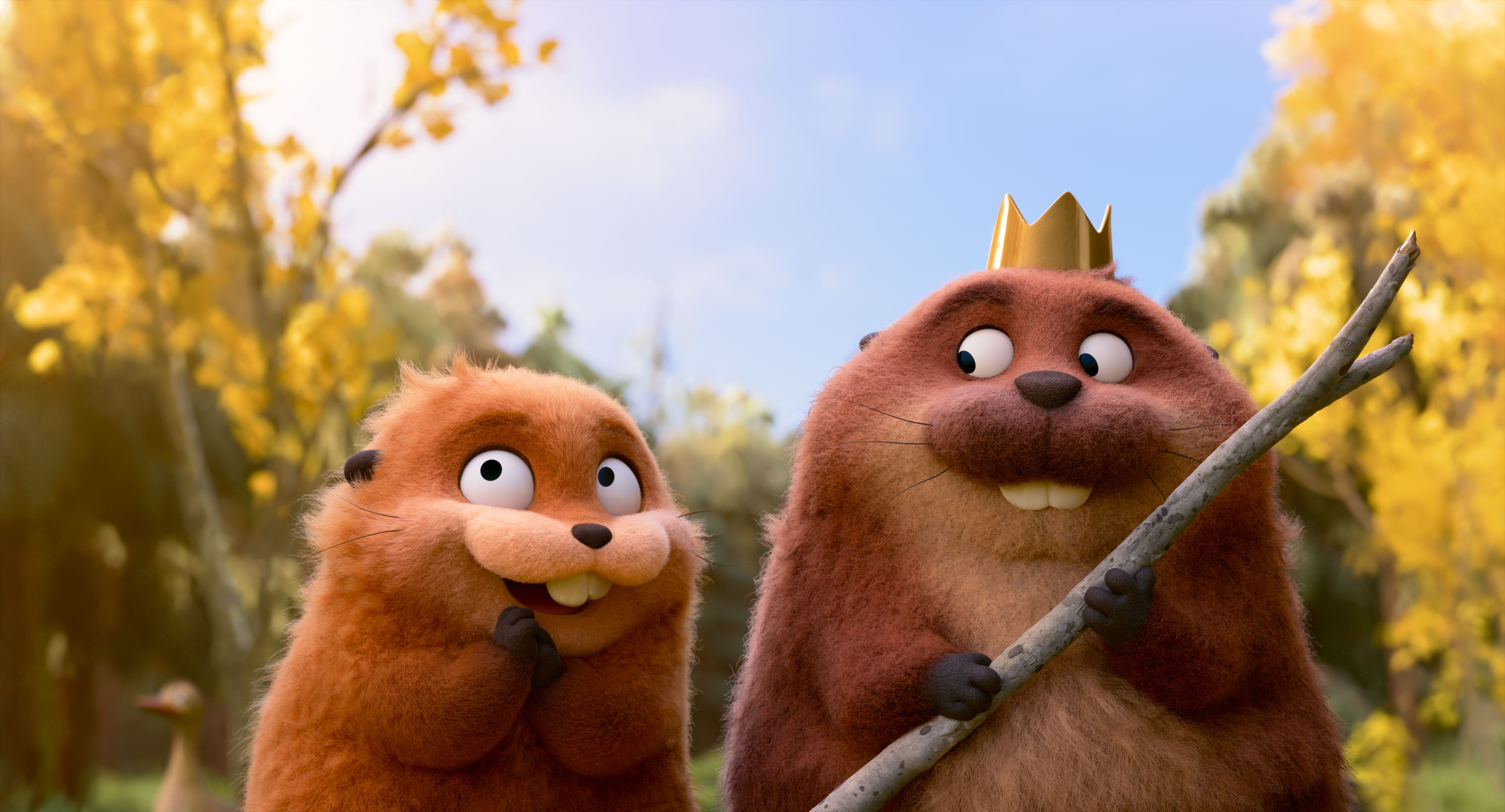
As successful as Pixar Animation Studios has been in its storied 31-year history of releasing some of the most game-changing films in animation, the innovators behind the movies rarely ever get the spotlight shone on them.
These filmmakers and storytellers work long hours under tight deadlines and yet produce some of the most gorgeous and brilliantly crafted works of art in cinema. That is why, upon arriving at Pixar to learn more about Hoppers, it became an incredible honor to sit down with some of the studio’s amazing behind-the-scenes talent who poured time, effort, energy, and passion into crafting one of the studio’s best original films in years!

During the Hoppers press day we covered a few weeks ago, we were given the opportunity to sit with some of the artists and storytellers responsible for this terrific movie. As we uncovered, the creation of a Pixar movie, like most films, is a highly collaborative process focused on ensuring the story comes first.
However, like any movie, the movie is absolutely finalized in the edit bay. Thus, we were fortunate to have some delightful conversations with some of the studio’s talented team members, namely Story Supervisor John Cody Kim, Story Lead Margaret Spencer, Assistant Editor Diana Flores, Story Artist Wesley Fuh, and Film Editor Chloe Kloezeman.
Chloe Kloezeman – Editor
Kloezeman has been a member of the Pixar family since 2013. She began as a second assistant editor on Toy Story of Terror before building an illustrious career at the company, working on Finding Dory, Coco, Toy Story 4, and Lightyear. Naturally, her valuable skills and keen editorial intuition meant she contributed immensely to Hoppers.
GoC: Chloe, congratulations. I saw the movie last night. It is awesome! It is honestly Pixar at its most punk rock, and it’s just because it feels so different from any other Pixar project that I’ve seen. Going into this, did you feel that way as well? Did you approach it similarly to other Pixar projects?
Kloezeman: Yeah, it’s a great question. I mean, coming in early as an editor, we’re one of the first departments on the show, and Daniel had already created, like a playlist of the kind of music that he was hoping to have in the film. And it’s exactly what he said. It was super punk rock. And it was really diverse. Songs that you would never associate with Pixar films. And it kind of set the tone early. And Daniel, as a director and his style, he just knew that it was going to be something different. It wasn’t going to be our similarly structured, sweet and clever Pixar film. It was going to really push it over the top. That’s what we did. And that was important to him.
GoC: I love that, and I love that you guys contributed to that as well, because everything about this feels just out there. It just escalates into something that’s even more unhinged as things go by. Did the fact that things were escalating in these very unorthodox ways impact your contributions?
Kloezeman: Yeah, I feel like one of the cool things about working here is we’re all just trying to make each other laugh. And I’ve never felt that more than on this show because, we were just trying to just push each other to have fun and make each other laugh. I feel like that was the priority from day one. So whenever I was cutting a scene, it was like, ‘what is the funniest thing I can do?’ And I just knew that it would be well-received. Daniel, as a director, was just so open to people’s ideas. He had his own ideas going into this, but he was just so approachable and so ready to hear other people’s thoughts. He had just created an environment where everybody was throwing down their most pushed, most unhinged ideas and a lot of them made it onto the screen. It’s awesome.
GoC: Were a lot of the ideas that we see in the final cut very much present at the very beginning of the movie? Or did they all just kind of start coming in more and more? Like Diane the Shark?

Kloezeman: It’s funny you bring up the shark. Yeah, that was there from the very beginning. And in the beginning, I actually wasn’t a fan of the shark. I was like, ‘Oh my God.’ It felt like we were going to have a shark camp. But, you know, I was being a little bit too literal about it. But, yeah, a lot of things he just knew that he wanted. Daniel knew that he wanted the animals to then hop. And at some point, we were like, ‘We don’t have time in this film to have all these different plot points.’ And he was like, ‘I just can’t imagine the film without animals also copying humans.’ And so we found a way to squeeze it in. But it’s more like small little jokes that kind of got pushed. But the big set pieces over there from the beginning.
GoC: I love that. And the thing is, when you’re editing the entire movie you do have to kind of kill your darlings at some point, right? And I love that he had these strong convictions that you all kind of believed in as well, that ended up making it to the final cut. But what were some of the hardest things for you to see kind of go from the movie?
Kloezeman: Oh, that’s a good question. This is really small, but I love this scene where it was called, “The Call.” And it was when King George was going to call up the other kings and queens to come have a meeting. And then it was just this really silly little scene…to kind of illustrate what their system was for contacting one another. And it was just kind of a little bit of magic; sort of whimsical. And it was cool to be in the animal world. So they were using just all kinds of things to send messages and all the animals were involved.
GoC: My last question for you, if you could hop into any creature, person, place, or anything, what would you choose?
Kloezeman: Oh, gosh. I’m a cat person. I think I’d have to hop into a cat, see what they’re doing, see what they’re talking about. They do live kind of wonderful lives. I would love to just lay in the sun all day and relax, nap.
Wesley Fuh – Story Artist
Fuh has been with Pixar since 2018, working on Turning Red, Win or Lose, and now Hoppers. He worked closely with director, Daniel Chong, contributing ideas to We Bare Bears at Cartoon Network. He will also be working on the upcoming Pixar film, Gatto, from Luca director Enrico Casarosa.
GoC: Honor to meet you! I saw the movie last night. Loved it. And it’s funny because I was talking to Chloe as well. There was just an energy to this movie and just this sense of chaos, but in a great way, that separates it so much from previous Pixar releases, in my opinion. When you get a script like this and you read about all this chaotic stuff happening, how are you translating this all to the storyboards?
Fuh: Well, it sort of starts like with the script. They’re working on something that makes some kind of sense. And what’s fun about our jobs, especially working with Daniel, who comes from story, is the additive nature. And so knowing Daniel and how he likes to work, when I’m with the script, I’m a little playful with it too. And so there are jokes in there and the rhythm and shape that I’m like, ‘Oh, the director wants to see this. The writer wants to see this.’ But I’m also adding things…Like, ‘What happens if you check out this leaf over here or George talks to this little fella here?’ And, I think, there’s sort of an allowance for the artist and creative working on it, that kind of what you get in the film, is sort of an amalgamation of all of us kind of playing as the characters. And the design is a little cute. And charming. And they can be pushed. and so we’re testing all these outs that’s what I’d say. Like, we’re in the chaos, but we’re adding to and two.
GoC: What was your favorite thing that you added to the movie that really made it to the final cut and then the saddest thing that you had to take out?

Fuh: Yeah. I think a highlight was like, I got to work with Pond Rules; and that one was a scene built for chaos. And it was a unique case where they hadn’t scripted it out. They said, we need this tour of the pond. George is taking Mabel around, and she’s learning things that aren’t at all what she thought of the animal world. And so I got to brainstorm all these rules, and the function of the scene was to kind of not to disorient or disarm, but to be funny, be charming, be a little strange.
And so, I came up with all these rules and pitched them. Some of them make sense. Some of them didn’t and pitched them to the team, pushed them to Daniel, and then they, you know, they approved. They shaped it down a little bit, and then they gave it to our writer, Jesse…then they gave it right back to me. So that’s pretty unique. But I got to board that after. But it’s an odd case of like, ‘Oh, I came up with that. And then I got to storyboard it out. Like that doesn’t always gets happen. So a lot of weird little jokes or ideas are in there…it’s sad in the sense that the deleted scenes only exist in storyboards.
But I’m quite happy with them as scenes and I understand why they didn’t make it in. There was a lot of other scenes that George was showing Mabel around, like, inside the lodge or these parts of the animal kingdom that I boarded as well, that didn’t quite fit with Pond Rules there, occupying the same space. And there was some stuff that I was really personally quite attached to of we were experimenting with how when George and Mabel were making up. Basically, at some tension points in the movie, what that looks like, and what does that look like in a human and beaver? I think we got somewhere interesting and beautiful in the final, but I did some versions that didn’t make that cut, yeah.
GoC: I want to see those someday, honestly. It’s hard to come up with Pond rules. We don’t know anything about the animal world. And you have to world build something that we’ve never lived in. But you did such a great job of it. And I’m so glad that made it in there. You know, we always wonder when we’re watching Zootopia or any animal movie, what do these people eat? You guys are just like, ‘If you have to eat, you eat.’ That’s brilliant. If you could hop into anything, human, animal, you know, another person that you admire or something like that, or any other animal that you want to live as, what would it be?
Fuh: You know, I’m cold a lot, so I’d like to hop into something warm. Like a penguin, maybe, you know? They stay pretty warm. I mean, this was going to be penguin avatar, right? Like, so at one point, but, yeah. Definitely, a penguin is a good choice. I would love that, too. lighting down ice. Yeah. I think it would be pretty fun. A bird would be fun too.
Diana Flores– Assistant Editor
Flores started with Pixar in 2021. A Bay Area native, Flores has worked on huge projects like Inside Out 2. However Hoppers represents her first full film as assistant editor.
GoC: The editing process on a movie like this has got to be crazy because the energy, the chaos that you bring to this, it’s so well done. It’s fast paced as hell, but also it’s very well balanced. Everything escalates perfectly and it’s not like anything’s all over the place or out of nowhere. So can you talk about the challenges of putting together a movie like that that has such a fast pace, but also tells a story very coherently?
Flores: Yeah, I think you put that really well. It’s very much an action film. So we had a lot of really fast paced, high energy scenes, and I think what we tried to do is balance that out with our overall story. Like, what does Mabel want? What is her over-arching story? How do we not keep things at 110% all the time and kind of even it out with kind of some quieter moments? Like, why does she care so much about nature and how do we show that not only with how it looks, how it sounds, but with the timing of all of that.
And that really starts at the very beginning. We’re on the film since day one. It’s like director, producer, editor, and the story artist. I was on the film for three and a half years. So just watching it evolve and seeing what works, what doesn’t work. And sometimes you have a scene that you’re like, ‘This is perfect. This will be the moment of the film.’ You see it cut together with three or four other scenes and you’re just like, ‘Oh, maybe it doesn’t belong there. Maybe it goes somewhere else. Maybe we need to tell this part at a later time or before. Or maybe this joke that we thought was so funny just doesn’t work anymore.’ So it’s all really just trial and error on our part.
GoC: I was talking to Chloe a little earlier, and I’m guessing you guys probably work pretty closely together. One of the things that I asked her is that movies are actually finished in the editing bay. And a lot of that requires killing your darlings. Was there anything specific that didn’t make it in the film, that you had to let go, but didn’t want to?
Flores: I think that happens on any film that you work on. This is personally my first film, so I’m getting to see all of that was really exciting. I think there’s just certain things, certain jokes, even like certain tiny moments where I’m like, ‘oh, my God, we cut two seconds sooner, and I liked it more when it was cut just a little bit faster. I think that joke hit a little bit harder than that.’ It just ultimately is kind of for the greater service of the story, you know, like stories always first here.

So in editorial you cannot be precious about anything because you don’t know what’s going to get cut out, you know? You could spend weeks crafting this beautiful sequence that you think is great. And then it just doesn’t work. And it’s nobody’s fault. It’s not the editor’s fault, it’s not the one who wrote it, the one who drew it, nothing. It’s just in greater service of the story. And that’s just, you know, what we do and it’s what we’re used to.
GoC: I want to go back really quickly to you saying that this was your first real project. This is amazing. I’m so impressed. Congratulations. What was it like to take on that responsibility, working on a big Pixar tentpole as your first big gig?
Flores: Yeah, it’s so cool. It’s just everyone here is so supportive and everyone here genuinely like wants you to succeed and to be good at your role. So just kind of getting thrown into this and starting at the very beginning is super helpful because, not only do you get to know the characters, the story, and watch it evolve, but I also got to know our director and our producer really well, Nicole and Daniel.
And, you know, one of the nice things about being an editorial is that we have director reviews. So they’ll come by, where we sit all the time and so we get to interact with them. I get to go to recording sessions with the actors and all that. So I get to spend time with director producer there also. So just forming these relationships and having it not feel so much like this giant responsibility of, ‘Oh, my God, it’s like a $200 million film and will people like it, or will people not?’ I mean, yeah, I’m worried about that. Like that that’s a thing for March. We’ll see how that happens. I don’t know how people are going to like it. But just to know that for the past three and a half to four years, we’ve had something that we made together, that we’re genuinely proud of. You can’t beat that feeling.
GoC: Absolutely. My final question to you – There’s something about Hoppers that I’ve found so much more special than some of the other things that I’ve seen. It throws the book out on the conventional Pixar formula and really does something different. As somebody who probably grew up in love with Pixar as well, were you also trying to do something slightly different than you’ve seen before in other movies?
Flores: Yeah, I think that the nice thing about this film is that it caters a lot to our as a team, like our sense of humor. And our sense of humor generally was very weird, I think. And I think the vibes of Hoppers in general is just so different than other Pixar movies in terms of like humor. And a lot of that goes to Daniel. I mean, that’s 100% his sense of humor. But just how well it translated over to us and how we all just kind of rolled with it, and we’re like, ‘Oh, yeah, and what if we like, did this? What if we made him go, Lizard, Lizard, Lizard, Lizard,’ and just go crazy at the end? Like, it’s just stuff that we would just throw out. And then just seeing what sticks, you know?
Story Supervisor John Cody Kim and Story Lead Margaret Spencer
We were given the pleasure of speaking with Kim and Spencer who are the Story Supervisor and Story Lead of Hoppers. Kim started his career at Blue Sky, working on films like Nimona before coming on to Pixar in 2023. Spencer worked at both Walt Disney Animation and Pixar, contributing greatly to projects like Lightyear and Turning Red, before Hoppers.
GoC: You were nice enough to give us some time today with the gag session. From what I was hearing, some of the funniest bits in this movie came out of those sessions. What were your favorite bits to come out of the gag session that make it made it into the movie? And which ones do you regret not putting in the movie?
Spencer: So, for me, I don’t want to spoil anything, but the entire third act involved us finding a way to get all of the characters and in the same location. And that was a huge challenge because there’s a lot of components in the film that were leading us in different directions. And some of the characters are in a compromised situation, some of them are about to cause a lot of problems. And so we had to find a way to clearly visually show what the situation was and how they escaped and you know when things would explode and that was really fun.

Kim: ‘It’s an arrow Ted.’ The spider joke. We did so many versions of that and we’re like, ‘I don’t think this is funny. I don’t think it’s funny.’ We gave it so many different versions. And we tried it, and then even in the edit room, when we were cutting it, Daniel’s like, ‘It’s only like 70% funny.’ But we played it anyway. We did a test audience screening and it got one of the biggest laughs. And we’re like, ‘I don’t know why this is funny but I guess it’s funny.’ There’s a weird magic to it.
Spencer: It probably works because we were so exhausted by the end of that session that when we had Rachel read the line, it was just so authentic.
GoC: That sense of frustration, we’ve all been there, too. It’s so relatable. Which is one of the things I really love about this movie. You guys have made a movie that is insanely zany and insanely out there in terms of the concept, but it is so deeply and innately human and relatable. Even though we’re dealing with beavers, we are also dealing with a lot of anger, frustration, and what that could lead to with with individuals. And I think that, when you guys were thinking about this and putting the movie together, did the present situation- where we are today as a world – really come into play with all of that?
Spencer: Yeah, definitely. I mean, something that I feel really proud to have gotten into the movie was identifying with the protagonist who feels like she’s trying to do the right thing and nobody cares. And in fact she’s getting in trouble for trying to do the right thing. And I think from that very relatable position, we were able to explore other concepts like miscommunication and listening and trying to understand where your adversaries are coming from. And seeing that maybe we all actually do care about the same things in the end.
Kim: The feeling of powerlessness. That beginning scene didn’t exist until much later in the production where Mabel, as a young Mabel, an elementary student rescuing all those animals from the school – that was such a key moment for audience to understand this is why Mabel is the way she is.
GoC: My final question to you guys – it’s not an exaggeration to say that we’ve grown up with Pixar, and to every Pixar movie, there’s a lot of expectations. However, this is a movie that really throws out the Pixar book and really goes full punk rock. This is so different than most Pixar movies I’ve seen from a humor standpoint, from the realism, in terms of what it’s trying to talk about in terms of its themes, its characters, everything. So, was that the intent when you first approached this? To try and do something different than you’ve ever done before?
Spencer: I think something that every Pixar production prioritizes is being emotional, and emotionally resonant. Something that is reflective of the reality of being human. And those are the only two real important rules.
Kim: That and character driven. Make sure you care about that main character.
Spencer: But other than that, it’s like, we I don’t think we were trying to do anything different. We were just telling the story that John does and that I do and Daniel does.
Kim: I think Daniel wasn’t afraid to like modify his style. That’s just a lot of the humor and just the way he would just work. That’s just how it was. And he just brought all of that to the studio. He’s like, “This is the movie that we’re going to make” in his style. And I think we all kind of like held hands and we’re like, ‘Yes ,that’s exactly how we’re going to make it.’
And we are so incredibly glad they did, because Hoppers truly is one of the most original Pixar films the studio has ever put out. It’s remarkable to say that after 31 years of making groundbreaking features, the studio is still finding ways to stay fresh.
Suffice it to say, all that is thanks to the dedicated, hard working, immensely creative minds of all the incredible artists that bring these films to life.
Don’t forget to see Hoppers when it comes out in theaters on March 6!