

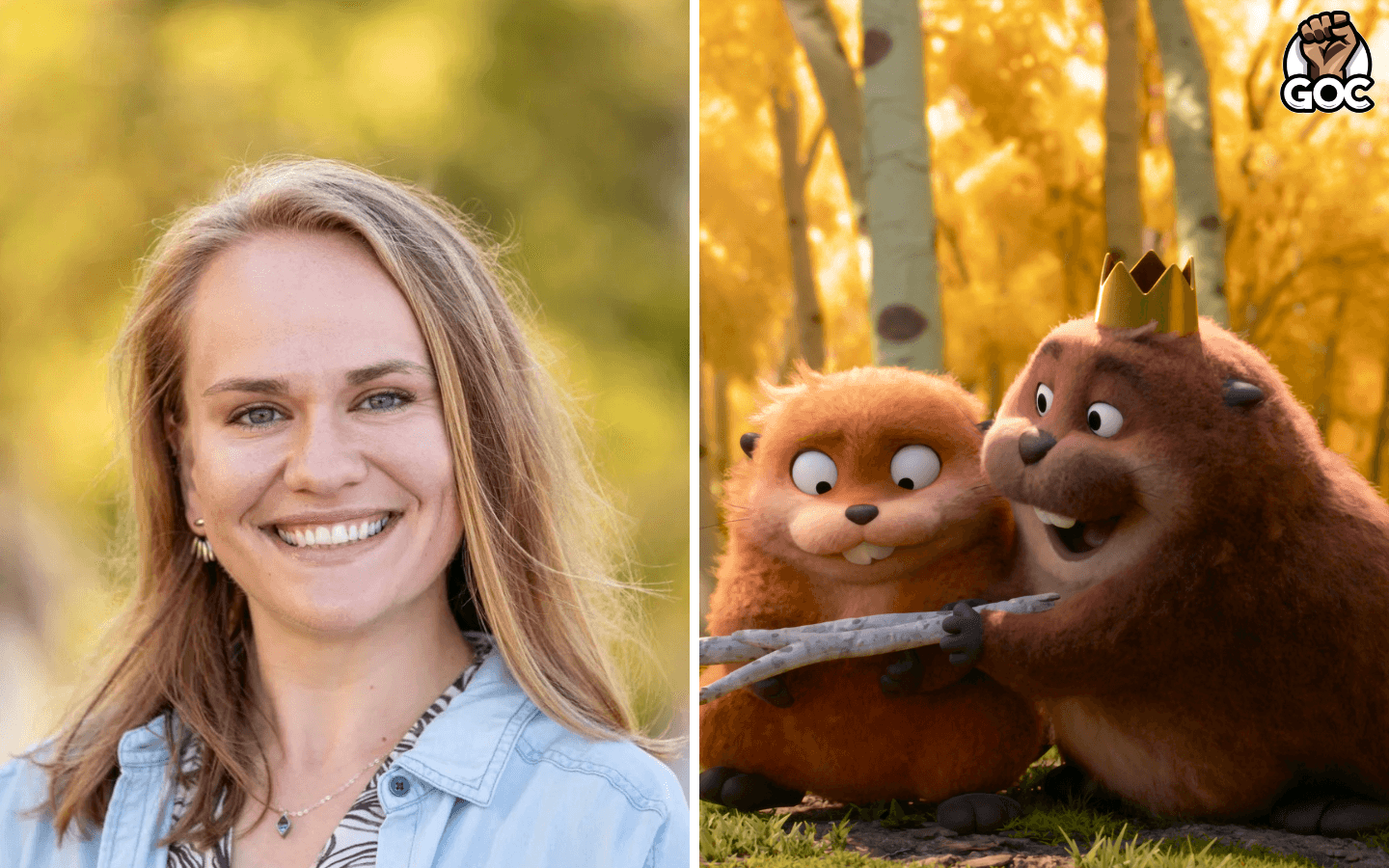
A movie about humans hopping into the bodies of beavers might seem like a work of pure science-fiction. However, believe it or not, in the hands of the geniuses at Pixar, who love doing their homework, Hoppers is surprisingly a lot closer to science fact! To prove it, we got a deep dive into the beaver dam with Dr. Emily Fairfax, the ecohydrologist and beaver expert, who consulted on the new Pixar comedy!
Hoppers does a terrific job of showcasing the importance of keystone animals to natural ecosystems. The fight to preserve these areas and the species that dwell within them is not only depicted in the film (in an incredibly fun and entertaining way), but also encouraged in the film’s overall messages. As such, it was super important for director Daniel Chong, and the film’s crew, to learn as much as they can about beaver habitats, rivers, and dams, to accurately bring these environments to life accurately in animation, while also preserving the themes of conservationism and respect for nature throughout the film.
To truly capture this accuracy, they consulted one of the foremost experts in beaver habitats in the country to school the filmmakers in the ins and outs of beaver habitats. Enter Dr. Fairfax. We were able to speak to her on two separate occasions: during a 1:1 interview with her during our Pixar press day, and in an intimate panel with her during the Hoppers junket.
A Wonderful 1:1 with Dr. Fairfax

The privilege of speaking with one of the most respected authorities on the beaver habitat was a true honor. In addition to being an incredible expert on beavers and their habitats, Fairfax is an incredible human being, leaving behind a scientific career in weapons to do something that would benefit the planet instead. In many ways, she’s like a modern day Tony Stark (but for beavers). So getting to chat with her was truly wonderful. Here’s what she had to say about her contributions to Hoppers:
GoC: Dr. Emily, you consulted on this movie very heavily. And what I love about Hoppers is in addition to being a hilarious and just a wonderful, chaotic film all around, is that there is so much of this movie rooted in natural science. Everything that we know about beavers today, and still so much more that we’re discovering, you consulted on. So when Pixar came to you and was like, ‘we need an expert in beavers,’ what was that like? Was that like, kind of shocking that Hollywood was doing a movie about beavers? And what was your reaction overall?
Fairfax: It was totally shocking. I had no idea. I had just given a talk for a webinar, and then I had this email in my inbox from Pixar saying, ‘Hey, could you give us a talk?’ At first I was like, ‘Is this phishing? Like, why would this happen? This doesn’t make any sense.’ But I said, ‘Yeah, sure, of course.’ And at that point, I didn’t know why. So I just gave them the standard beaver talk, and they were like, ‘Awesome, thanks.’ A couple weeks later, another email comes saying, ‘Can we do another talk? We have some more questions.’ And it kept going, and I thought, ‘Well, this must be like a side character or something small or whatever. And then they asked me, ‘Can you take the art team to the field?’ And I was like, ‘What? That seems like a lot of work for a side character.’
And even in the field, I didn’t really know how much beavers were central to the movie. And I’m picking it up as I’m out there. They’re clearly paying attention to all the beaver stuff. And after that trip, I was then trusted enough to actually learn what was going on. And I got to see storyboarding of it and get asked questions about, ‘Would this animal be here? Would beavers do this? Is this important? Can we use movie magic on this, or will this make a bad beaver myth?’ And they listened so well, and I was so happy about it, because I love talking about beavers, and this huge captive audience. I think one time I talked to like 200 employees, and I was like, ‘Yes, I will tell everyone about beavers and everything I know.’ And I don’t even remember all of what I said, but watching the final form, I can see what I said. I can see my rant about beavers not using their tail to pack mud, and they use their hands, and then that’s there. And I can see all of my complaints about how people don’t appreciate that everything else depends on the beaver.
GoC: Would you say that the Hollywood bug has bitten you and you’re ready to quit science and go into Hollywood permanently?
Fairfax: No, I will not be quitting science, but I’m always happy to push my science on Hollywood.
GoC: I’m very glad you’re not because we actually do need a lot more scientists. We have way too many Hollywood people. Watching this movie, what was the craziest thing that you think people will be like, ‘Oh, that’s not real,’ but it actually is rooted in real beaver habitats and science?
Fairfax: I mean, the biggest thing is what I’ve spent the most time studying, which is that beaver wetlands can stop wildfires. And it’s not necessarily that they release their water or anything like that, but they genuinely can. They’re fireproof, they’re droughtproof, they’re floodproof, they’re these incredibly powerful places, and that’s in there. There’s also little things, like when the beavers are swimming and Mable’s not a great swimmer. Her being taught how to swim actually happens with baby beavers. Their parents teach them how to swim. When they’re little, they’re so chaotic, and then they learn, [they learn to] kick with [their] back feet. That lets them hold sticks and stuff. And that’s in there too. There’s just so many little nuggets of knowledge.

GoC: I love that! Beaver nuggets! Now, my last question to you. you know, everyone who’s going to watch this is going to fall in love with beavers. And I don’t think that a lot of people out there who will see this movie will have known a whole lot about beavers prior to going into it. And one of the things that I took away from it, now that I’m officially a beaver fan, is that they are so essential, so crucial to our environment. And the more that we foster those habitats, the more we learn to work with them, the better our environment is going to be. That’s literally the point of Hoppers. So if folks want to contribute to helping the beaver habitats and kind of getting into this field a little bit more, maybe donate things, what’s your best advice to them?
Fairfax: Step one is find your local beaver pond and visit it. Take a photo, put it on your social media, and call it beautiful. And say it’s amazing, and say you had a good time there. And I think the more that message will come out that these are amazing places. They’re not scary. They’re not stinky. Wetlands and swamps have often been portrayed as not positive in the media. And this is the time to change that. And then find your local beaver organization. It sounds silly, but they’re everywhere. We have the San Luis Obispo Beaver Brigade. We have Beavers Northwest, The Beaver Institute. They’re all over the place. Find them. Do a walk with them. Volunteer with them. Build a beaver dam analog, a fake beaver dam. We do this in places we don’t have beavers. There’s so many ways to get out in the pond and be the beaver. And it’s a lot of fun to do so, if I say so myself.
GoC: I can’t wait for folks to start watching this movie and start helping out as well. Dr. Emily, you’ve been fantastic. And congratulations on your contributions to this wonderful movie as well.
Beaver 101
Discussing beavers in the context of Hoppers from an entertainment standpoint is one thing. Learning more about beavers from an ecological standpoint is another. As such, we were treated to more time with her during the Hoppers press junket. She held an intimate talk to discuss the importance of beaver habitats to our environment. Here are some of the major points we learned.
Before the fur trade, there used to be 100M-400M beavers in North America
Beavers have been building their dams for at least 7.5 million years. We had 100 to 400 million beavers in North America before the fur trade. And then humans killed almost every single one of them on purpose. That peak population down to 100,000 beavers. When we lost all those beavers, we lost all those dams. Thankfully, Beavers are coming back today. We’re up to 10 to 30 million beavers in North America, and are benefitting from their engineering skills.
Bevers are central to maintaining clean water sources and ecosystems
Unhealthy rivers that are over grazed, stripped of groundwater, and agriculturally drained can be fixed by beavers. The dams they build can allow new plants to start to grow, bring back diverse species of animals, creating richer, more resilient habitats that everything else needs. That’s why they are a key stone species.
Beavers help fight fires
While many may not realize this, the wetlands created by beavers are incredibly important in saving ecosystems that may be surrounded by dry forests. Dr. Fairfax and teams like her own have shown through their studies that while many forests surrounding beaver wetlands may burn up, they stop right at the marshlands created by beaver dams, thanks to the stores of water that are captured by the habitat. it stops the spread of those fires, and preserves some of the land in the area.

We need to work with beavers to save our environment
Killing beavers and destroying dams will severely damage river lands, leading to even more risks in drier land and forests, which could lead to droughts, fires, and more dangers. To ensure we keep these risks down, it’s important to work with beavers to understand how critical their work is to our environment, and figure out how to spread them around in areas that need them the most.
There are still more unanswered questions about why beavers do what they do
When asked what the first thing Dr. Fairfax would ask a beaver about if she had the ability to hop into the body of a beaver, she said this: “I think the first thing I would want to know is why, like, why, from your perspective, are you doing all of this? It’s a huge amount of work to maintain this entire environment and we don’t see any other animal out there do this level of work other than humans. And I can ask humans why they’re doing things, but I can’t ask the beaver.
I have my own research, hypotheses, and science says they do this for that reason, and this is for predation, you know, protection, and this is for that. But I want to know, like, in their head, when they show up to a stream, do they just like that it looks better? They like that it’s a nicer place? Like, do they appreciate the wildflowers that grow on their dams? I want to know why, because they work harder than anyone else. I want that secret.”