

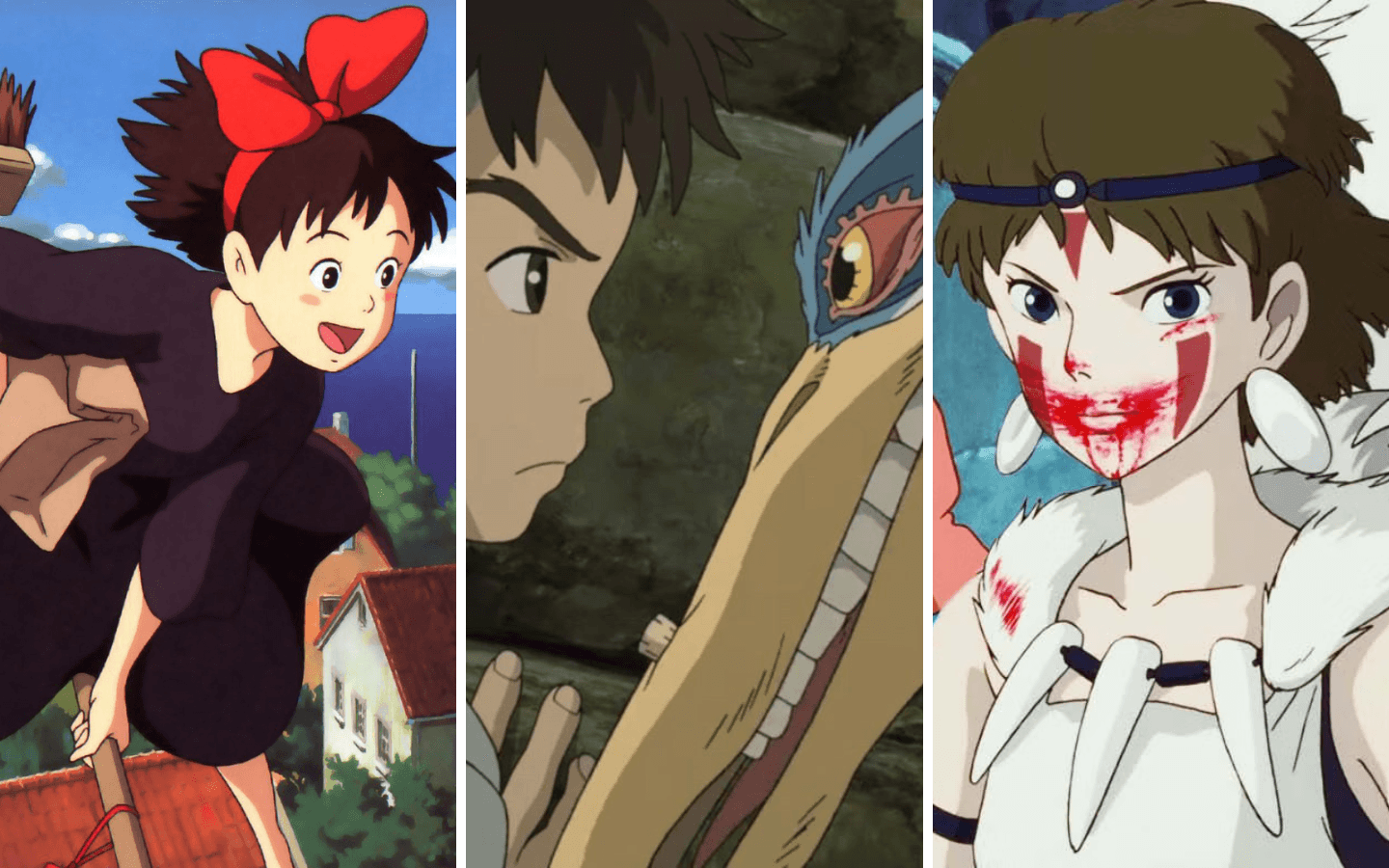
Hayao Miyazaki has proven to be one of the greatest animation directors of all time and one of the best filmmakers in general. Ranging from post-apocalyptic sci-fi epics to small-scale character-driven stories to high-concept spiritual fantasies, Miyazaki’s filmography boasts an incredibly diverse collection of movies that feel unique from each other in terms of tone, setting, and genre. However, despite these differences, Miyazaki’s movies are connected in that they all feel uniquely Miyazaki and could only have come into existence from this genius filmmaker’s mind. Therefore, with the release of his latest film, The Boy and the Heron, once again reinforcing this belief, it is then only natural to rank his entire filmography.
What makes Miyazaki’s films so difficult to rank, though, is that no single movie can be objectively stated to be his best. Each one of his films speaks to different people on different levels, and so naturally, they will gravitate towards the one that they feel the most connected to. Therefore, it is important to remember that this is only one ranking of Miyazaki’s movies, as there are plenty of other lists out there that you may agree with more. With that in mind, here are all of Miyazaki’s movies ranked from great to greatest.
Nausicaä of the Valley of the Wind

Based on Miyazaki’s 1982 manga of the same name, Nausicaä of the Valley of the Wind takes place in a post-apocalyptic world and follows a young princess named Nausicaä who must prevent a violent war between the kingdom of Tolmekia and the giant bugs that roam the world called Ohms. In many ways, this film is ground zero of Miyazaki’s career, as many aspects of Nausicaä would be prominently featured and thoroughly explored in his later movies. Examples include themes about environmentalism and pacifism, a strong female protagonist, and a fantastical setting that features mysterious creatures.
There is a lot to admire about Nausicaä, from its visually impressive action set pieces to its detailed worldbuilding. Additionally, Nausicaä herself is an incredibly compelling character, as her drive to achieve peace makes her very sympathetic. However, what ultimately holds this movie back is that many of the other characters do not feel nearly as fleshed out or properly developed as Nausicaä. A concept like this would be better explored as an anime series instead of a feature-length film, as having that extra length would not only allow the supporting characters to be properly developed but also expand the lore of this story’s universe. Considering that the manga didn’t conclude until 1994, it seems like Nausicaä is cutting many corners to keep its runtime under 2 hours. While Nausicaä is by no means a bad film, it is certainly a flawed one.
7/10
Ponyo

A loose adaptation of Hans Christian Andersen’s The Little Mermaid fairytale, Ponyo tells the story of a goldfish named Ponyo who wishes to become a human girl after meeting and befriending a boy named Sosuke. While many of Miyazaki’s films tend to appeal to a younger demographic, Ponyo is easily his most “child-friendly” film. However, that is by no means a criticism of the movie because, if anything, it uses its child-friendly sensibilities to its benefit. Because of how straightforward Ponyo’s story is, the film has this sense of simplicity and charm that even adults can’t help but smile and admire while watching.
While the film may be lacking in a lot of that rich meat and depth that older fans have come to expect from his older movies, it is still an entertaining movie that can be watched any day of the week. Ponyo is a gorgeously animated film that is enhanced by Joe Hisashi’s excellent score, and the result is a children’s film that, while simple, is never boring to watch.
7/10
The Castle of Cagliostro

The feature directorial debut of Hayao Miyazaki, The Castle of Cagliostro, is considered by many to be the “black sheep” of Miyazaki’s filmography as it very much stands out from the rest of his movies. Based on Monkey Punch’s iconic Lupin III manga series, The Castle of Cagliostro follows the misadventures of the titular gentleman thief who attempts to rescue a princess locked up within the confines of the Castle of Cagliostro. Unlike Miyazaki’s other movies, which, while having moments of humor, tend to lean more towards serious yet whimsical tones, The Castle of Cagliostro is the complete antithesis. The fast-paced, pulpy action comedy feels more reminiscent of Indiana Jones or a Shonen Jump adventure manga series than a more “traditional” Miyazaki film.
There are hints of Miyazaki’s artistic style present throughout The Castle of Cagliostro, such as making Lupin more of a pure-hearted good guy than the mischievous schemer that he’s normally portrayed as. Ultimately though, this film prioritizes being a fun, entertaining Lupin III adventure above all else, and it very much achieves that goal. From the iconic opening car chase to the final confrontation between Lupin and the Count and all the crafty disguises Lupin wears in between, it’s hard to hate a movie that is just so fun to watch.
7/10
Castle in the Sky

The very first Studio Ghibli film, Castle in the Sky, is an epic grand adventure that follows two young children named Sheeta and Pazu who attempt to find a floating lost castle called Laputa, all while being chased by a government agent named Muska and a band of air pirates led by an elderly woman named Dola. Part of what makes Castle in the Sky such an important and special film, aside from it being Studio Ghibli’s first feature, is just how uncompromised and singular Miyazaki’s vision for the film is. Everything that people come to expect from Miyazaki’s films all started with Castle in the Sky: a whimsical tone, detailed worldbuilding that blends real-life settings and fantasy elements, thematic commentary on environmentalism and warfare, and fleshed-out and interesting characters.
While Castle in the Sky has similar goals to The Castle of Cagliostro in that both films prioritize being exciting adventure movies, what makes Castle in the Sky the better film is its ability to better incorporate Miyazaki’s sensibilities and interests. Miyazaki has never been shy about expressing his love of flight and aviation, and the way that these obsessions are incorporated into the narrative, from the floating Laputa castle to the aircraft that the Dola pirates ride to the airships that Muska and the military fly in help make Castle in the Sky stand out from the usual adventure fare. This was the first Miyazaki film to truly feel like a “Miyazaki film,” and it is nothing less than outstanding.
8/10
The Wind Rises

Released back in 2013 and what was supposed to be Miyazaki’s “final film,” The Wind Rises is a fictionalized biopic about Jiro Horikoshi, the creator of the Mitsubishi A5M fighter aircraft and Mitsubishi A6m Zero, and explores how his dream of creating beautiful airplanes clashes with the horrors of World War II. In some ways, The Wind Rises differs greatly from anything else in Miyazaki’s filmography. Unlike most of Miyazaki’s other movies, which are very fantastical with fantasy-like creatures and settings, The Wind Rises strips away most of these elements and opts to tell a more grounded story centered around a real person. While the film utilizes various dream sequences and takes liberties with Horikoshi’s story, ultimately, The Wind Rises is based more on realism than fantasy.
However, despite this shift, this is still through and through a Hayao Miyazaki film, as this is easily one of the most mature and introspective films in his career. Despite how it may be seen on the surface, The Wind Rises is not about airplanes nor a thorough exploration of Horikoshi’s life and beliefs. It is about the struggles one has when their art becomes a dangerous weapon, a violent tool for war. Horikoshi’s dream is to create beautiful planes, works of art that he can be proud of, and yet he also must grapple with the fact that his art is being used to further fuel the death and violence of World War II. The Wind Rises tackles a very powerful yet difficult concept. In some ways, it feels more like something that Isao Takahata would have explored, and had it been Miyazaki’s final film, this would have been an outstanding finale to his career.
9/10
Porco Rosso

Arguably Miyazaki’s most underrated film, Porco Rosso, follows an ace fighter pilot and bounty hunter named Porco Rosso who gets involved in a series of adventures while also coping with the PTSD he gained from fighting in World War I. Like Miyazaki’s other action-adventure movies like Castle in the Sky and The Castle of Cagliostro, Porco Rosso is an absolute delight from a pure entertainment perspective. Filled to the brim with so many exciting action set pieces like the opening scene with the air pirates and the final airplane duel-turned-boxing fight between Porco and the hot-blooded American, Donald Curtis, the film has so much charm and character that it’s difficult to dislike any major aspect of the film.
However, what makes Porco Rosso truly a Miyazaki masterpiece is not its action scenes but its deep and touching exploration of themes like PTSD, nationalism, war, and, most importantly, fascism. “I’d rather be a pig than a fascist” is not only the greatest line in the film (and arguably in all of Miyazaki’s films), but it also perfectly symbolizes what Porco Rosso is trying to communicate about both the titular character and its themes to the audience. There are many ways that this line can be interpreted, but regardless of what conclusion different individuals come to about the movie, what is universally agreed upon is just how great Porco Rosso is.
9/10
My Neighbor Totoro

To say that My Neighbor Totoro is Studio Ghibli’s most famous film would not be a controversial statement to make. The film has become so popular and famous that the titular creature not only became the official mascot for the company but is also arguably one of the most recognizable characters in all of anime history, and for good reason, as My Neighbor Totoro has become a family classic since its 1988 release. The film is centered around two young girls named Satsuki and Mei who move to the Japanese countryside with their father. While adjusting to their new home, they encounter various spirits living in their new backyard, most notably the giant friendly creature, Totoro.
At first glance, My Neighbor Totoro seems to be nothing more than a simple girls-meets-dog children’s story, only in this case, the dog is some sort of rabbit-cat-owl-bear hybrid creature. However, like with many of Miyazaki’s other films, My Neighbor Totoro has much more to offer than it lets on as it is a sweet and emotionally powerful film about child-like wonder, imagination and ultimately is a celebration of youth. Whether or not Totoro is real doesn’t matter. To the kids, Totoro is as real as the grass they walk on, and considering how much adversity they face, like their mom being sick in the hospital and their dad always being busy with work, he is a much-needed positive figure in their life to keep them entertained and inspired.
9/10
Kiki’s Delivery Service

Based on the 1985 novel of the same name, Kiki’s Delivery Service follows a young witch named Kiki and her trusty black cat, Jiji, who fly to the city of Koriko with the hopes of starting a delivery business. What makes Kiki’s Delivery Service so special and unique, especially when compared to Miyazaki’s other movies, is just how low-stakes and “vibey” the film’s narrative feels. Despite there not being a lot of vast moments of spectacle or action set pieces like Castle in the Sky or Porco Rosso, the movie is still just as exciting and engaging to watch because of how well-developed the characters are, especially Kiki.
Part of what has made Kiki’s Delivery Service a timeless film that audiences today can still connect to is its commentary on writer’s block. All her life, Kiki has dreamed of being a witch, and she finally gets the chance to fulfill her dream when she opens and runs her delivery business. However, Kiki slowly releases that her dream job is still a job. It’s still something that she must do from 9-5, 5 days a week, and it slowly causes her to lose her ability to fly and her passion for the job in general. This is a universal feeling that almost everyone can understand and connect with. That’s why despite this film being made for younger audiences, Kiki’s Delivery Service is a much more resonant film for adults than kids.
9/10
Howl’s Moving Castle

Howl’s Moving Castle, in many ways, is one of Miyazaki’s more ambitious films. The movie tackles a wide range of subjects and themes like pacifism/anti-war, old age, feminism, and most importantly, self-love, and the fact that Miyazaki can excellently explore each one of these themes within such a tightly written and emotionally heartwarming script makes Howl’s Moving Castle easily one of his best. Loosely based on Diana Wynne Jones’ 1986 novel of the same name, Howl’s Moving Castle follows a young woman named Sophie who turns old after the Witch of the Waste places a curse on her. Determined to break the curse, she leaves for the countryside, where she meets a young wizard named Howl who refuses to fight in a war.
According to Dani Cavallaro’s book, Hayao Miyazaki’s World Picture, Miyazaki stated that out of all the movies he made, Howl’s Moving Castle was his favorite as he “…wanted to convey the message that life is worth living, and I don’t think that’s changed.” In many ways, Miyazaki achieves this goal through the romance between Sophie and Howl, highlighting that in a world where magic and steampunk technology exist, the most powerful tool a person can wield is love. How much self-love Sophie has for herself determines whether she becomes an old or young woman, and taking aside the magical aspects of this curse, these basic emotions and feelings that Sophie has is something almost anyone can connect to. This idea that love can help people overcome any adversity the world throws is an incredibly powerful message, and it’s exactly what makes Howl’s Moving Castle truly special.
9/10
The Boy and the Heron

It might be a bit shocking to see Miyazaki’s newest film this high up in the ranking, but when considering what The Boy and the Heron set out to accomplish and the steps it took to reach that goal, it makes complete sense as to why this should be considered one of his best movies. The Boy and the Heron follows a young boy named Mahito who follows a mysterious grey heron with the hopes of finding his stepmother but is suddenly transported to a fantasy world filled with birds, spirits, and a mysterious fire girl named Lady Himi. Out of Miyazaki’s entire filmography, this film feels the most like it has much to unload onto its audience. It’s clear from the very first frame of The Boy and the Heron that Miyazaki has a lot on his plate, with themes like grief, trauma, growing up, motherhood, and, most importantly, legacy being present throughout the movie
The fact that Miyazaki can masterfully explore each one of these themes through a simple tale of a boy and a grey heron going on an adventure in a mysterious fantasy world reinforces not only why Miyazaki is a master of his craft but also solidifies The Boy and the Heron as one of his greatest. At first glance, the film may appear to be a simple Alice in Wonderland-type story in which Mahito must go to another world to find his stepmother and bring her back. However, as the film goes in, it becomes immediately clear that, at its core, The Boy and the Heron is about a boy who is grieving over the sudden death of her mother, and the fantasy adventure is simply an avenue for him to cope with his trauma and finally move forward with his life. It is an incredibly sweet and powerful story and had this truly been Miyazaki’s last, it would have been a fantastic way to end his career.
10/10
Princess Mononoke

It would be an understatement to say that environmentalism has become a dominant theme throughout most of Hayao Miyazaki’s filmography since many of his movies have tackled this subject. However, out of all of Miyazaki’s films, there is no movie that truly encapsulates the spirit of environmentalism better than his epic fantasy masterpiece, Princess Mononoke. Released in 1997, Princess Mononoke follows a young prince named Ashitaka, who attempts to stop a violent conflict between the animals and spirits of the forest and the humans living in the mechanical city of Iron Town. There is very little to say about Princess Mononoke that hasn’t already been said.
The action scenes are not only beautifully animated and violently intense but also highlight just how destructive this conflict between nature and humanity has truly become. The score from Joe Hisashi is stupendous and is quite possibly the best soundtrack he’s ever composed for a Studio Ghibli film. The messages that Miyazaki communicates in the film about how there’s no hero or villain in the struggle against environmentalism but simply beings trying to do what’s best for their loved ones and defending themselves against external forces that they deem as “threats.” In almost every single manner, Princess Mononoke is a perfect movie, and it’s no wonder films like Avatar took inspiration from it. Princess Mononoke is simply one of the finest movies ever made, and while it may be a bit more mature and violent than Miyazaki’s other films, it is still something that is worth seeing repeatedly.
10/10
Spirited Away

In many ways, Spirited Away is Hayao Miyazaki’s magnum opus. When critics and film fans talk about the best animated movies of all time, Spirited Away is almost always mentioned, and it’s not difficult to see why. Released in 2001, Spirited Away follows a young girl named Chihiro who travels to a spiritual world, and when she discovers that her parents have been turned into pigs, she agrees to work at the bathhouse owned by Lady Yubaba in exchange for their freedom. Like with Princess Mononoke, Spirited Away is perfect in every conceivable way. The film takes full advantage of the animation medium by showcasing various colors, set pieces, and creatures that would have been impossible to pull off in a live-action setting.
However, as much as the movie has been highly praised for its endless creativity and imagination, what makes Spirited Away truly amazing is its core protagonist, Chihiro. What appears to be a simple story about a girl trying to rescue her parents slowly reveals to be a much more complex coming-of-age tale of Chihiro trying to grow up while also maintaining her independence and identity within the cold, capitalist machine of Yubaba’s bathhouse. There are so many ways that the film can be interpreted, but one thing is very clear. Spirited Away is not just one of the best animated films ever made but simply one of the best movies of all time, and the fact that it is still being watched today by both children and adults continues to prove this statement.
10/10