

The upcoming movie GOAT hit home for me immediately.
I grew up playing basketball from fourth grade through middle school, travelling the country on select teams, then into high school and eventually at the Division II level in college. I still remember playing against Julius Randle in sixth grade. Our parents were in the crowd asking for his birth certificate. We could barely get the ball past half-court. On one inbound play, I threw the ball in; he stole it, dunked, then rolled it back to the ref. Disrespectful in the way only real hoopers understand.
I’m older now, but I still watch basketball as much as I can. The culture never leaves you. That is why GOAT feels personal. It understands that basketball is not just a game. It is life.

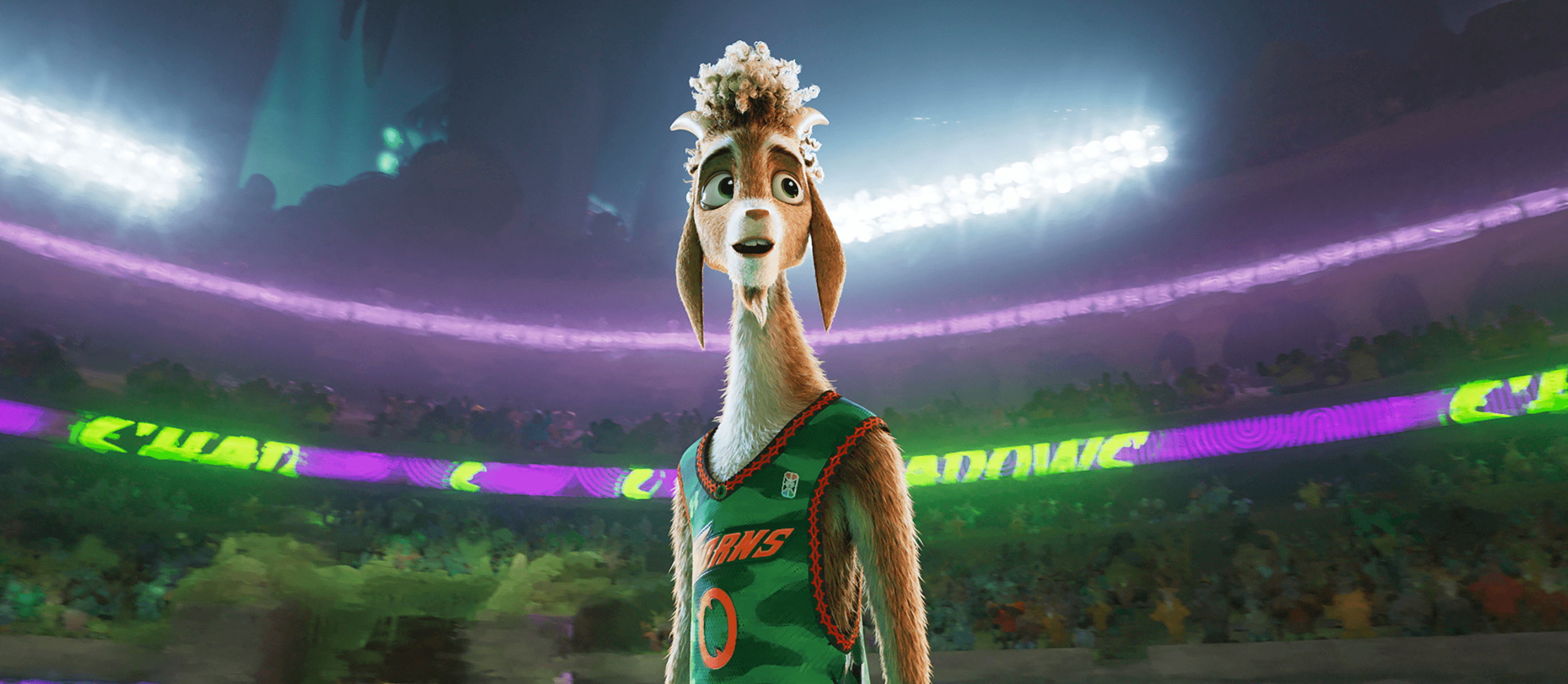
For anyone unfamiliar, GOAT is Sony Pictures Animation’s upcoming animated sports film, set to release on February 13 during NBA All-Star Weekend. The film follows Will, a small goat, as he chases his dream of going pro in Roarball, a fast, physical, co-ed sport inspired by basketball. Roarball blends high-flying action with environmental chaos, placing athletes in massive arenas shaped by distinct biomes.
The voice cast includes Caleb McLaughlin as Will, with Gabrielle Union, Nick Kroll, Nicola Coughlan, David Harbour, and Jenifer Lewis. GOAT is directed by Tyree Dillihay and Adam Rosette, with Michelle Raimo-Kouyate producing.
During a recent press day at Sony Pictures Animation, Dillihay and Rosette walked the press through the development of GOAT from the ground up. Very early on, Dillihay made it clear that basketball culture was not an afterthought. It was the foundation. He described the film as one where the sport had to “feel lived in,” not staged or stylized for effect.
The World of GOAT Is Built Like the Court Matters

One of the most striking takeaways was how much the environment shapes the action in GOAT.
Production designer Jang Lee and art director Rich Daskas explained that each roarball team plays inside a biome designed to influence how the game unfolds. These arenas are not neutral spaces. Courts feature elements like ice, lava, wind, vines, and uneven terrain. Lee described the court as “another defender you have to read and react to.”
That idea reshapes the action. Players are not just reacting to opponents. They are reacting to the world itself. Daskas noted that Roarball was designed so “the environment is always talking back,” forcing characters to adjust their instincts and timing on the fly.
The result is action that feels unpredictable and physical, even in animation, mirroring the reality of basketball, where momentum, spacing, and surroundings constantly shift as the other team throws things at you.
Character Design in GOAT Feels Personal for a Reason

Watching the character design breakdown for GOAT, I kept thinking about my own frame growing up. I’ve always been tall and lanky, with what my friends used to call KD arms. Long. Awkward. Still figuring out how to move with confidence.
That body type matters in basketball. It affects how you play, how you are guarded, and how people size you up before you ever touch the ball. Seeing Will designed with that same wiry build made the character feel honest. Lee explained that Will was intentionally built as someone who “hasn’t grown into his body yet,” a player still learning how to use length and timing rather than raw strength.
That thinking extends across the roster. Characters are intentionally not polished. They sweat. Their shoes are dirty. Their clothes wrinkle and stretch. Daskas noted that nothing should feel “fresh out the box,” because real hoopers rarely are, especially in the environments the film places them in.
Hairstyles and fashion pull directly from basketball culture, blending streetball influence with modern NBA style. The goal, as Lee put it, was to make the characters feel like they belonged to the world long before the camera ever found them.
How Trading Card Culture Lives Inside GOAT

That attention to specificity does not stop with how the characters are built. It also shows up in how GOAT chooses to celebrate moments.
The impact frames immediately reminded me of a more complex version of the MVP cards that pop up at the end of a Marvel Rivals match. If you know, you know. That same instinct to pause, highlight, and immortalize a performance is baked directly into the film’s visual language.
Motion graphics effects artist Dylan Casano explained that the idea was to treat big plays the way basketball culture already does, by “immortalizing a moment the same way a trading card does.” Foil textures, typography, worn edges, and stat-style layouts are pulled directly from card culture.
What makes the impact frames work is restraint. They do not stop the action or pull the viewer out of the scene. Casano noted that the challenge was ensuring the graphics felt like they belonged in the animation, not layered on top of it.
Each character’s impact frame reflects who they are and how they play. Some feel scratched up and raw. Others feel cleaner and more official. The effect mirrors how basketball culture already freezes highlights in time and turns them into something collectible.
How Unreal Engine Shaped Action in GOAT

To support that level of immersion, the GOAT movie team built a new production pipeline.
Head of cinematography John Clark walked the press through how Unreal Engine was used alongside Maya to block plays, test camera angles, and adjust timing in real time. This approach was critical for sequences involving large crowds, fast movement, and constantly shifting environments.
Clark described the goal as putting the audience “on the court with the players,” not above the action. The camera stays close. The speed feels intentional. The perspective keeps you inside the chaos instead of observing from a distance.
Why GOAT Feels Timely

At its core, GOAT is an underdog story. It is about learning how to believe in yourself when the odds are stacked against you. Basketball culture becomes the framework for exploring identity, confidence, and ambition.
With its February 13 release approaching, GOAT stands out as a project built with intention. The craft is deliberate. The cultural references are specific. The visual language feels confident.
For anyone who grew up with basketball as more than just a game, GOAT understands the assignment.