

Earlier this month, we were given the honor of visiting the hallowed halls of Pixar Animation Studios to get a first hand experience in seeing how their latest classic-to-be, Elio, was created.
We got to animate an alien for ourselves, record lines with Elio, himself, Yonas Kibreab, and got a sneak peek at three completed scenes from the film (all of which you can read about here). However, that was only half the story, as we were also given the opportunity to personally chat with many of the filmmakers that brought the magic of Elio to life.
Today we’d like to share one of these special conversations with you all!
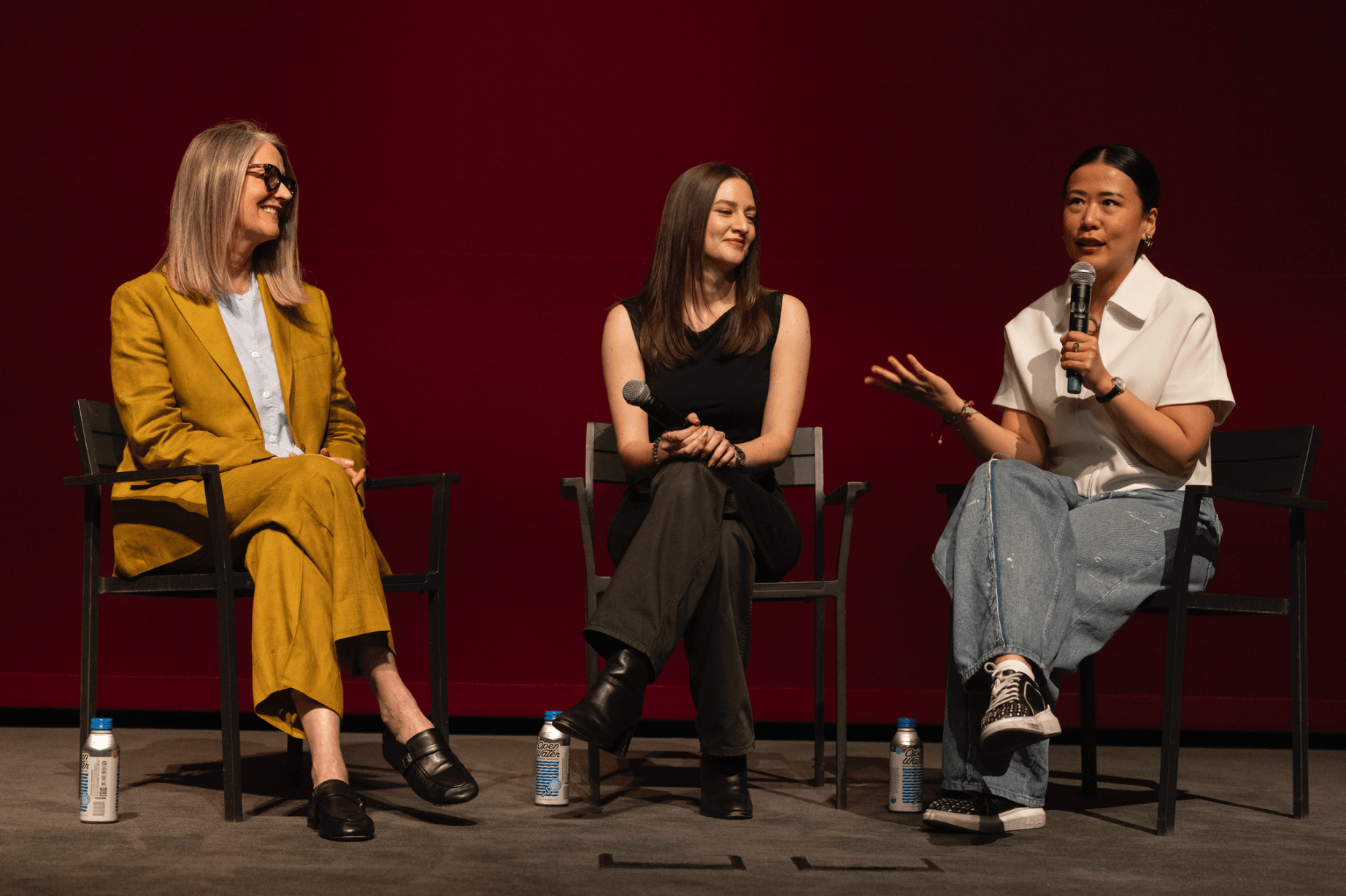
A Special Press Conferencewith Domee Shi, Madeline Sharafian, and Mary Alice Drumm

The second half of our Pixar visit included a wonderful 20-minute press conference with directors Domee Shi and Madeline Sharafian, and producer Mary Alice Drumm. Together, the trio was able to talk us through how the project evolved over the past few years, what it means to them, and what we can expect from their charming new film.
Are there any Easter eggs in Elio that we’re going to be seeing?
MadelineSharafian: Domee and I, and also a lot of people on the crew are huge sci-fi fans. And we wanted this movie to feel like Pixar’s love letter to sci-fi. So, obviously, you could easily draw a parallel with E.T. Spielbergian films were a huge inspiration. Close Encounters, and even some that you may not expect, like John Carpenter’s The Thing, and Alien. I think there’s just something about the visual style of these movies. A lot of them have iconic soundtracks as well. So, we reference that a lot in our score. And we want the audience to, kind of, keep their eyes open for little moments that they might recognize. And even the way that we lit and added noise to the film, kind of tried to recreate that rich, a little bit nostalgic, sort of, sci-fi feeling.
Is there any way you would all use AI anywhere in the process of structuring your films or just to do stuff?
DomeeShi: I just know, for us, that we take a lot of pride in the fact that our movies are handmade here in Emeryville, California by an incredible crew of people. These movies are really hard to make. And, you know, it’s animation, which means you don’t get anything for free on the screen. Like, every single thing that you have seen, like every set, every prop, every piece of fabric, a hair follicle, was made by hand by a human. And I think, you know, we strive to tell very human stories. And in order to do that, I think that human stories should be told by humans. So, that’s kind of been our philosophy in making this movie. But, you know, technology will continue to evolve. But I think Pixar movies will always have that handmade touch.
You touched upon loneliness being a key part of Elio’s journey and storyline. What do you personally want audiences to take away when really thinking through that and that piece of that story?
Shi: Our hope is that, you know, this movie encourages people to connect with others around them. To reach out and make a connection with someone, maybe, who doesn’t necessarily look like them or is, maybe, the same species as them, like Elio does with Glordon. But, yeah, I think especially right now, our world seems more isolated than ever. So, our hope is that this movie just encourages us to come together and observe and marvel at the stars. And kind of think about our own place in the universe together.
Sharafian: Yeah. I think I agree with Domee that, right now, the way that the world feels is very much how Elio feels at the beginning of the film. There’s sort of this very pessimistic view of planet Earth as a whole, which I feel might be a relatable feeling right now. And at the beginning of the film, Elio has black and white thinking. He thinks, you know, there’s no way Earth could ever be a place for me, and it’s completely written off. And I think our hope is that if any audience member who’s watching the film might be in that headspace at the beginning of the film, that maybe they can walk away from it with something a little bit more hopeful. You know, we can’t solve the world’s problems. But I think we can try to help ease people’s individual struggles.

Did any elements of the story come from your own personal journeys as a child?
MaryAliceDrumm: Yeah, I think, Adrian Molina is one of the directors of the film. He’s the original concept, and certainly there’s a lot of Adrian in this film. Adrian’s dad was an Air Force dentist and Adrian was born on an Air Force base. And I think one of the keys that he brought to the film at the beginning was just growing up as an artist in a family that was, maybe, more military. He felt a little bit out of place. And he would talk about how, when he ended up going to animation camp, it was really the first time he found people like him and really felt accepted and excited. And that became, kind of, a metaphor for the story. But I think Domee and Maddie really, too, as well.
Shi: Yeah, I definitely, kind of, infused a lot of my own experience into Elio. I was definitely that weird kid in school that was obsessed with this one thing that no one else was really into. For Elio, it’s aliens. For me, it was anime, which is really big now. But back then in the 2000s, it was less so. Yeah, I was Vice President of the Anime Club. My best friend was President. There were only two members in the club. And every single day, I would hope and dream that I could get to a place, like animation school or Pixar, where people understood all the references that I knew. People understood the jokes. People kind of talked my language. And I was just so determined to get there. And I think that determination is kind of what inspired us to write Elio in that way. Just he’s just so hellbent on getting into space, no matter what. And once he’s there and it’s this magical place where he finally feels like he belongs, he’ll do anything and say anything in order to stay. So, yeah, I feel like Elio is very much a part of us.
As Co-Directors, how did you divide creative technical responsibilities to ensure a cohesive vision on this movie?
Sharafian: Yeah. I mean, I think what made this process work is the fact that Domee and I have already been friends before we even embarked on this project in the first place. We also share a lot of creative sensibilities. I was lucky enough to be one of the Story Leads on Turning Red. So, we already knew that we aligned on a lot of things, especially things like emotion and humor. I think, making movies can be a really stressful process and it’s obviously very hard. But by having someone next to you at all times who is a friend of yours, it actually makes the whole experience a lot more fun. I mean, we know that if we’re working on a joke in, like, an editorial session, if one of us is laughing at a joke the other one is making, then we’re on the right track. So, it actually, I think, helped us a lot. And the friendship that we have, I think, kind of infused into the friendship that Elio and Glordon share. There’s definitely moments that are taken straight from us in the movie. And I feel lucky that there’s this little time capsule of our friendship on the screen.
Shi: Yeah, and, you know, in terms of how we would run meetings or dailies, I think it was always important for us to gut check with each other before we walked into a room.
Sharafian: There was lots of eye contact.
Shi: A lot of eye contact. A lot of active listening and gut checks at the end of a meeting as well. We were always really honest with each other. And, you know, our tastes did align most of the time. But when they didn’t, we would be comfortable enough to bring it up with each other and hash it out. So, it was just a really great collaboration, I think, that was was really fun.

What made Elio the project to use “The College Project” on (the process of everyone going into the room, ignoring titles, roles, ranks out the window, and deciding on the best ideas)? What was the decision there, that this was going to be the one where we opened it up more as opposed to other projects?
Drumm: Yeah. I think working at Pixar is so great ’cause every film gets to decide how they’re gonna work and different films have worked in different ways, and other films have had shots departments, which handle a certain amount of the work. But I think when we were extended, we knew we were going to take more time. We had a leadership that really knew each other. And so, we decided to challenge ourselves. And we called it, “The College Project” because it was just a way to make people think differently. But I think a large part of it was Domee and Maddie are so open and so flexible as directors, and really willing to work with the group. And we had this group of supervisors who were also really close. Again, leaning on the friendships, and they really loved being in the same room. So, it’s often about the people. But yeah, it was a great show to experiment on. And I think it was really positive for almost everyone and something we might explore on other films.
Shi: Yeah, it really allowed us to work fast because we could just grab a supervisor that was just right beside me, and shove their head in front of the computer screen and be like, ‘Look at this.’ Or you would poke your head on their screen and be, like, ‘Can I see that?’ And that’s something that you can only do by work being under one roof, working in person. It was just a really collaborative, kind of hands-on way of working, and we were able to get so much done so quickly, which was amazing.
As a Latina, hearing Elio’s last name, what’s his background? I’m just curious. Do you guys base on a specific background?
Sharafian: Elio is based on Adrian Molina’s background. So, he is half-Mexican and half-Dominican. Zoe Saldaña is Dominican. So, for that side of his family we wanted to make sure we preserved that for her. We got a lot of Zoe’s input to get little details right, even touches in the Solis household. If you look closely, you’ll see some, Dominican folk art shelving behind them when they’re having dinner in this one scene. But it was important to us to make sure that we kept checking with our — we have an internal cultural trust. A lot of people on our crew got to weigh in on small details. Like, when Elio was packing to be abducted to go to space, what kind of treats would he pack in his bag? He’s going to pack his favorite. So, we wanted to make sure that we got that right. We were very lucky to have people on the crew and people externally, as well, who helped us really make sure that we got that right so that you can see yourself a little bit more when you see the Solis’.
What tonally did you want to get from Domee when she was brought on to the project? Like, when you hire her, what do you get from her?
Drumm: Oh, my gosh. I could talk about this all day. I have a whole agenda of other movies I want Domee to make, which she knows. I mean, Domee is an amazing filmmaker. She’s an encyclopedia of films. It’s so impressive. I think she has grown up on great animation, knows it, and knows Pixar films really well, but brings her own sensibility. And I think Turning Red is just a fun, different kind of Pixar film. There are scenes in this film that are not in the clips you’ve seen today that I think really reflect both Domee and Maddie. I like to say they’re a Venn diagram. They’re both two very different creative people, but there’s a big part where they overlap. But yeah, I think Domee can be irreverent, very, very funny, and likes to joke that she’s not that emotional but actually has a wonderful heart. And I think you’ll see that irreverence and that heart in the film. I can’t wait ’til you see it all because Maddie also brings a lot of wacky and a lot of heart as well. But yeah, it’s a privilege to work with them, and the crew loves working with them. They’re so decisive, so creative, so clear.
From a creative standpoint, how does knowing the film will be on the big screen inform your process?
Shi: It definitely informs our process. Like, for me, I love watching sci-fi movies on the big screen because that’s pretty much the only way just to absorb the scope and scale of space. And, you know, we definitely thought about the screen when we were making this movie, when we were shooting it. Just that moment when Elio gets abducted and he first gets to experience The Communiverse for the first time. And we just totally went all out and just really tried to just think about audience immersion, and what it must feel like to be transported to this magical, colorful, vibrant, otherworldly place. And just really just tried to cram as much detail and color into every pixel of the movie when you’re out in space. And just feel what Elio’s feeling, which is just, like, ‘Finally, I’ve arrived. I’m in heaven. I never want to leave.’
Sharafian: Yeah. And I don’t know if you’ve had the chance to see some of the other rooms on either side of this room, but Pixar has a lot of smaller theatre rooms. Whenever we’re reviewing any piece of the movie, anytime you can possibly watch it on a screen that’s as close to a movie theatre screen, we will take that chance. Because the more we get in our headspace and what we want the audience to experience, the bigger we can go. Sometimes, we realize, oh, maybe we shot this too tight. We can go a lot bigger. Like, Elio could be this tiny little dot on the screen. It’s going to feel epic. So, we’re committed to making that sort of intense cinema experience. And the score is a big highlight of this movie. And it’s a music-forward movie. We turned up the score. So, the best way to experience the sound and picture at the same time is in the theatre. It’s pretty incredible.
Shi: Yeah. And it was you who changed the aspect ratio, right? Like, you want to talk about the two, three, nine of it? Get nerdy about aspect ratio!
Sharafian: Yeah! When I first started on the project, I mean, a lot of things already existed. But when I talked to Derek Williams and Jordan Rempel, our DPs, something that they pitched to me they were really excited about was if we’re doing a sci-fi movie, shouldn’t we be doing it in widescreen? And they showed us this sort of demo reel in this theatre. It was just maybe, four people in here of what The Communiverse looked like before and what it looked like after in the widescreen. And it was this no-brainer creative decision. It’s a lot more difficult to switch an aspect ratio from an organizational standpoint. But for us, it was very much worth it. And I’ve never looked back. It looks much, much cooler this way.
Drumm: And I’ll say, everyone here loves seeing movies on a big screen. And I think even for us, watching the movie over and over and over again, I’m constantly surprised where there’s one little detail you saw an animator threw in that you’re just noticing on your fourth or fifth time. So, everyone here is absolutely dedicated to seeing it on the big screen and making that a great experience. And, of course, seeing it at home would be fine. But you’re not going to see everything you’re going to see on the big screen.

A lot of people have talked about The Communiverse and how it kind of opened up this creative path because you weren’t Earthbound, and you wanted a lot of characters that were very alien, that didn’t feel like they were just, you know, humanoid versions of aliens.
Can you talk about figuring out the balance between delivering something that is otherworldly but also not venturing so far that it’s hard to get a grasp on and still make it feel like something that people can connect to?
Shi: Harley Jessup, our Production Designer, he was really inspired by macro photography and just really trying to create this look of space that we haven’t seen yet in any movie, but also trying to keep it grounded in some rules, like in macro photography; just the organic shapes and the translucency. And just having that as kind of a theme throughout The Communiverse was something that he kind of kept track of. And I think for us too, well, for me, one way that we were able to kind of keep things grounded it was important for us that all of the main alien characters had eyes. Except for Glordon. But just making sure that there was enough design in the face so that audiences could understand the emotions that were being expressed through their bodies and faces.
Drumm: Absolutely. And I think Harley, if you think back of all the films Harley’s made, like, for me, MonstersInc., you know, is a world where you have all these different species of monsters, but it feels like one cohesive world. And I think with The Communiverse, he just brought that skill of all these different kind of aliens but still making it all fit together.
Sharafian: And I feel just to plug them, it’s a testament to our animators as well that they are able to rise to the challenge of not every alien gets a face. And when Domee and I give the direction of, like, Elio needs to look behind him and see all the aliens looking at him hopefully, they need to figure out how. How did they make something with no face look hopeful? And they figure it out. They actually are so advanced at this point that I think that kind of challenge, kind of, lights their fire.
Shi: Yeah. And I think also, like, animation style-wise, we went with a little bit more of not super realistic, but a little bit more of believable motion in all the aliens, all the humans. It’s not gonna be as wacky and snappy as Turning Red, which was more inspired by anime. But here, you know, because the designs are so crazy, we still wanted to ground them a little bit in some more realistic physicality. So, when you look at the character Questa, that large, flappy, pink alien goddess, you know, she still moves very liquid and smooth. But, you know, there’s a physicality and a realism in the way that she moves, which is really cool. So, that’s another way that we were able to balance that out.
How do you get emotion across in films like Elio?
Sharafian: I think, for us, and this is something that Pete Docter really helped coach us through. Obviously, he’s the master of these sequences here. Our goal is that these sequences should be able to play without any dialogue attached to them. So, if you were to turn all the sound off in your strongest emotional sequences you should be able to get that feeling without any words. And there was a scene near the end of the film, our, finale moment. You guys haven’t seen it, ’cause it would spoil everything. But our first pass at it, it was kind of working. But it wasn’t reaching that emotional peak. And Pete challenged us to take the script, cut everything out, and just put music on top of it. Just put the theme of the movie on top of it and see how that will work. And we were very nervous [laugh]. But it totally worked. And I think I, personally, learned a lot from watching the way that he was willing to just take things out, even if it might disrupt what we were currently working on, for the greater good of the film.
Shi: Yeah. And I think, you know, Andrew Stanton has also been kind of a guardian angel for us too. And he’ll always just, kind of, be in the story room banging his hand on the table, being like, ‘Just make me care! Make me care about your character. So, that’s kind of what we had in the back of our heads as we were thinking about this movie. And, you know, we also consulted with a lot of child psychologists. We talked to the Surgeon General about this loneliness epidemic that is happening with a lot of young people and children in our world. And just tried to approach this character of Elio with a lot of thoughtfulness and sensitivity. But, you know, just tried to tell this truthful kind of story about a lonely kid who’s looking for connection.