

Over the past month, we’ve had the good fortune of sharing details about our incredibly special day at Pixar with you all, in which we got to celebrate the release of their latest film, Elio.
We first brought you details about the special activities we did there. We then brought you an awesome press conference with directors Domee Shi and Madeline Sharafian, and producer Mary Alice Drumm, And for today, our final installment in our set visit coverage, we are proud to bring you our conversations with the entire team that brought this intergalactic adventure to life!
Ernesto Nemesio (Lighting Art Director) & David Luoh (Sets Supervisor)
Thank you both for today. Ernesto, I’ll start with you. Did you get a chance to do the VR testing with David, and did that kind of help influence where lighting might go throughout the actual 3D rendering of the movie and the sets when the movie was actually being animated?
ErnestoNemesio: Great question. I wish I had done the VR stuff. We were in really early stages of thinking about lighting, and so there was no actual set dressing yet. It was…as you might have seen, those very basic shapes. So it’s great for finding compositions and staging and camera work, but for lighting, because we’re still trying to figure out what’s going to be in the Communiverse, we hadn’t decided on what type of vegetation or buildings, what the light sources were going to be.
Everything I do is so light driven so that without all that information, there’s nowhere for me to build anything on. So at that time, we were just still exploring concepts. And so, yeah, we were still doing the VR later in the process. It would have been really helpful for me, but because it was later on, all the information I needed wasn’t quite there yet.

David, for you, one of the things that I spoke to Ernesto about earlier was that you all are ideating on every part of this from the very beginning to the end of the actual production. When you saw Ernesto’s sketches, and the way that the lighting might affect the scenery and setting as you’re constructing everything in VR, was there kind of a constant feedback loop for you as you’re ideating on the sets and creating them from scratch?
DavidLuoh: I think, you know, Ernesto and a bunch of the other folks across art and lighting really helped us continue to enhance things, especially the light sources throughout the Communiverse because it’s a place that is full of luminescent glowing…and how they glow from a close up, macro perspective. But also just the Communiverse as a whole, including even like the nebula in the space beyond. So we were constantly being inspired by evolving artwork, and ideas that we were getting from conversations. Conversations with the directors, with the lightning department and with other folks across the crew. So yeah, I think in sets, because our work also spans so much, from just discovering that the shape of a room all the way to through to supporting our sense through final lighting, there’s a continuous opportunity.
Nemesio: And it’s the same for me too, because David thinks that they would be doing those that they were inspired by from what we were doing, but they were making it better. So then once they made it better, then we were inspired to go back in there. So it’s definitely very much a back and forth. Kind of inspiring one another to where we ended.
Really, one of the most inspiring things about hearing about the work environment at Pixar is everybody teams up and they work together. They collaborate in a beautiful way that generates something so amazing. True art. My last question for you guys is this: When we’re talking about planets and the galaxy, there’s so much out there that’s just unknown, and you guys have to really make that up from scratch.
Now, you got some direction from the screenplay, which is focused a lot on the characters and narrative. And then, of course, Domee and Maddie, are there to help facilitate. But a lot of this just comes from scratch; from you guys. So did you have to do any research into planets and lighting sources from where a planet would be in our solar system and what the terrain would look like when you constructed this?
Nemesio: No. I think we kind of tried not to limit ourselves. Because I think there was a concern that if we started researching a lot the scientific aspects of it, that will really start grounding it. So much that it will limit what we can do. So a lot what we ended up doing in the universe is not physically possible, but it’s what makes it magical. It’s like you’re kind of going more towards the fantasies and less towards reality. So I think we purposely kind of give ourselves a lot of leeway. Like if, for some reason it bumps, because it’s too far fetched, then we can always dial it back. But I think the idea was to not give ourselves some limitations, really.
Luoh: Yeah, I think there’s always the overarching structure of the contrast of Earth and the Communiverse…sort of fully vibrant and imaginative in space, and the creative license also. Because the Communiverse isn’t a planet that just exists in nature. It’s like a thing that these alien species have come together and created. So the terrain itself doesn’t have to be naturally formed. It actually has sort of this sort of alien-made quality to it that gives us freedom to take some inspirations from what we see in nature here on Earth – things like coral and fungi and seashells – and spin them into what we hope is this balance of elegant and simple, but also rich and vibrant. I feel like that was sort of the framework that helped us start to wrap our heads around what the Communiverse might look like.
I love that, because this is how you transport us into some place that we’ve never heard of or been before. And how for so many years, you all have just done stellar work on that. I can’t thank you enough.
Jude Brownbill (Animation Supervisor) & Travis Hathaway (Animation Supervisor)
So character goes beyond the dialogue. That’s all on the page. But we have to look at body language too. And really, that’s what you guys do. You infuse the body language into these characters. So I wanted to ask, what is the process of the script informing that character, first and foremost, and then the feedback loop of the movements that you guys infuse into these characters, that informs the character further?
JudeBrownbill: Elio being a kid, he wants to be abducted…so to the detriment of even, you know, going from A to B without bumping into things and knocking things over, you know, he has a lot of energy and a lot of drive. And so that can flow into the choices we’ve made. Like, energy, to go straight from what he wants and sometimes run away. And that’s all because that is his goal, and it sort of all came around full circle.
When you look at the history of Pixar films, it’s like watching the history of computer animation unfold, because you’re revolutionizing on every single movie. And I love that. I want to ask if you could talk about some of the biggest challenges from Elio. And can you speak through the process of how you overcome and ultimately approached some of those challenges?
TravisHathaway: Yeah, that was kind of new for Pixar. New tech for us. It’s been around for a little while outside of our studio, but it’s the first time we’ve ever implemented it. But yeah it really comes down to the breadth of characters that we’ve had to try and realize, and the different kind of solutions that were required to kind of execute each one to its full fullest potential. Some of those involved like super complex rigs that had a ton of math. Some of them used that tech that we had never really used before.
I think getting all the animators – we had maybe like 90 total, something like that – to kind of learn the rigs that they needed for the characters that they had in their shots. There’s so many shots that had 20 different types of characters. So how to organize that work so that, you know, someone can track the most important character in the shot, and in a chunk of shots. And then other people can kind of focus on some of these groups, or those groups of characters. Just kind of organizing our way through the production of the film was really challenging.

My final question: were there any innovations that you guys wanted to do on Elio, but it just didn’t seem to fit in the movie, and that you’re looking forward to potentially using in the future?
Brownbill: The story pushes the direction we go. So as long as there’s something to say, then we can go, “Okay, let’s try and do that.” I think you saw what the Communiverse will be. What the scenario is, which is that it’s like paint floating. That was a very complicated rig to make and animate…so, I think, the best thing to say is whatever someone comes up with next, whatever drives the story drives the tech.
Hathaway: If there’s room for evolution or revolution of technology and a reason to do it for the movie, wow, we can’t figure out a way to do this one thing that we know we need in the movie, then they’ll pursue and perfect and implement that tech, just like, do you know if, if at some point we have decided we don’t want to use these men, of all things. We might have done that 20 years ago, but we never really had a reason to pursue it until now, and somebody says, I know what we could use. It feels like new to us.
I want to thank all for really pushing storytelling forward, pushing tech forward, and pushing the ways in which we can convey story, character and emotion forward for the future of cinema. Thank you!
Harley Jessup (Production Designer) & Claudia Chung Sanii (Visual Effects Supervisor)
I want to start out by saying thank you guys, not only for the presentations, but literally for your contributions. Literally, I mean, from Innerspace and Ghostbusters to Incredibles and Up. I’ve been watching your work for a long time and loving every second of it. And it just warms my heart to be able to talk to you both.
Harley, if I could start with you now. First off, congratulations on your legendary career. With as much as you’ve done throughout this amazing and illustrious career, by the time that you got to Elio, did you feel like there were no challenges with this movie? Or were there still challenges that you felt you needed to conquer?
HarleyJessup: From a production design standpoint, with this one, there definitely were challenges. I felt like, when I read the synopsis of the story and the directors pitched the idea, I thought, “Okay, there actually is technology now.” Now is the time that’s perfect for this movie that I think, even five or ten years ago, it would have been possible, but it wouldn’t have been as great. And the possibilities visually are so awesome right now. And Claudia, her approach was always go for it, challenge us. And I think that really was reflected in what we were able to get on the screen.
With Pixar, you all set the bar, and then you top the bar, and then you keep topping the bar. And on that same note, Claudia for you, with everything that you’ve seen from Incredibles and Up, I feel like there’s always something new that you learn on each project that you take with you to the next one. For Elio, can you single out any specific things that you felt were completely new for this one, which you feel are definitely going to help Pixar on the next few movies?

ClaudiaChung Sanii: Harley is not wrong…I do think we’re at this golden age of computer animation art, where anything is possible. And so for Elio, when they were like, “Can we make a space that we’ve never seen before?” I’m like, “Yes, probably. Are you ready?” And Harley was so open for technical artists to be in his art room and work with him and his artists. And there were no titles or lanes.
And so much of how we work was previously built because there had to be lanes, because we didn’t know what the heck we were doing. But now the abilities of the artists and the people here are phenomenal. And so what I hope to take on the next films is the idea that it’s not prescribed. We can do anything…and try different, crazy ideas, right? And I love that the crew and the leadership and the supervisors on this team embraced that. They were willing to go there.
One of the things I spoke about with Ernesto and David about, was that when you think about space, there’s so much that has been unexplored. And a lot that also has been somewhat theoretically written about. And they said that they wanted to just throw the book out the window and let the imagination fly, because things don’t necessarily need to be grounded by reality and science. Did you guys take that approach for this as well?
Jessup: Well, we definitely took advantage of the device – the translator disk – and made gravity variable and controllable. It also made atmosphere. So there’s a little bit of magic there to allow characters to breathe in space and but at the same time, there were other things that, like, the stars Claudia was telling me about.
Chung Sanii: Yeah, the stars in Elio are really based on the real stars in the universe. So, like, because that data is available we sampled that and created points of stars. And so when Elio was hanging up at the stars, those are real stars you would see at the summertime in Northern California. And then the Communiverse is situated at the Felix Nebula. So when Elio is looking at the stars there, that is what the stars will look like from the Felix Nebula. It’s super nerdy, I know.
But to your question, I think there’s a bit where we try to be authentic as possible. Because I think as humans and earthlings, there’s a grounded truth. Like Harley’s exploration of microscopic platforms and things that are recognizable to us as humans. So we’re not so discombobulated when we’re seeing the universe, but at the same time, the fact that it’s set in space gives us a “Get Out of Jail Free” card. So if something doesn’t make sense, like time travel, both can be true.
That’s honestly the best thing about what Pixar does. We feel connected to it, because there’s is that element that we relate to and that we are knowledgeable of. But you also take us to places that we’ve never gone before, and for that, I want to thank you both for everything.
Jasmine Derry (Simulation Technical Director)
Honestly, based on everything that I’ve seen for this movie, I love it already. There’s so much art, there’s so much emotion, and there’s so much going on in the foreground, in the background; the way that you are building out this entire Communiverse is astonishing. I have to commend you for your work there. Just really, truly brilliant.
JasmineDerry: Of course, it’s definitely a team effort, but I was definitely proud to be a part of that team. It was a really special project to work on.
It looks like it too, and I can’t wait for audiences to see all the work that you put into it. When it comes to effects for animation, there’s always so much that Pixar is doing to set that bar. I gotta ask, were there any specific challenges for you going into this project, creating the universe and expanding the world of Elio?
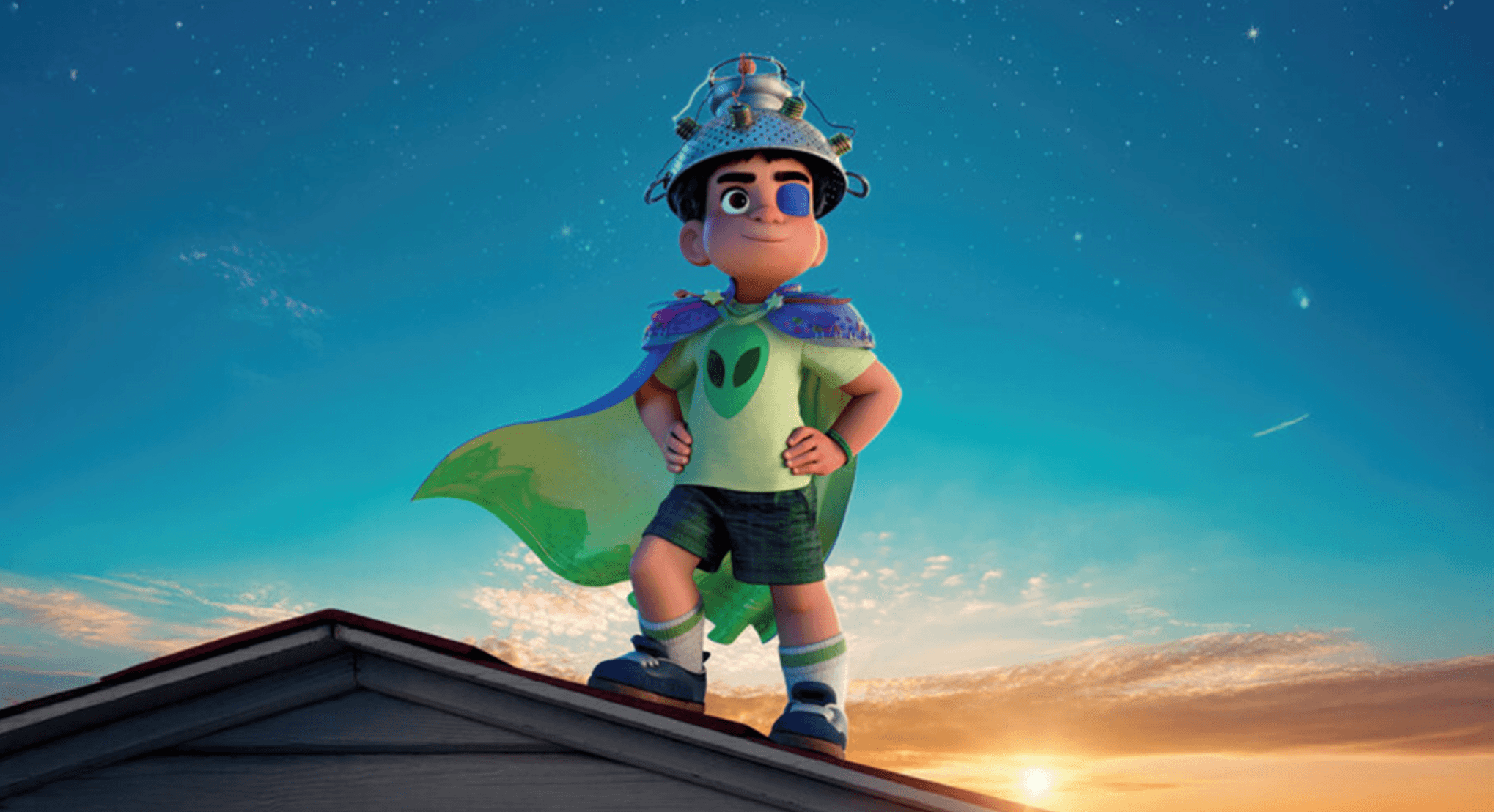
Derry: Yeah, I would say there are definitely some challenges. I think the number one thing, which is something that I see you’re wearing right now, is the cape. Elio has multiple capes, and it kind of acts as its own character. There’s always, you know, a little flourish or when he’s in space, zero gravity. A lot of things where the cape needs to have motion on its own. And while the animation department is handling the acting for Elio, the simulation department handles the cape. It’s kind of like a handoff process.

But in doing that, we also have to ensure that we are supporting the acting. Are we supporting the motion? Are we distracting from the face? Things like that. So the cape definitely had a lot of challenges. We were definitely put through our cases as a department, but I think we ended up with a really gorgeous result. I think that we end up with something that has its own flair and definitely supports Elio and his personality as he goes through the film.
I love that so much, because it says so much about the character too, you know? And I really enjoyed that. It’s kind of funny, and I find it ironic that you could do something like an explosion, or you could do something like the world and the universe and stars and everything going on. But the more difficult aspects tend to be the smaller, subtler details. Has that been your experience working at Pixar?
Derry: Definitely. There’s definitely a lot of shots and a lot of effects that I’ve done in my time in the effects department and the simulation department, where things are so small, but you spend days or sometimes even weeks on the tiniest thing. But all of it is to support the acting. All of it is to support the story. Something that my supervisor said, is sometimes you feel it. You might not see it, but you feel it. Another example is Helix, one of the aliens. He has these little jiggly bits, kind of hanging off of his head. And there’s a lot of care and attention spent putting the angle of it. Is it inflated or deflated? That’s such a small thing, but it is something that adds to his acting, that adds to the emotion. So it’s small, but it’s important. And as a more technical artist, I like that type of unsung hero stuff. It really speaks to me.
It’s that attention to detail that really separates Pixar from everybody else, you know? I mean, anyone can create a character, but that’s not necessarily bringing the character to life. It’s the details and the finite motions that you guys do that makes everything feel real and lived in. And that’s just something that I absolutely love.
If we can get nerdy a little bit, can you talk about the physics that kind of go into play when creating these kinds of effects? Because you’re dealing with things that could be theoretical in Elio, like space, and things that we might not necessarily experience, such as the way that aliens move. We don’t necessarily know. But then you’re also dealing with real life, things like how a cape would would react in zero-G. Can you talk about what you guys did to prepare for the physics of some of these motions and how that all works?
Derry: Yeah! That’s actually a really interesting question. I love nerding out about this stuff. So the thing is, with the physics, is that we’re handling multiple different environments, right? There’s the Earth where it has regular gravity, and space, which most of the time does have regular gravity, but there are also zero-G moments where there’s zero gravity. Specifically for the simulation department, we will create wind fields and also custom gravity fields. So for example, if Elio is flying through space on a Communiverse disc there’s a wind field that’s applied that makes the cape kind of stream behind him. And whenever he’s in zero gravity, we don’t have any wind field or any gravity, per se, but we’re still applying custom velocities because, although, as a lot of us are very technical at this, at the studio, although technically, there will be zero gravity, artistically, we still have to keep an eye for motion, for timing, for what do we want to see on screen.
So if, whenever we do, a physics based simulation for Elio and it looks physically accurate, but it’s covering up his face, or it’s covering up his knees, so we can’t see the silhouette, we will actually add in our own custom forces in order to help hit poses. So it’s kind of a combination of physics space and artistic space, but a lot of what we do when handling the physics is apply a lot of custom velocity fields and custom gravity fields.
I love that, because you’re bringing to life things that we haven’t seen, but you’re also making it feel realistic with the things that we have seen. So that’s really cool. Jasmine, I wish we could talk all day. I could get so much nerdier for you, but I know that we’re at time, and I just want to say congratulations on this amazing film and all on all of the work that you’ve done at Pixar, because you guys are the wizards and geniuses that bring these worlds to life, and have been part of us for 30 plus years already. So we’re so grateful for all of it.
Mary Alice Drumm (Producer), Madeline Sharafian (Director) & Domee Shi (Director)

So first off, thank you guys so much for being with us. Not only does this look incredible, but I’ve just been so inspired and influenced by all the work that you’ve done already at Pixar, and you’re just changing the game once more with this one. So thank you so much for all of that.
For us, this is such an inspirational movie, because we don’t get a lot of POC representation from most major studios. That’s one thing that I love about Pixar in general. When you guys debut a film, everything in the movie feels authentic: the world, the characters, and their relationships. It’s especially so when you center a movie around People of Color and having them take the lead. So when you do have a POC lead, like with Turning Red or Coco, and now Elio, what are the steps involved ensuring that that authenticity is reflected on the screen, so that we’re feeling it the same way that we felt it would Turning Red and Coco?
DomeeShi: Yeah! I mean, the first step is just trying to involve as many People of Color in that creative process from the ground up. This movie is very much inspired by Adrian Molina and his own background as the military brat with an affinity for art; just feeling like a lonely kid on the base. That moment when you went to animation camp and feeling like you finally found a place where you belong – when me and Maddie came on, we immediately identified with that feeling. It was like when we went to animation school the first time, but also like thinking back to when I went to my first anime convention high school. It was Anime North, the anime convention in Toronto (Canada). I stepped through the doors and was like, “Oh my gosh.” And that feeling that Elio has is kind of inspired by that.
We worked with several cultural consultants. There are many people on the crew who were from a Latin American background. It was also important for us to create a safe space in every review that we were in. And every room that we were in that people could chime in. People could raise their hand, flag something or offer a suggestion. And just making sure that the kind of process was very inclusive and inviting to these voices.
When Adrian first had this project and then you guys inherited it, what evolved between when the story was first created to now?
Drumm: It’s so collaborative here at Pixar, you know. Adrian had this idea and Matt, he was actually one of the first people working with him doing drawings. Domee and Maddie were at every brain trust meeting along the way. So we talked about a lot of building it out the loneliness. And I think maybe you guys just like your love of space.
Sharafian: Elio’s room was a really fun thing to do. We wanted it to almost look like his obsession. When you just see him, he doesn’t have to be doing anything to see him in this room. You know, there’s something weird going on here with this character. So, yeah, we tried to really turn that to the theme. The theme of loneliness was always there at the beginning, but we really kind of brought it to the surface. We added a lot of friction between Elio and Olga. I think it was important to us to really make the audience worry that maybe these two characters would not end up together. And I think it was a little risky sometimes to push a guardian/child relationship to that level; to shy away from non perfect parents on screen. But I’m really glad we did this to capture the emotion.
It’s what separates Pixar’s storytelling from anyone else. Most other studios would pull punches, you guys don’t and that’s the one thing I love the most about your storytelling, your work, and everything that you’ve done so far. So from the bottom of my heart, thank you so so much, not just for your time but for all of that and everything you’ve done for cinema!