

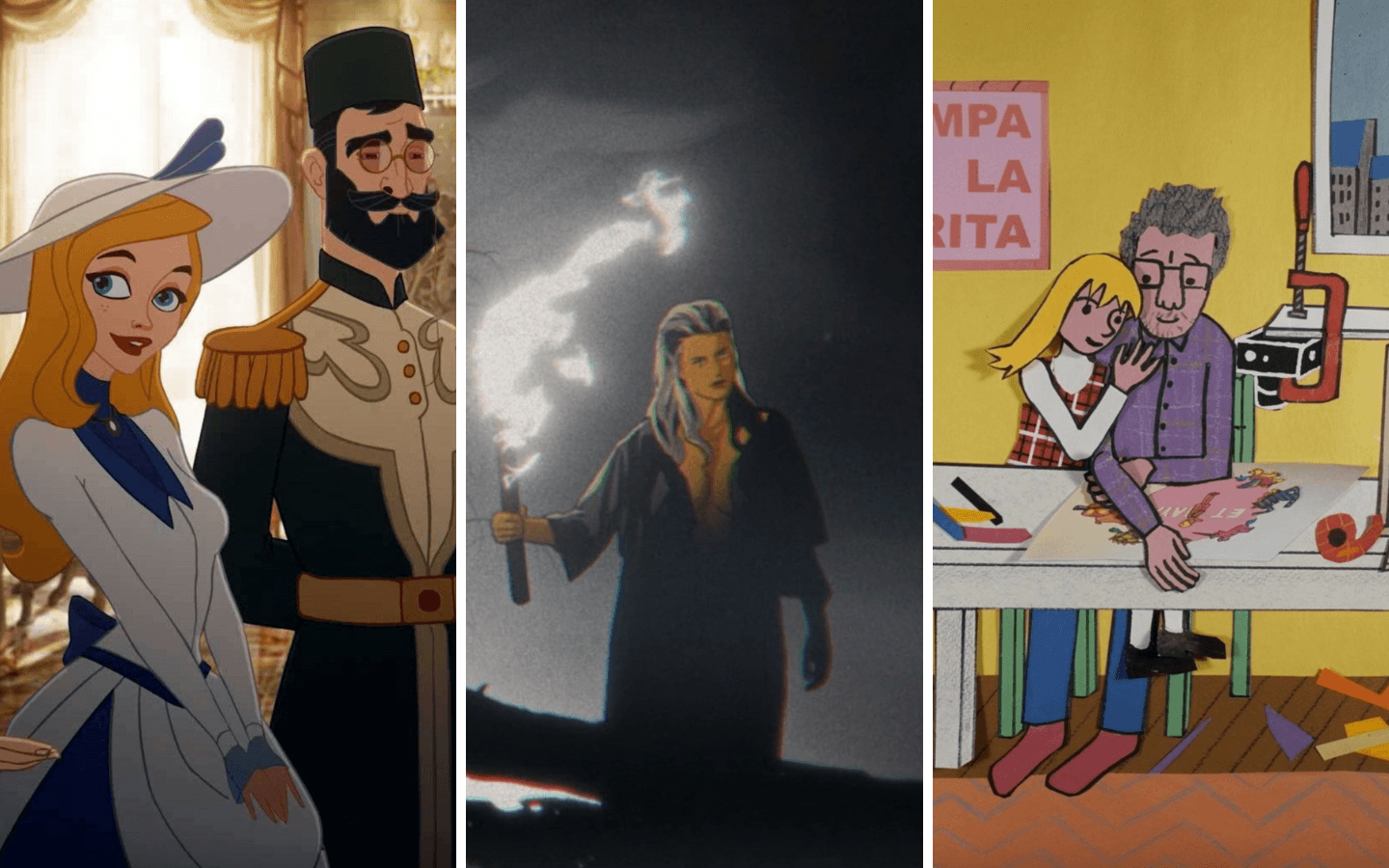
Boasting a massive catalogue, interesting viewing experiences awaited everyone for this year’s Fantasia Fest, which includes nightmarish and gory horror films, bone-chilling thrillers, martial arts action flicks, absurdist comedies, and various interesting and unique animated projects from all over the world.
I made it my goal to watch as many movies at the festival as possible. From the latest project from an established director I’m a fan of or international filmmaker I’m not familiar with, everything was on the table.
Check out my reviews for the animated films I watched during the fest’s duration!
Maya, Donne-Moi Un Titre (Maya, Give Me a Title)
Director: Michel Gondry

Maya, Donne-Moi Un Titre is an interesting little animated film because it’s less of a large-scale studio production made using the most high-tech animation tools and more of a homemade movie designed for only a group of loved ones to see. By design, this is an intentional choice, as all the animation is created using nothing more than colored construction paper, scissors, markers, Scotch Tape, and Gondry’s phone and laptop. The film employs a crude and amateurish filmmaking approach, yet that never detracts from the creativity and imagination that burst forth from this film or how surprisingly often I chuckled while watching.
In the best way possible, the movie evokes the old ForestFire101 Lego shorts I used to watch when I was younger, in that both have so much heart, passion, and genuineness, despite having presentation styles that are a bit rough around the edges. While part of this movie’s charm comes from Gondry’s eccentric style and sensibilities as a director, it primarily stems from the input that Gondry’s young daughter, Maya, had on this film’s production and “storylines.”
The idea behind Maya, Donne-Moi Un Titre, is that Maya gives a title to her father, no matter how wacky or absurd it sounds, and then Gondry takes the title and turns it into an animated short. The film consists of eight short stories, and while some are more entertaining than others, they all maintain a similar level of endearment and sweetness that I found infectious. Each segment has a structure and tone similar to that of a bedtime story a parent would read to their children, and once I understood that was the vibe Gondry was going for, I became that much more engrossed with what was happening on screen. The movie isn’t interested in having a traditional structure, nor are the shorts connected in any meaningful way. For Gondry, all that matters is that the stories being told and presented to Maya are as entertaining as possible, and for the most part, he achieves this goal.
However, as enjoyable as my experience was watching this glorified homemade movie, I will most likely never see it again. Unlike Gondry’s other films, like Eternal Sunshine of the Spotless Mind and The Science of Sleep, Maya, Donne-Moi Un Titre offers very little in rewatch value, as I pretty much experienced everything this movie has to offer in this first viewing. Nonetheless, I still had a fun time and don’t regret watching this film.
Rating: 6/10
Dog of God
Directors: Raitis and Lauris Ābele

Dog of God is the best film I saw at this year’s Fantasia Fest, and that’s a sentence I never anticipated I would write, as I didn’t expect to love this strikingly debaucherous movie as much as I did. With this and Flow, Latvia has quickly cemented itself as a country to look out for when it comes to producing creatively bold and engrossing animated films. That being said, do not go into this film expecting another Flow. Dog of God not only has an entirely different animation style, but it is also a much more violent, raunchy, and explicit movie filled with gore, penis imagery, flogging, and animalistic sex that is evocative of adult animated dark fantasy movies from the ’80s like Fire and Ice or Heavy Metal.
Dog of God is a rotoscoped animated film that revolves around a witch trial that takes place in 17th-century Livonia after a female alchemist is accused of stealing a valuable possession from the local pastor. While the trial is taking place, strange supernatural events start popping up, the most notable of which is the discovery that a werewolf is among their community, who goes by the Dog of God. Despite its period setting and historically inspired premise, Dog of God is, at its core, a B-horror movie with a pulpy, campy, and grindhouse approach to realizing its supernatural and horror elements. From the graphic violence and gore to the inclusion of numerous sex and penis jokes, the movie feels more akin to campy splatter films like Sam Raimi’s The Evil Dead series or Peter Jackson’s Braindead/Dead Alive than a more traditional horror period movie like The Witch. Now that’s not to say that Dog of God is devoid of any seriousness, as one of the film’s most poignant thematic and narrative aspects is its harsh critique of religious zealotry and how the villains (primarily the pastor) use it to justify violence and cruelty against the villagers.
However, it’s clear that the priority was to create a hyper-stylized and maximalist film, and if you ask me, directors Raitis and Lauris Ābele undoubtedly achieved what they set out to accomplish. What makes Dog of God such a visual marvel is its ability to showcase both a wide range of color palettes and surrealist visual imagery that wouldn’t have been possible within a live-action film. There is so much imagination expressed in every frame, and yet not once does the weirdness or surrealism ever feel strange for the sake of it. Every creative choice made in Dog of God, whether it’s a specific color or character/creature design, contains so much purpose that it significantly contributes to either the tone, the humor, or the hyper-stylized/maximalist approach. Additionally, the film’s rotoscope techniques create numerous moments of visual absurdity, such as the strange faces certain characters make or how the pastor runs as he chases after a bird, which adds a layer of comedy that blends surprisingly well with the darker horror elements.
Dog of God walks a fine line between scary and silly, and the result is a movie that makes me laugh and leaves me terrified. As someone who adores maximalist, hyper-stylized, and colorfully imaginative visual experiences, Dog of God very much falls within the same category as some of my other favorite films like Mind Game, Redline, and Mad Max: Fury Road. This movie left a wide, goofy grin on my face from start to end, and I can’t wait to revisit this in the future. This is not only the best film I saw at this year’s Fantasia Fest but also my favorite movie of the year so far.
Rating: 8/10
Juliet & The King
Director: Ashkan Rahgozar

The first thought that came to mind while watching Juliet & The King is how much this film feels incredibly reminiscent of Don Bluth’s animated musicals, such as Anastasia or An American Tail. I do not like Don Bluth movies, musical or otherwise, so the film already created a massive hurdle for me to overcome. That being said, I am more than willing to set aside my biases for a movie that I don’t consider “for me” as long as it 1) succeeds at being the film it’s trying to be and 2) has any noteworthy moments of filmmaking or animation that are worth praising. Unfortunately, Juliet & The King not only fails to hit either point, but it is also such a poorly paced and unfunny film that I could barely find anything to appreciate throughout its 90-minute runtime. The result is one of the most unbearably obnoxious films I’ve sat through at this year’s Fantasia Fest.
The film’s premise is that an Iranian king attends a Romeo and Juliet play while visiting Paris, and he falls in love with the lead actress, Julie, so much that he invites her back to Tehran to perform the same play in the same role. While the king hopes to use this opportunity to win the actress’s heart, Julie is quickly thrust into danger, in which the king’s court ladies become jealous of how much attention she’s getting. It’s a fairly simple premise that one would expect to find in a Don Bluth or early Disney film, and to give Juliet & The King some credit, it wears its influences on its sleeves. The movie features various musical numbers, and while I don’t consider any of them particularly amazing or memorable, they nonetheless served as much-needed breaths of fresh air that broke apart the monotonous barrage of unfunny comedic gags and set pieces. This film is, at its core, attempting to be a family-friendly comedy in the same vein as Madagascar or The Emperor’s New Groove. Still, I can’t say it achieved that goal if I mostly just sat there with a blank look on my face, with the occasional moments where I cringed at some of the attempts at comedy.
However, my biggest issue with this film is its many technical issues. I have no problem with the animation itself; during any quiet or minimal scene where dialogue isn’t spoken, I genuinely liked how these moments looked visually, especially when contrasted with bright lights. Yet despite the good-looking animation, it’s offset by the myriad of other issues I discovered while watching the film. For starters, I noticed how poorly dubbed this movie was, as a lot of the spoken dialogue often didn’t match the characters’ mouth movements. I disliked how overanimated and exaggerated the facial expressions and movements are in a desperate attempt to evoke a zany and wacky tone. I was confused why there wasn’t any breathing room in between dialogue, resulting in an experience where it felt like characters were speedrunning through lines instead of having an everyday conversation.
Ultimately, while I admire that Juliet & the King’s uniquely Iranian perspective and that an animation studio in Tehran developed it, the result is a movie I can’t say I enjoyed much. This is a film that I have no desire to revisit and will most likely forget about by the end of this sentence.
Rating: 2/10