

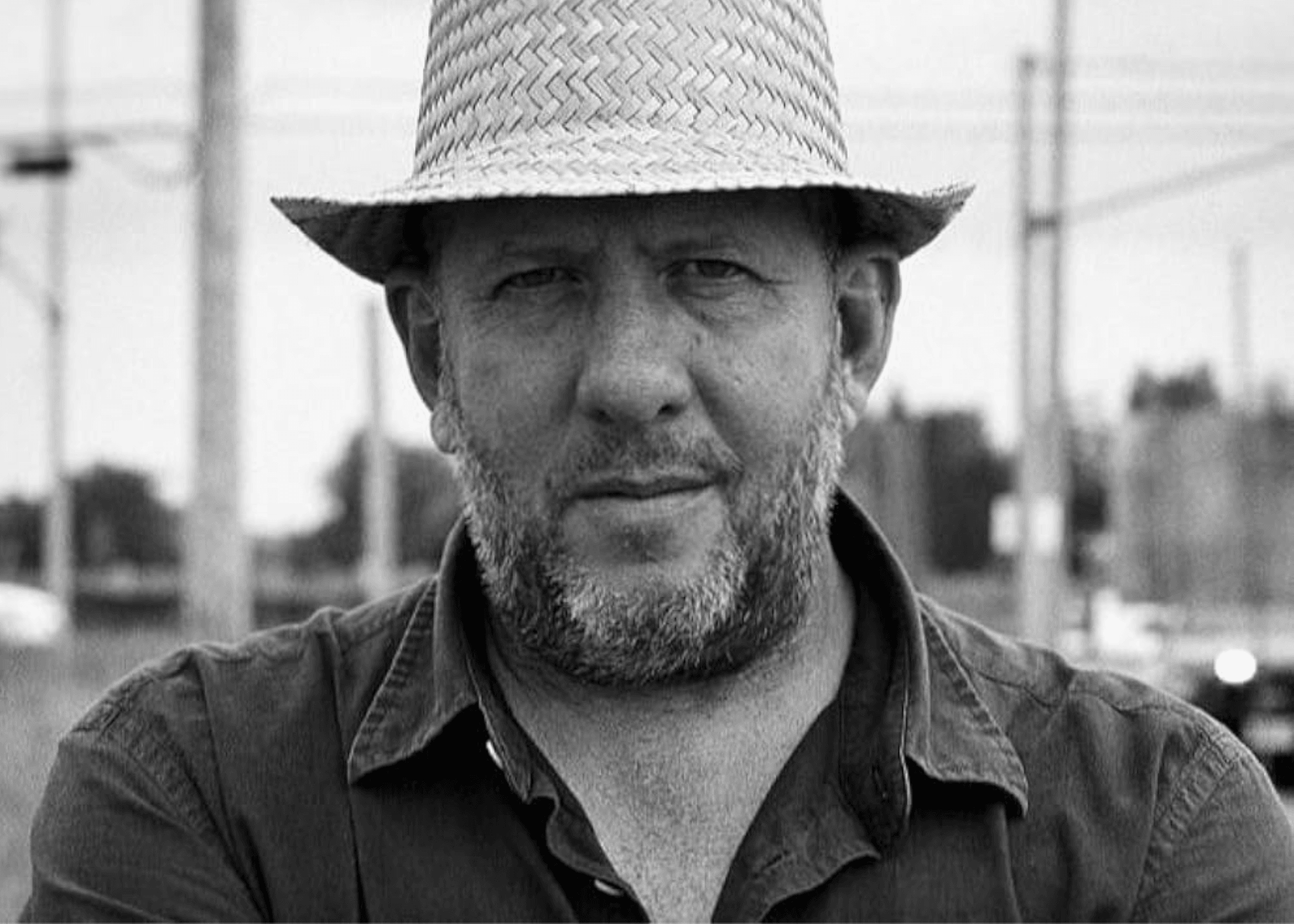
One of the films I had the opportunity to see and review at this year’s Fantasia Fest is Terrestrial. This dark, comedic, psychological thriller follows an up-and-coming sci-fi author named Allen (Jermaine Fowler), who invites his friends to a weekend reunion at his mansion. However, what starts as a relaxed vacation quickly spirals into chaos and terror as Allen becomes more paranoid and erratic, hinting that not everything is as it seems.
On top of Jermaine Fowler in the lead role, the film features a cast that includes James Morosini (I Love My Dad, The Sex Lives of College Girls), Pauline Chalamet (The Sex Lives of College Girls, The King of Staten Island), Edy Modica (Jury Duty, Shrinking), Rob Yang (Succession, The Menu), and Brendan Hunt (Ted Lasso, Elio).
The film, directed by Steve Pink, known for Hot Tub Time Machine, marks his debut into the psychological thriller genre. I had the pleasure of sitting down with Mr. Pink to discuss Terrestrial, including what inspired him to take on this project, how his approach to this film differed from his approach to making comedies, and a couple of surprising cameos that fans of Hot Tub Time Machine will surely appreciate.
Check Out The Full Interview With Steve Pink Below:

Thank you so much for being here today. I’m sure you’ve had so many interviews these past couple of hours, so I’m glad you’re taking the time to speak with me today.
Steve Pink: I mean, it’s at their peril, you know? I could go on forever. So, you might regret this whole experience, you know?
Sure, but you know, at least it’ll be a memorable experience, and that’s all I need.
Pink: Yeah, I love being interviewed for this movie. I was honored to make it, and I’m even more honored that people are interested in it, have seen it and seem to like it, you know?
Yeah, for sure. I guess we could start there. How did you get involved with the project? Did the screenwriters come to you with this script specifically, or were you more just in search of a horror/thriller/sci-fi type project, and this came across your desk at some point?
Pink: Yeah, no, I wasn’t searching for it at all. You know, these young producers, who just turned out to be crazy people, with whom I made The Wheel, which is a romantic drama, we’ve been looking for movies to do together since that one. They’re the ones who brought me this psychological movie that Sam and Connor wrote, and it was such a brilliant script. I was like, “You’re gonna let me jump into another genre? Are you mad?” And I’m so happy that they did. Their faith in me is far too great, but it’s to my benefit.
The script was just so compelling, and the opportunity to make a psychological thriller, since I had never made one, was an opportunity I couldn’t pass up. I’m like, “I’m gonna fall on my face eventually.” If I’m not challenging myself, then what’s the point? And I just hope I get away with it every time.
I’m glad you mentioned the genre itself, because people might know you best for your work in comedy, whether as a director for films like Accepted or the Hot Tub Time Machine films, or as a writer for stuff like Grosse Pointe Blank and High Fidelity. I was wondering if this shift into more seriously toned filmmaking was an intentional choice or if it happened naturally over the course. I know you had made a bunch of other stuff before. I know you made the documentary The Last Republican and The Wheel with Amber Midthunder. So I’m curious if this is kind of a new chapter in your career where you’re like, “Alright, I feel like I’ve said everything I need to say with comedy. I want to try other genres. I want to try and dip my toe into other pools.”
Pink: I mean, some of my favorites. I obviously love Hereditary. I love It Follows. I love The Witch. The Witch is just, to me, one of those extraordinary films. Then, going back, I love The Shining. So much is going on in the mind of the character that the audience is not actually aware of. There’s obviously a greater presence around him that manifests itself in various ways, you know, the ghosts and stuff. So that was a scenario, right?
So The Shining was a big inspiration for me, just in terms of its structure and everything going on with the protagonist. And then Hitchcock movies in general, figuring out how to create suspense and anxiety, and kind of unwelcome surprise without a lot of gore, you know, this movie isn’t gory in that sense. We didn’t have some terrible, violent, horrible thing happen to somebody. So we had to figure out how to increase the stakes and intensify the terror without just explicit violence, right?
Yeah, for sure. I definitely got those vibes as well when I was watching the film. It was surprising. For a movie like this, there would be a bit more violence and gore. But it’s kind of like a waiting game, you know, there’s only gore and violence at the very end. All the craziness is a natural buildup of the climax. Yeah, I’m glad you pointed that out, because I was realizing that while I was watching the film, and I thought that was really great.
Pink: I was really nervous. After I was like, “can’t we just kill someone sooner? If we just killed one of these people? Just please, for the love of God?” So yeah, that made it really, really challenging. I’m glad that you know you noticed and that you stuck with it. It’s one of the challenges.
Yeah, and on the topic of characters, not in terms of the gore or anything, but I was wondering what about the script and the characters really spoke to you? Was there anything particular about a specific character, like the main character, Alan? What about this character made you excited about revolving the film around him? Is there anything thematically that you connected with that you wanted to explore?
Pink: It’s actually a really simple and relatable idea. He’s an artist. He’s striving for validation. He has doubts about his own talent, but he wants to express himself through writing the main character. Then, without malice, he spirals out of control to kind of shape this, or to fulfill this need; to be accepted in the world. Like the world, more broadly, rejects him. But in particular, the literary world rejects him. And so, he has this massive doubt, but it’s so important to him. And so then he goes down a road just to feel right, like his first, his initial desire is just to feel what it would feel like to be successful. He invites his friends over to this mansion, and without giving so much away, he presents himself as a very successful author.
And that feeling, like when he comes out, and you can see how, because he doesn’t come upon it organically, obviously, it spirals out of control, and there’s a ton of tragic circumstances that come as a result. But then, of course, the twist is, later, and it’s not really giving that much away, is that he actually is talented, that he has something. And so all that was just fascinating in terms of how to achieve it within a story. But I thought that was just a very simple, relatable premise, that we all have something that we want to contribute to the world, and we want validation.

For sure, and did you have Jermaine Fowler in mind when you were casting for this character? Or was it just that you were wowed by the audition process?
Pink: I didn’t even audition him. I mean, I knew his work in comedy, and I saw this movie, The Drop, in which he was extraordinary, because he’s in this really horrible situation. It’s really comedic, but he takes on this very contemplative kind of behavioral mode because of the funny and crazy thing that happened. And now his whole marriage is disintegrating in front of his eyes, but the way he was playing that he was almost in his own personal drama, and in the context, it was very, very funny, but I could see that he had so much depth as an actor. Because there’s so much going on, he was communicating so many ideas and knew exactly what he’s thinking, “Is my marriage gonna work out? What if I had a kid with this person? Like, what’s gonna happen?” There are no lines that support that, you just know.
And so, it’s like that actor Jermaine had, you know, Jermaine is such an astonishing level of talent in that regard, where he can be communicating a lot of really specific feelings without saying a word. Great actors can do that, but he’s certainly one of them. And then everybody else, too. I mean, Edie is so quirky and funny, and brought that tone, brought that “you know she’s up for anything” vibe. And James Morosini was this amazingly kind, cheerful scrutinizer of the truth, and therefore, he’s the audience. Pauline brought the heart to it, and her desire for everyone to restore their friendships. And then, of course, Brendan Hunt was this kind of selfish, bitter, washed-up author, and he just played it brilliantly.
He’s more of a dick than Coach Beard from Ted Lasso. He was more of a dick than I would have expected. I thought that was also a really cool casting choice, to cast him for that particular character.
Pink: And it was his idea, by the way. The character was written as a bit more of a sad sack, just kind of not a good person, but kind of burned out. This guy’s probably a bad guy, right? He’s selfish. He’s resting on his laurels. He’s no longer inspired, so he’s probably really angry about that. And he’s not a great dad. He’s very, very selfish. He owes money; he’s been gambling. So, it’s just like we should establish that, and he [Hunt] gave his character so much energy. When he enters the film, his character walks into the story, but then, when things go wrong, he’s right; you don’t feel as much empathy as you would otherwise, knowing who he is. You kind of think he doesn’t deserve it, exactly, but you have more empathy for Jermaine than you would have otherwise, if he were just a sad guy who Jermaine put in that position. So, yeah, that was all Brendan.
Cool. Because of these major comedic star powers, was there kind of a temptation to make it…I mean, it’s not to say that the movie is devoid of jokes or humor at all, but was it tempting to make it a bit more of a darkly comedic film? Or was it mostly just, “Let’s just stick to the script, let’s just stick to what’s written on the page and just kind of go from there.”
Pink: It was kind of both. I think it’s in some places. I probably should have been a little bit more comedic. You know, for some comic relief. But we just went down this road, and the story started telling us what it wanted to be, and I think all the actors felt that. When it was organic to be funny, everyone was really funny, and then when it wasn’t, nobody was funny. So, I didn’t want to force it. I wasn’t like, oh, let’s make a joke here, or whatever. It’s like everyone in the room kind of understood where they were in the story. There just wasn’t sometimes anything funny about it in one case, but then other times it was obviously very funny. And since everyone’s such a great actor, one great moment like that is where James Morosini goes, “spelled the regular way,” in the dinner scene. That’s one of the biggest laughs. It’s supposed to be awkward because of what Jermaine is expressing. There’s nothing necessarily overtly comedic in terms of such a killer live delivery like that, but you know he’s a brilliant actor. So it just came out that way. There would be surprising moments where that would take place.
So, we can’t have an interview without mentioning the Hot Tub Time Machine, and I only say that because I wanted to specifically comment on the cameos that you had in the film within the film, because I have to ask. How did you convince Craig Robinson and Rob Corddry to cameo? Was it a hard sell, or was it just more “Hey, you want a cameo in this movie?” kind of thing, and they were like, “Sure, why not?”
Pink: I mean, begging helps. It really does, even with your friends. First of all, I consider them close friends. They were so brilliant in the Hot Tub movies, and we became very close. I owe them so much. I’m in their debt in so many ways. I was like, “Hey, Craig, how would you like to play a 3000-year-old space priest, you know, space guru.” And he’s like, “Okay.” Then I call Rob Corddry, and I’m like, “How would you like to be the evil villain of a space adventure, and he was in. So, the absurdity of the movie within the movie was just so funny. It was like, one day, come and do it, pick any wardrobe out. They all wardrobed themselves.
Oh really?!
Pink: Oh yeah, I was like, “This should just be fun.” So, we had the sets and we knew the narrative, but I said to the costume designer, the brilliant Emily. I was just like, “Buy a couple of racks of stuff, and you can have things in mind for people, but let them just go to town.” So everybody showed up on set, under the direction of Emily, or showed up on set from wardrobe in their version; their incarnation of the space character. And so that made it all the more fun. I was just so lucky, Violett Beane and Taylor Gray were in The Wheel. He brought Violett. It’s criminal. It was bananas.
Was there any temptation at all to bring in more of the old crew, like Clark Duke or John Cusack or any of those people?
Pink: I think we could have gone for more. I think we probably checked on Clark. I think he’s directing a movie at the time, Johnny, that’s not really Johnny’s speed, and he was also in Chicago. It was everyone who was like, “Are you available to come to this soundstage in East Hollywood on this day?” So much fun still.
I was very satisfied nonetheless, even though the whole crew didn’t get back together. Thank you again for taking the time to speak with me.
Pink: Thank you for watching the movie and having this conversation.