

Incredible chart-topping songs. Parents telling the hero to conceal their true self. A braided protagonist with powers singing about accepting the best and worst parts of herself. The power of sisterhood. What movie is this? Frozen. But also Netflix’s delightful KPop Demon Hunters!
At the time this review is being published, you’ll likely have heard of, if not seen, KPop Demon Hunters. As stated before, the music has climbed to the top of the Billboard charts, and the streaming numbers have steadily grown week after week on Netflix, quickly becoming one of the most viewed films in the platform’s history. Now audiences everywhere are preparing to see the film the way it was meant to: on the big screen, where it will undoubtedly break even more records.

I’m not one to equate success with quality. After all, poor to mediocre films can become overnight successes at any point for random reasons all the time (Minions 2, anyone?). However, what fills my heart with glee as a writer is when we get to talk about the successes of movies that truly deserve it. And I’m pleased to say KPop Demon Hunters is legitimately one of those movies.
I’m by no means a K-pop fan. I know nothing of BlackPink, BTS, TXT, or Twice. I’ve heard the occasional mainstream hit, but overall, I have no significant investment in the genre. So, when I thoroughly enjoyed the songs, characters, energy, and story of KPop Demon Hunters, it should serve as a testament to the movie’s terrific quality and the stellar work of all filmmakers involved.
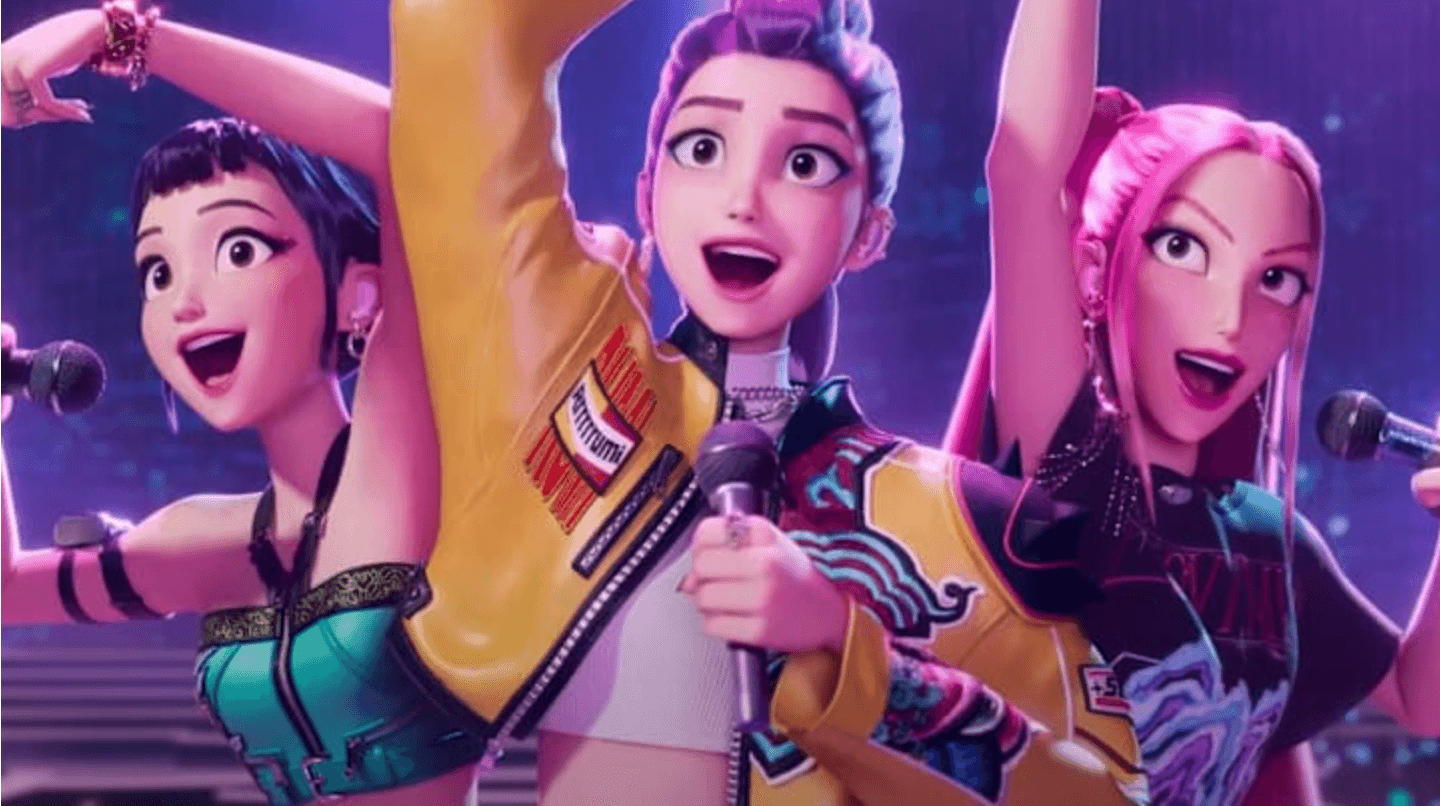
The film centers on the eponymous K-pop group, called Huntrix. They are secretly protectors of the Earth and humanity, using their incredible vocal abilities to generate a shield over the world, called the Honmoon, that protects mankind from demonic forces lurking in the spirit realm. However, trouble brews when one of the group’s members, Rumi, who is secretly half-demon by birth, begins to manifest patterns all over her body, potentially exposing her true heritage to her fellow demon-hunting bandmates. To make matters worse, a demon boy band known as the Saja Boys comes to Earth to try and stop Huntrix from permanently sealing the rift between the demon world and the human world with the Honmoon.

There’s so much to like about KPop Demon Hunters, from the story and world-building to the sympathetic characters and catchy tunes, all of which come together with incredible energy. However, first and foremost, I have to commend the amazing animation. You can easily see how much time, effort, and energy were poured into making this vibrant, anime-inspired film. Utilizing similar tech as the Spider-Verse films, the artists at Sony Pictures Animation have managed to give the movie a gorgeous color palette with striking pink, blue, and purple hues that make every frame that’s brought to life pop as a candy-coated feast for the eyes. The Sailor Moon-esque sight gags (such as eyes turning into corn that becomes popcorn at the sight of a hot boy) are hysterical and dynamic. And even the realistic choreography of the characters, from the fight sequences to the musical numbers, would be impressive enough in live-action, but to see it animated gloriously is not only stunning, but an impossible mission in itself that these animators have accomplished in spades! It’s terrific that Netflix decided to put this film in theaters this weekend for a sing-along edition, because visually, the film demands to be seen on the biggest screen possible!
That being said, the visuals would be nothing without a story and characters to back it up, and co-directors/co-writers Maggie Kang and Chris Appelhans lead a crew of storytellers who do not disappoint. There’s a remarkable complexity and brilliant sense of world-building in KPop Demon Hunters that establishes an expansive, but never convoluted, mythology of its own that justifies the K-pop elements and musical numbers of the film. The work of the writers, as well as Kang and Appelhans, gives the film a sense of urgency that’s personal to the characters – especially Rumi. It also allows us to identify with and sympathize with the film’s villain, Jinu, leader of the Saja Boys. The dialogue is as quick as the pacing, with really sharp jokes, but also poignant moments that really derive from the complexities behind these characters.

Rumi, as a character, is so incredibly complicated; a character born of trauma, burdened with great responsibility, and afraid of the scars that exist within her. However, she’s also brave and tough, and can confront the darkest parts of herself, ultimately recognizing that those are not all that define her. Having her foil be Jinu, a character completely defined by his guilt and his worst mistakes, was a stroke of genius, and the conversations the two have are rich and emotional. It helps significantly that voice and vocal actors Arden Cho/Ejae for Rumi and Ahn Hyo-seop/Andrew Choi for Jinu really do an incredible job selling the torment plaguing their respective characters, and (if I may say so) also the chemistry between them. These aren’t just stock characters or easy heroes and villains. They legitimately challenge their younger audiences with deeper questions about identity and self-love, as they themselves face difficult decisions throughout the film.
That being said, Cho and Ejae are accompanied by wonderfully hilarious and emotional performances from May Hong/Audrey Nuna and Ji-young Yoo/Rei Ami, as Mira and Zoey, Rumi’s bandmates and closest friends. The tension they bring to their arguments and confrontations with Jinu hit hard, but what gets us as audiences even more emotional is the sense of tender friendship and sisterhood felt in their vocal performances. Mira and Zoey, as characters, have their own personal struggles as well. While it’s not nearly as prominent in the film as Rumi’s, the details we get of the two characters are enough to flesh them out, so they’re just complex enough for us to love them the same way Rumi does. They’re also incredibly hilarious, with their unique personalities contributing to much of the hilarious dynamic between the three girls. Zoey is the sweeter and softer of the two. Mira is the toughest and most aloof. They complement Rumi, who serves as a solid medium between them, fitting since she herself is caught in between her heritage as a demon hunter and a demon.
The film also features an emotional subplot between Rumi and her adopted mother/former demon hunter, Celine, played by Yunjin Kim. Unfortunately, though, if there’s one area the film stumbles in its storytelling, it’s the wasted opportunity to explore this relationship more. Conflicts arise between the two due to Celine’s insistence that Rumi keep her demon heritage a secret, rather than accepting and embracing it as part of herself. But, ultimately, nothing really does come out of those confrontations, and unfortunately, outside of trauma, Celine doesn’t play much more of a role in this story. Rumi confronts her, but there’s a significant lack of payoff after that. One would hope that a character as important as Celine would have a complete story arc by the film’s end, but the film leaves this moment hanging anticlimactically. It’s a pity, because it could have made the film even stronger from an emotional standpoint. However, the filmmakers felt that it may have overstuffed the movie, given there is still a lot going on. Still, it would have been nice to see a resolution to this one.

That said, however, thematically, KPop Demon Hunters is a triumph. It approaches the very familiar themes of self-acceptance, regardless of your differences or any scars that may exist in one’s past. One’s worst aspects do not make them terrible individuals, and objectively may not even be true scars. It’s a very real message that anyone and everyone can relate to, but it’s also told in a natural way that is inherently driven by the characters and their arcs. There’s also a smaller message about indoctrination, in a way, given that the hunters are raised to believe the worst about all demons, going as far as to declare all of them unfeeling and evil immediately, only to find out there’s more to some than they ever anticipated – Jinu being the key example. As a result, the film has a lot of charming universal messages to share that never feel forced or heavy-handed, and are just poignant and honest enough.
Now, however, comes the part that everyone has been flocking to this film for: the music. Oh boy, do they deliver! Many of the songs, written by Ejae, are bangers! Everything kicks off with the catchy-as-hell “How It’s Done” but continues to rise in both relevance to the film’s themes and story, as well as further defining their characters. In other words, KPop Demon Hunters is even better than a lot of movie musicals in that regard, as the songs feel necessary and contribute to the plot and story. For instance, let’s be frank here, “This is Me” from The Greatest Showman is a banger, but if you took it out of the movie, you’d still basically have the same film. The same can even be said for the aforementioned Frozen, which literally could have removed superfluous tunes like “Fixer Upper” from its lineup without much consequence. Songs like “Golden” and “This is What It Sounds Like,” are emotionally incredibly important for the characters journeys and the plot of the film, however, and even something like “Takedown” showcases the negativity that comes from the indoctrination of the hunters and their crusade against demons, as Rumi starts to question everything they know. They’re not just bangers for the sake of bangers. They’re key to the film’s narrative and characters that happen to be bangers, and that’s what’s most important in a movie musical.

The other thing that’s inspiring about the film is the influence and impact we’re getting to see on audiences everywhere. While this doesn’t necessarily speak specifically to my subjective opinion of the film, there is something to say about the quality of it when it inspires the type of response we’re seeing in the fans that watch it. I was lucky enough, for instance, to preview the sing-along version in a packed theater. To see the reaction and interaction of every fan screaming, jumping, and joyfully participating in the song numbers, or crying during the emotional moments, I’d be lying if I didn’t say how good it felt to see them truly embracing the cinematic experience. That’s what theaters are made for, after all; the shared communal experience of laughing together, crying together, and enjoying what we love about a movie like this all together. I hadn’t felt this enthusiastic about the crowd experience at a film since Avengers: Endgame, and getting to witness the phenomenon of KPop Demon Hunters grow from the ground up has been a privilege.
While I can’t outright say KPop Demon Hunters is the best animated film of the year just yet, it certainly comes close at the moment. It’s a spirited, fast-paced romp with stellar animation and terrific music. However, more than that, it’s also a great story with an entertaining, expansive mythology, terrific, complex characters, strong performances, and a lot of mature, profound things to say without ever feeling forced. Although my age might suggest I’m outside the movie’s intended demographic, I was blown away by how much I enjoyed it and am proud to see it as an incredible piece of art. This is a global phenomenon I’m genuinely excited to be part of, and it’s because KPop Demon Hunters is a stellar storytelling showcase within the animation industry that future filmmakers and animators can witness firsthand “how it’s done, done, done!”
Rating: 8.5/10