

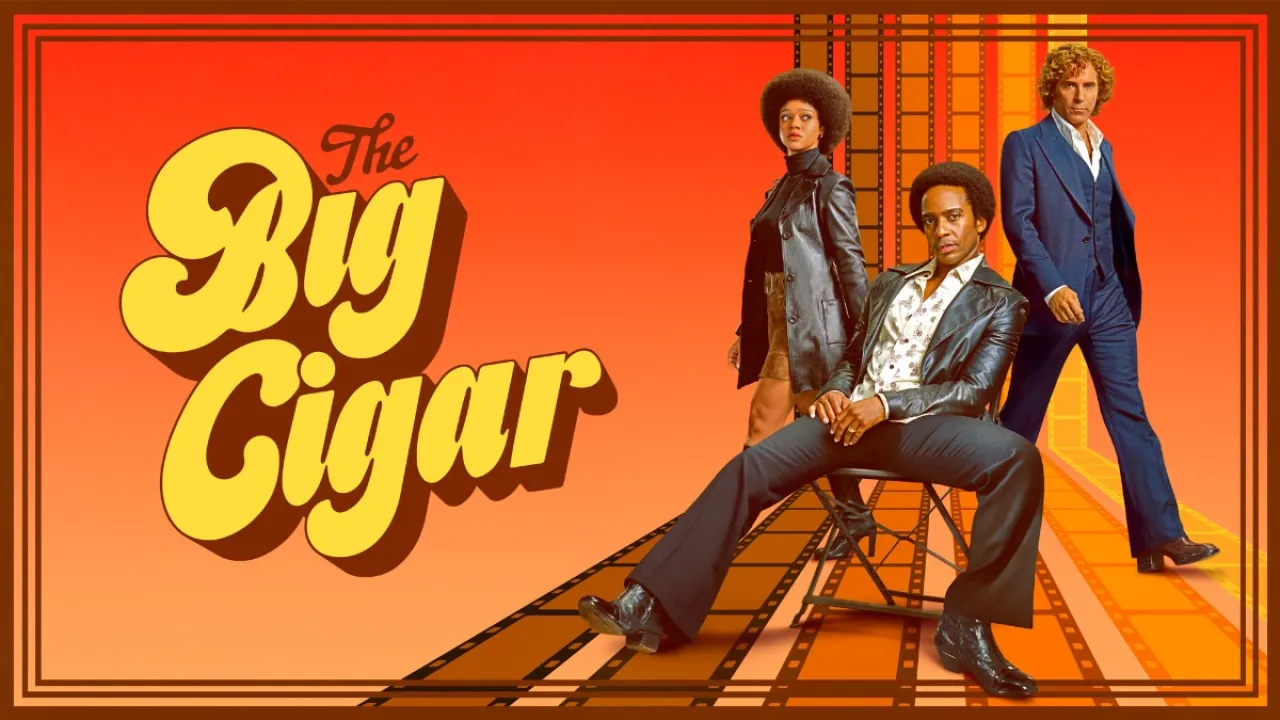
Hollywood’s involvement in revolutionary movements is not an unexplored subject in cinema. If you’ve seen the 2012 Best Picture winner Argo or the Kristen Stewart snoozefest Seberg, you know how enthusiastically the entertainment industry wants to showcase its progressive footing. And now the same can be said about The Big Cigar, the new Apple TV+ original series.
Loosely based on the magazine article by Joshuah Bearman (Argo), The Big Cigar is the wild true story of Black Panther co-founder Huey Newton’s escape from the FBI to Cuba with the help of famed Hollywood producer Bert Schneider.

Co-created by Janine Sherman Barrois (Self Made: Inspired by the Life of Madame CJ Walker) and Jim Hecht (Winning Time), The Big Cigar stars Andre Holland as Huey P. Newton, Alessandro Nivola as Bert Schneider, P.J. Byrne as Steve Blauner, Tiffany Boone as Huey’s love interest Gwen and Inny Clemons playing Richard Pryor. Don Cheadle directs the first two episodes of the six-part miniseries.
Right off the bat, I am a big history buff. I appreciate when biographical films and series adhere to the strictest constraints of historical accuracy instead of making stuff up to paint an exaggerated truth. A GREAT biopic comes when the storyteller thrives on capturing as much objective fact as possible, then inserts artistic liberties through the subjective lens of its protagonist. Think of movies like Malcolm X, Oppenheimer, Amadeus, and Schindler’s List, all depict many real moments, scenes, and conversations but use style and directorial flairs to emphasize the emotion of their lead character.
Naturally, we cannot hold EVERY piece of content to the same standard as the greats, but actual history is always more interesting to me than contrived historical fiction. So when The Big Cigar jokingly warns we’re seeing the Hollywood spin of this story during the opening narration, my hope dashed out the door.

The Big Cigar occasionally showed these moments of brilliance, particularly when the filmmakers honed in on Newton’s backstory. In trying to redirect the Black Panther Party’s agenda away from violence and towards social programs for children, Newton consequently divides the organization’s leadership. Examining his disagreements with Eldridge Cleaver and other factions of the Black Panther Party, his despondent relationship with BPP co-founder Bobby Seale, and his spiralling mental state were the most compelling parts of the series. Visualizing these sections of Newton’s life non-chronically was essential to understanding why he was constantly on edge. Holland’s performance portrays an anxious leader whose political movement crumbles before his eyes.
Most known for his roles in Moonlight and the aforementioned American Horror Story, Holland also delivers a softer side to the screen when interacting with Boone’s Gwen – a fellow revolutionary who stands alongside Huey through thick and thin. Her presence in the show remains limited, but it allows Huey’s stakes to parallel both the internal strains within the BPP and the external surveillance from the FBI. In the first couple of chapters, Nivola is serviceable in his supporting role as Bert Schneider, while his sidekick Steve (P.J. Byrne) steals scenes with his well-timed comedic relief.
As the show rolls along, Steve’s arc from reluctance to full-stop commitment to the cause is the most satisfying character journey throughout the program. Don Cheadle’s direction arms the actors with plenty of humour to give the characters an empathetic connection with the audience. But as the story unfolds in the later episodes, we witness how the tumultuous smuggling operation wears on their psyches, deepening their emotional depth.

Scenes of psychological torture allow ample opportunity for expressive storytelling, which The Big Cigar is not short of. Co-creator Jim Hecht’s flashy, split-screen-heavy editing choices, shared by both Winning Time and The Big Cigar, demonstrate the most consistent temporal sensibility since Ryan Murphy’s distinctly ADHD-coded rapid-fire editing in the first couple of seasons of Glee and American Horror Story. The questionable intentionality of the split-screen edits is a microcosm of the show’s most significant issue—its prioritization of style over substance. While many sequences feel like a genuine recreation of critical history, others play like a gold-plated fashion catalogue filled with ’70s celebrity lookalikes.
Does the style overwhelm the substance all the time? No. But about a third of each episode feels like a completely different show than what was initially sold on. Sometimes, The Big Cigar is an authentic biographical thriller. Other times, it’s a cheesy ’70s Hollywood nostalgia dramedy. I’m not opposed to creative genre-bending…. the problem is that these genres don’t really bend. They almost feel like separate anthology stories compacted into one show. And the times there is genuine genre overlap, it feels forced. Did Newton watch Shaft multiple times in theatres while on the run?
Of course, the overtly glitzy aesthetic reflects the glamorous industry lifestyle Newton must embrace during his evasion. So the fish-out-of-water novelty works for a while, but the bit is dulled out by episode three. What’s left is a primarily solid historical recollection of the undermining of the Black Power movement through the reign of J. Edgar Hoover’s FBI. There were also silly elements in the serious storylines, like the hippy federal agent Sydney Clark (Marc Menchaca). The constant tone shift further added to the show’s disjointed, confusing narrative perspective.

The cynical part of me wonders if this series is just another example of Black history presented through the white gaze of Hollywood. At times, the amount of screentime dedicated to pale-skinned social justice warriors pontificating on the importance of the Black revolutionary in the foreground of glossy cosmopolitan production design feels more like Shampoo than Judas and the Black Messiah. Then I remember how much talent is behind the camera, from directors Don Cheadle and Tiffany Johnson to showrunner Janine Sherman Barrois.
After finishing the series, I’m left with a sense of amusement and a hint of disappointment. All the ingredients are there, but the food’s a little undercooked. That being said, the time we spent learning what induced Newton’s past and present paranoia was riveting in its own right. Plus, Holland’s performance is worth the watch alone.
Rating: 6/10